4,068 posters, 219 videos, 101 topics, 69 sessions, 14,365 authors, 6,128 institutions
ePostersLive by SciGen Technologies S.A. All rights reserved.
Alzheimer's Association International Conference 2026
July 12-15, 2026 | London, United Kingdom, and Online

4490
In Silico Identification Of A Novel Cd47 Inhibitor As A Potential Modulator For Alzheimer’S Disease Pathology
Poster Presenter
Authors
Part of Topic
Title: In Silico Identification Of A Novel Cd47 Inhibitor As A Potential Modulator For Alzheimer's Disease Pathology
Authors: Gajendra Choudhary, Rutweek Rajendra Kulkarni, Ajay Prakash, Bikash Medhi.
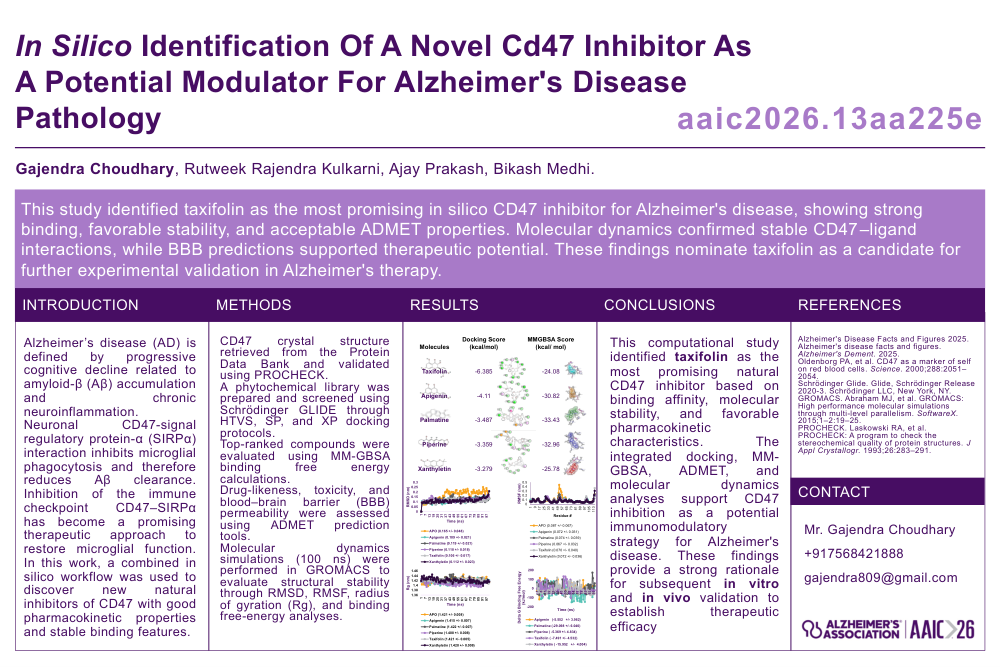
Key Take away: This study identified taxifolin as the most promising in silico CD47 inhibitor for Alzheimer's disease, showing strong binding, favorable stability, and acceptable ADMET properties. Molecular dynamics confirmed stable CD47–ligand interactions, while BBB predictions supported therapeutic potential. These findings nominate taxifolin as a candidate for further experimental validation in Alzheimer's therapy.
Introduction: Alzheimer’s disease (AD) is defined by progressive cognitive decline related to amyloid-β (Aβ) accumulation and chronic neuroinflammation. Neuronal CD47-signal regulatory protein-α (SIRPα) interaction inhibits microglial phagocytosis and therefore reduces Aβ clearance. Inhibition of the immune checkpoint CD47–SIRPα has become a promising therapeutic approach to restore microglial function. In this work, a combined in silico workflow was used to discover new natural inhibitors of CD47 with good pharmacokinetic properties and stable binding features.
Methods: CD47 crystal structure retrieved from the Protein Data Bank and validated using PROCHECK.
A phytochemical library was prepared and screened using Schrödinger GLIDE through HTVS, SP, and XP docking protocols.
Top-ranked compounds were evaluated using MM-GBSA binding free energy calculations.
Drug-likeness, toxicity, and blood–brain barrier (BBB) permeability were assessed using ADMET prediction tools.
Molecular dynamics simulations (100 ns) were performed in GROMACS to evaluate structural stability through RMSD, RMSF, radius of gyration (Rg), and binding free-energy analyses.
Results
|
Molecules |
Docking Score (kcal/mol) |
MMGBSA Score (kcal/ mol) |
|
Taxifolin |
-6.385 |
-24.08 |
|
Apigenin |
-4.11 |
-30.82 |
|
Palmatine |
-3.487 |
-33.43 |
|
Piperine |
-3.359 |
-32.96 |
|
Xanthyletin |
-3.279 |
-25.78
|

Conclusion: This computational study identified taxifolin as the most promising natural CD47 inhibitor based on binding affinity, molecular stability, and favorable pharmacokinetic characteristics. The integrated docking, MM-GBSA, ADMET, and molecular dynamics analyses support CD47 inhibition as a potential immunomodulatory strategy for Alzheimer's disease. These findings provide a strong rationale for subsequent in vitro and in vivo validation to establish therapeutic efficacy
References:
Alzheimer's Disease Facts and Figures 2025. Alzheimer's disease facts and figures. Alzheimer's Dement. 2025.
Oldenborg PA, et al. CD47 as a marker of self on red blood cells. Science. 2000;288:2051–2054.
Schrödinger Glide. Glide, Schrödinger Release 2020-3. Schrödinger LLC, New York, NY.
GROMACS. Abraham MJ, et al. GROMACS: High performance molecular simulations through multi-level parallelism. SoftwareX. 2015;1–2:19–25.
PROCHECK. Laskowski RA, et al. PROCHECK: A program to check the stereochemical quality of protein structures. J Appl Crystallogr. 1993;26:283–291.
Comments
Email is required but is not shown publicly.
Loading comments...