4,068 posters, 219 videos, 101 topics, 69 sessions, 14,365 authors, 6,128 institutions
ePostersLive by SciGen Technologies S.A. All rights reserved.
Alzheimer's Association International Conference 2026
July 12-15, 2026 | London, United Kingdom, and Online

10821
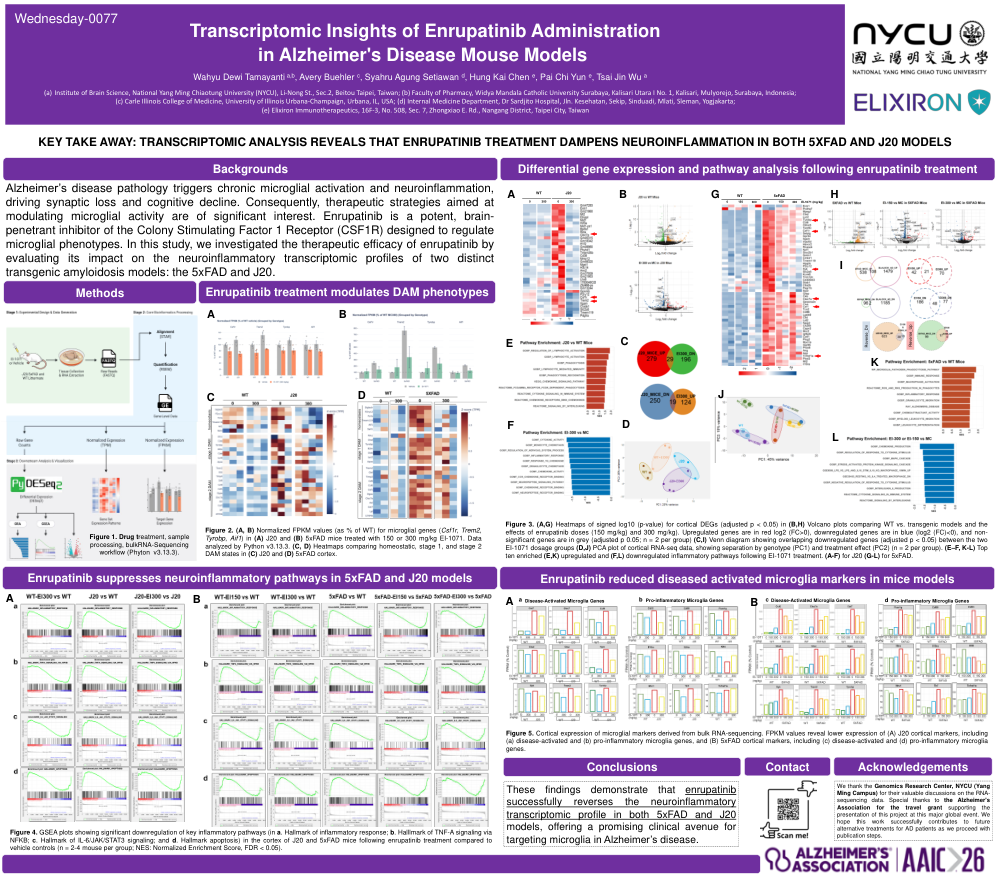
Transcriptomic Insights Of Enrupatinib Administration In Alzheimer's Disease Mouse Models
Poster Presenter
Authors
Wahyu Dewi Tamayanti, Avery Buehler, Syahru Agung Setiawan, Jin-Wu Tsai, Chi-Yun Pai, Hung-Kai Chen
Affiliations
Institute of Brain Science, National Yang Ming Chiaotung University (NYCU), Li-Nong St., Sec.2, Beitou Taipei, Taiwan and Widya Mandala Catolic University Surabaya, Kalisari Utara I No. 1, Kalisari, Mulyorejo, Surabaya, Indonesia, Carle Illinois College of Medicine, University of Illinois Urbana-Champaign, Urbana, IL, USA, Internal Medicine Department, Dr Sardjito Hospital, Jln. Kesehatan, Sekip, Sinduadi, Mlati, Sleman, Yogjakarta, Institute of Brain Science, National Yang Ming Chiaotung University (NYCU), Li-Nong St., Sec.2, Beitou Taipei, Taiwan, Elixiron Immunotherapeutics, 16F-3, No. 508, Sec. 7, Zhongxiao E. Rd., Nangang District, Taipei City, Taiwan
Part of Topic
Transcriptomic Insights of Enrupatinib Administration in Alzheimer's Disease Mouse Models
Alzheimer's disease pathology is accompanied by a robust innate immune response featuring chronic microglial activation and elevated inflammatory cytokines. This neuroinflammatory environment is a critical mediator of synaptic dysfunction, neuronal loss, and the progression of cognitive deficits. Consequently, strategies to therapeutically modulate microglial activity are of significant interest. Enrupatinib, a brain-penetrant inhibitor of the Colony Stimulating Factor 1 Receptor (CSF1R), represents a clinical candidate for such an approach. Here, we examine the impact of enrupatinib treatment on microglial function in two transgenic models of amyloidosis: the 5xFAD and the J20.
Methods:
Mice were treated with enrupatinib (150 or 300 mg/kg) for 4 weeks, followed by behavioral assessment and cortical RNA-seq. Analysis used custom Python scripts. Gene expression matrices (raw counts, TPM, FPKM) were built with pandas. Differential expression was determined via PyDESeq2, applying a 10-read filter, a sex-adjusted negative binomial model, and an FDR < 0.05. Pathway enrichment (GSEApy) included GSEA (FDR < 0.25) on all genes and Over-Representation Analysis (ORA) on filtered gene sets (p<0.05, |log2FC|>0.1) against hallmark databases. Visualization (Plotly) featured Z-scored TPM heatmaps and FPKM bar plots with overlaid replicates; statistical comparisons used the Mann-Whitney U test (p < 0.05).
Results:
RNA-seq analysis demonstrated that enrupatinib therapy significantly reduced neuroinflammatory markers, suppressed disease-associated microglia (DAM) gene expression, and downregulated inflammatory pathways in the 5xFAD and J20 mouse models.
Conclusions:
Collectively, RNA-seq analysis shows enrupatinib exerts its therapeutic effect by suppressing neuroinflammatory pathways, offering a promising pharmacological strategy for Alzheimer’s disease.
Keywords: Alzheimer’s disease, CSF1R inhibitor, enrupatinib, microglia, neuroinflammation
KEY Take away: Transcriptomic analysis reveals that enrupatinib treatment dampens neuroinflammation in both 5xFAD and J20 modelS
Comments
Email is required but is not shown publicly.
Loading comments...