4,068 posters, 219 videos, 101 topics, 69 sessions, 14,365 authors, 6,128 institutions
ePostersLive by SciGen Technologies S.A. All rights reserved.
Alzheimer's Association International Conference 2026
July 12-15, 2026 | London, United Kingdom, and Online

2683
RNA Interference Knockdown Of Microtubule-Associated Protein Tau (MAPT) As A Potential Therapeutic Strategy For Tauopathies
Poster Presenter
Part of Topic
RNA Interference Knockdown of Microtubule-Associated Protein Tau (MAPT) as a Potential Therapeutic Strategy for Tauopathies
Jon Farley1; Matthew Whittaker1; Jeffrey Kurz1; Olufemi Adeduji1; Diana Cha-Purcell1; Shelley Patrick1; Jeffery Haines2; Sean Gannon2; Joe Dybowski1; Kirk Brown1; Kevin Sloan1
1Alnylam Pharmaceuticals, Cambridge, MA, USA; 2Regeneron Pharmaceuticals Inc., Tarrytown, NY, USA
Takeaways
• Tau-lowering using a microtubule-associated protein tau (MAPT)-targeted RNA interference (RNAi) therapeutic may provide the potential to slow or reverse the aggregation of tau and slow progression of disease in primary and secondary tauopathies such as Alzheimer’s disease (AD) and progressive supranuclear palsy (PSP).
• ALN-5288 is a potent and selective C16-conjugated RNAi therapeutic that has demonstrated robust and durable tau‑lowering in nonhuman primates (NHPs).
• Designed to lower tau protein expression in the central nervous system (CNS), ALN-5288 is currently being evaluated in a Phase 1 study in patients with AD (NCT07214727).
Background
• Aggregation of tau protein is a central driver of disease pathology in a family of progressive neurodegenerative disorders, known as tauopathies, which include AD and PSP.1
• Tau proteins are encoded from MAPT mRNA.2
• ALN-5288 is a potent and selective investigational RNAi therapeutic that leverages a MAPT‑targeting synthetic small interfering RNA (siRNA) conjugated to a C16 moiety.
• By degrading MAPT mRNA, ALN-5288 is designed to lower tau in the CNS and potentially slow disease progression.
Mechanistic Differences Between ASOs and siRNAs
SEE POSTER FIGURE
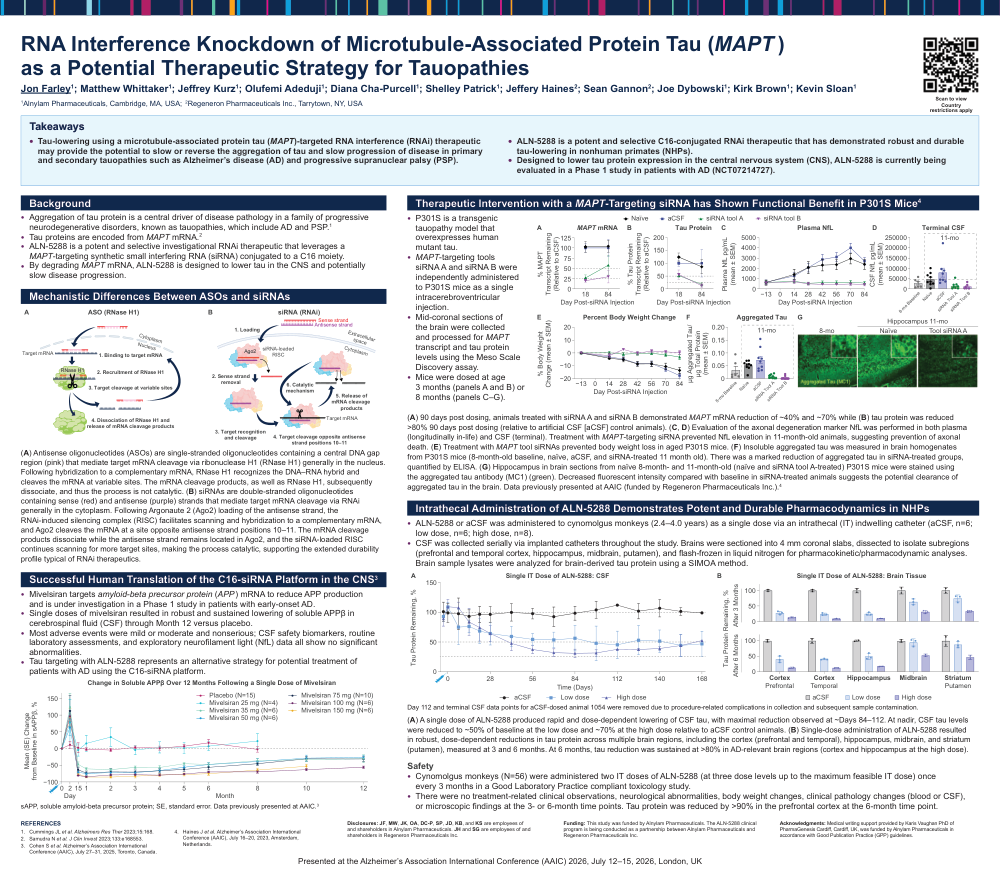
(A) Antisense oligonucleotides (ASOs) are single-stranded oligonucleotides containing a central DNA gap region (pink) that mediate target mRNA cleavage via ribonuclease H1 (RNase H1) generally in the nucleus. Following hybridization to a complementary mRNA, RNase H1 recognizes the DNA–RNA hybrid and cleaves the mRNA at variable sites. The mRNA cleavage products, as well as RNase H1, subsequently dissociate, and thus the process is not catalytic. (B) siRNAs are double-stranded oligonucleotides containing sense (red) and antisense (purple) strands that mediate target mRNA cleavage via RNAi generally in the cytoplasm. Following Argonaute 2 (Ago2) loading of the antisense strand, the RNAi‑induced silencing complex (RISC) facilitates scanning and hybridization to a complementary mRNA, and Ago2 cleaves the mRNA at a site opposite antisense strand positions 10–11. The mRNA cleavage products dissociate while the antisense strand remains located in Ago2, and the siRNA-loaded RISC continues scanning for more target sites, making the process catalytic, supporting the extended durability profile typical of RNAi therapeutics.
Successful Human Translation of the C16-siRNA Platform in the CNS3
• Mivelsiran targets amyloid-beta precursor protein (APP) mRNA to reduce APP production and is under investigation in a Phase 1 study in patients with early-onset AD.
• Single doses of mivelsiran resulted in robust and sustained lowering of soluble APPβ in cerebrospinal fluid (CSF) through Month 12 versus placebo.
• Most adverse events were mild or moderate and nonserious; CSF safety biomarkers, routine laboratory assessments, and exploratory neurofilament light (NfL) data all show no significant abnormalities.
• Tau targeting with ALN-5288 represents an alternative strategy for potential treatment of patients with AD using the C16-siRNA platform.
Therapeutic Intervention with a MAPT-Targeting siRNA has Shown Functional Benefit in P301S Mice4
• P301S is a transgenic tauopathy model that overexpresses human mutant tau.
• MAPT-targeting tools siRNA A and siRNA B were independently administered to P301S mice as a single intracerebroventricular injection.
• Mid-coronal sections of the brain were collected and processed for MAPT transcript and tau protein levels using the Meso Scale Discovery assay.
• Mice were dosed at age 3 months (panels A and B) or 8 months (panels C–G).
SEE POSTER FIGURE
(A) 90 days post dosing, animals treated with siRNA A and siRNA B demonstrated MAPT mRNA reduction of ~40% and ~70% while (B) tau protein was reduced >80% 90 days post dosing (relative to artificial CSF [aCSF] control animals). (C, D) Evaluation of the axonal degeneration marker NfL was performed in both plasma (longitudinally in-life) and CSF (terminal). Treatment with MAPT-targeting siRNA prevented NfL elevation in 11-month-old animals, suggesting prevention of axonal death. (E) Treatment with MAPT tool siRNAs prevented body weight loss in aged P301S mice. (F) Insoluble aggregated tau was measured in brain homogenates from P301S mice (8-month-old baseline, naïve, aCSF, and siRNA-treated 11 month old). There was a marked reduction of aggregated tau in siRNA‑treated groups, quantified by ELISA. (G) Hippocampus in brain sections from naïve 8-month- and 11-month-old (naïve and siRNA tool A-treated) P301S mice were stained using the aggregated tau antibody (MC1) (green). Decreased fluorescent intensity compared with baseline in siRNA-treated animals suggests the potential clearance of aggregated tau in the brain. Data previously presented at AAIC (funded by Regeneron Pharmaceuticals Inc.).4
Intrathecal Administration of ALN-5288 Demonstrates Potent and Durable Pharmacodynamics in NHPs
• ALN-5288 or aCSF was administered to cynomolgus monkeys (2.4–4.0 years) as a single dose via an intrathecal (IT) indwelling catheter (aCSF, n=6; low dose, n=6; high dose, n=8).
• CSF was collected serially via implanted catheters throughout the study. Brains were sectioned into 4 mm coronal slabs, dissected to isolate subregions (prefrontal and temporal cortex, hippocampus, midbrain, putamen), and flash-frozen in liquid nitrogen for pharmacokinetic/pharmacodynamic analyses. Brain sample lysates were analyzed for brain-derived tau protein using a SIMOA method.
SEE POSTER FIGURE
(A) A single dose of ALN-5288 produced rapid and dose-dependent lowering of CSF tau, with maximal reduction observed at ~Days 84–112. At nadir, CSF tau levels were reduced to ~50% of baseline at the low dose and ~70% at the high dose relative to aCSF control animals. (B) Single-dose administration of ALN-5288 resulted in robust, dose-dependent reductions in tau protein across multiple brain regions, including the cortex (prefrontal and temporal), hippocampus, midbrain, and striatum (putamen), measured at 3 and 6 months. At 6 months, tau reduction was sustained at >80% in AD-relevant brain regions (cortex and hippocampus at the high dose).
Safety
• Cynomolgus monkeys (N=56) were administered two IT doses of ALN-5288 (at three dose levels up to the maximum feasible IT dose) once every 3 months in a Good Laboratory Practice compliant toxicology study.
• There were no treatment-related clinical observations, neurological abnormalities, body weight changes, clinical pathology changes (blood or CSF), or microscopic findings at the 3- or 6-month time points. Tau protein was reduced by >90% in the prefrontal cortex at the 6-month time point.
REFERENCES
1. Cummings JL et al. Alzheimers Res Ther 2023;15:168.
2. Samudra N et al. J Clin Invest 2023;133:e168553.
3. Cohen S et al. Alzheimer’s Association International Conference (AAIC), July 27–31, 2025, Toronto, Canada.
4. Haines J et al. Alzheimer’s Association International Conference (AAIC), July 16–20, 2023, Amsterdam, Netherlands.
Disclosures: JF, MW, JK, OA, DC-P, SP, JD, KB, and KS are employees of and shareholders in Alnylam Pharmaceuticals. JH and SG are employees of and shareholders in Regeneron Pharmaceuticals Inc. Funding: This study was funded by Alnylam Pharmaceuticals. The ALN-5288 clinical program is being conducted as a partnership between Alnylam Pharmaceuticals and Regeneron Pharmaceuticals Inc.
Acknowledgments: Medical writing support provided by Karis Vaughan PhD of PharmaGenesis Cardiff, Cardiff, UK, was funded by Alnylam Pharmaceuticals in accordance with Good Publication Practice (GPP) guidelines.
Presented at the Alzheimer’s Association International Conference (AAIC) 2026, July 12–15, 2026, London, UK
Comments
Email is required but is not shown publicly.
Loading comments...