4,068 posters, 219 videos, 101 topics, 69 sessions, 14,365 authors, 6,128 institutions
ePostersLive by SciGen Technologies S.A. All rights reserved.
Alzheimer's Association International Conference 2026
July 12-15, 2026 | London, United Kingdom, and Online

10736
The Cognitive Impact Of World Trade Center Exposure Among Community Members
Poster Presenter
Authors
Part of Topic
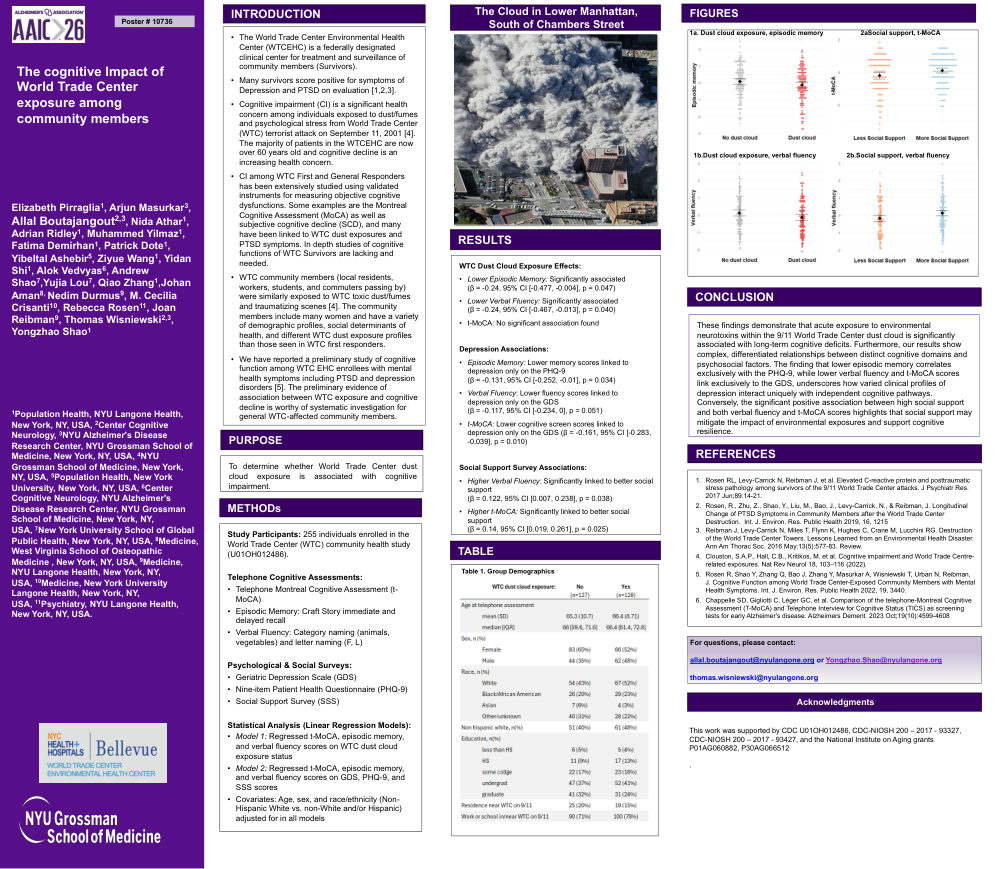
Background: There is a risk for accelerated cognitive decline in community members, including those who lived or worked in the surrounding community during the 9/11 World Trade Center (WTC) terrorist attacks and the aftermath. In particular, evaluating domain-specific cognitive function in relation to exposure to the dust cloud created by the destruction of the WTC towers on 9/11 considering the roles of depression and social support, may provide novel insight into cognitive vulnerability in this previously understudied community-based population. To address this issue, we conducted telephone-based interviews to assess the cognitive functions of recruited members of the WTC Environmental Health Center using standardized questionnaires.
Methods: Telephone cognitive assessments measuring MoCA (t-MoCA), delayed and immediate recall of the craft story (episodic memory), verbal fluency (animal, vegetable, F and L word naming), geriatric depression scale (GDS), nine-item Patient Health Questionnaire (PHQ-9), and social support survey (SSS) were conducted on 255 participants enrolled in the WTC community health study (U01OH012486). In linear regression models, t-MoCA, episodic memory, and verbal fluency scores were regressed first on WTC dust cloud exposure status with age, sex, and race/ethnicity (Non-Hispanic-White vs non-White and/or Hispanic) as covariates, then on GDS, PHQ-9, and the SSS adjusted with the same covariates.
Results: Exposure to the WTC dust cloud on 9/11 was associated with lower episodic memory (β=-0.24, 95%CI[-0.477,-0.004], p=0.047) and verbal fluency scores (β=-0.24, 95%CI[-0.467,-0.013], p=0.04), but did not reach significance in t-MoCA (β=-0.079, 95%CI[-0.321,0.163], p=0.521). While lower episodic memory was significantly associated with depression only on the PHQ-9 scale (β=-0.131, 95%CI[-0.252,-0.01], p=0.034), lower scores on verbal fluency and t-MoCA were significantly associated with depression only on the GDS (β=-0.117, 95%CI[-0.234,0], p=0.051 and β=-0.161, 95%CI[-0.283,-0.039], p=0.01). Higher scores on both verbal fluency and t-MoCA were significantly associated with better social support (β=0.122, 95%CI[0.007,0.238], p=0.038 and β=0.14, 95%CI[0.019,0.261], p=0.025).
Conclusion: Exposure to the WTC dust cloud on 9/11 was associated with poorer episodic memory and verbal fluency in a community-based sample. Cognitive performance was also differentially related to depression and social support, underscoring the importance of psychosocial factors when evaluating cognitive outcomes following disaster exposure.
Comments
Email is required but is not shown publicly.
Loading comments...