4,068 posters, 219 videos, 101 topics, 69 sessions, 14,365 authors, 6,128 institutions
ePostersLive by SciGen Technologies S.A. All rights reserved.
Alzheimer's Association International Conference 2026
July 12-15, 2026 | London, United Kingdom, and Online

4721
Cns Penetrant Cgas Inhibitors Block Microglia Activation In Vitro And Reduce Brain Inflammation In Trex1 Ko And 5xfadIn Vivo Model
Poster Presenter
Part of Topic
Objectives
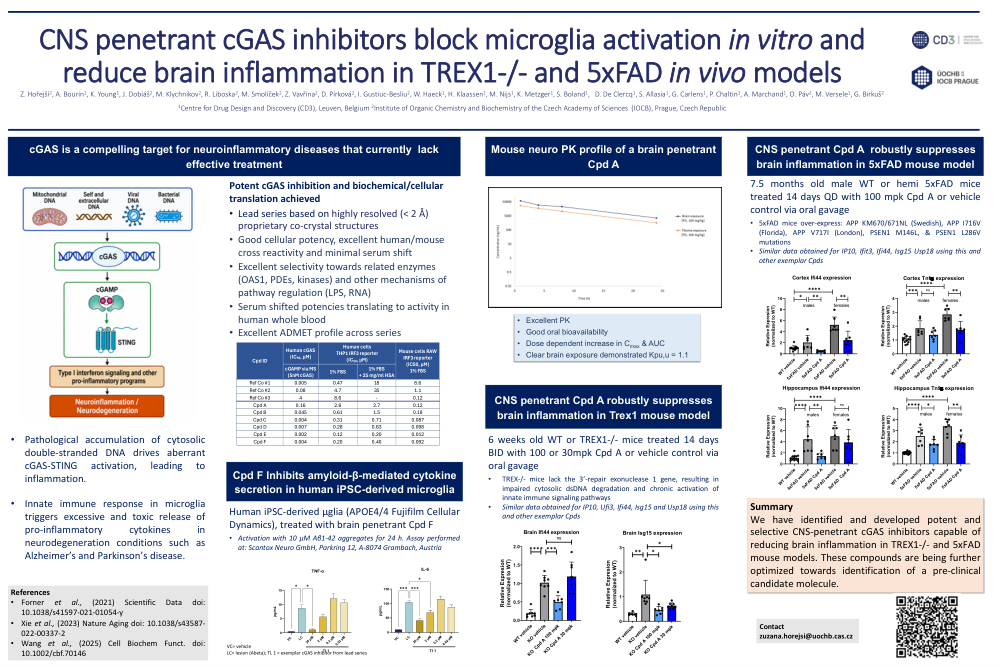
Activation of the cGAS-STING innate immune response in microglia drives excessive and toxic release of pro-inflammatory cytokines in neurodegeneration conditions such Alzheimer’s and Parkinson’s disease. cGAS detects increases in cytosolic DNA which can occur in microglia via engulfment of extracellular DNA or through leakage of mtDNA upon mitochondrial damage. Activated cGAS synthesizes the second messenger cGAMP, which in turn activates a STING-mediated type I IFN response. The objective of the work was to develop brain penetrant inhibitors of cGAS to block aberrant activation of the cGAS–STING pathway and reduce damaging inflammatory responses observed in neurodegenerative diseases.
Methods
Small-molecule inhibitors of cGAS were identified via high-throughput screening and lead molecules optimized via medicinal chemistry supported by crystallography, binding assays and enzymatic assays. Compounds were assessed in human and mouse cells including human iPSC-derived microglia. Lead compounds were prioritized based on DMPK properties and tested in mouse TREX1-/- and 5xFAD models.
Results
Compounds demonstrate low nM potency in human and mouse enzymatic assays, potent inhibition of cGAMP production and IFN responses in cells, and block IFNalpha release in human whole blood. Compounds also demonstrate good oral bioavailability and brain exposure. When tested in human iPSC-derived microglia, this series robustly inhibited Abeta1-42 mediated cytokine release. Based on these data, compounds were then selected for testing in TREX1-/- mice. TREX1 encodes a 3'-exonuclease that degrades DNA, and TREX1−/− mice develop a lethal, IFN-driven autoimmune response which includes a significant CNS component. Compound treatment significantly reduced levels of cytokines and IFN-stimulated genes in TREX1−/− mice including in brain. Finally, compounds were also shown to reduce neuro-specific inflammation observed in 5xFAD +/- mice.
Conclusions
In this study we have identified and developed potent and selective CNS-penetrant cGAS inhibitors capable of reducing brain inflammation in TREX1-/- and 5xFAD mouse models.
Comments
Email is required but is not shown publicly.
Loading comments...