4,068 posters, 219 videos, 101 topics, 69 sessions, 14,365 authors, 6,128 institutions
ePostersLive by SciGen Technologies S.A. All rights reserved.
Alzheimer's Association International Conference 2026
July 12-15, 2026 | London, United Kingdom, and Online

3794
Thn391 - An Anti-fibrin Antibody Targeting Fibrin-driven Inflammation In Early Alzheimer’S Disease: Update From An Ongoing Phase 1b Study
Poster Presenter
Authors
Aaron B. KANTOR, Tanja A.M. Hoffman, Sarah Kavanagh, Nuno Mendonca, Henk J.M.M. Mutsaerts, Ellen Dicks, Frederik Barkhof, Khalid Abd-Elaziz, E (Jort) G.B. Vijverberg, Catherine Mummery, Craig Ritchie
Affiliations
Therini Bio, Amsterdam UMC, Amsterdam UMC, University College London Hospitals, CTC Groningen, University Medical Center Groningen, University College London Hospitals, Scottish Brain Sciences, University of St Andrews
Part of Topic
Background
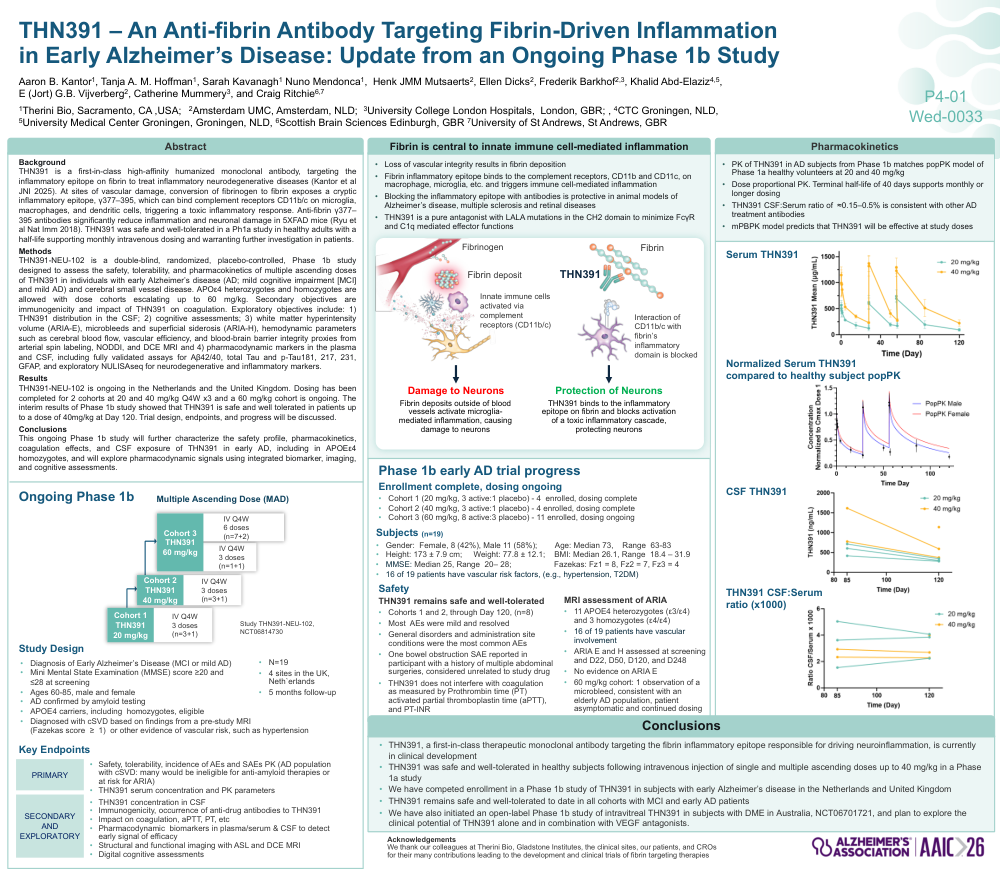
THN391 is a first-in-class high-affinity humanized monoclonal antibody, targeting the inflammatory epitope on fibrin to treat inflammatory neurodegenerative diseases (Kantor et al JNI 2025). At sites of vascular damage, conversion of fibrinogen to fibrin exposes a cryptic inflammatory epitope, γ377–395, which can bind complement receptors CD11b/c on microglia, macrophages, and dendritic cells, triggering a toxic inflammatory response. Anti-fibrin γ377–395 antibodies significantly reduce inflammation and neuronal damage in 5XFAD mice (Ryu et al Nat Imm 2018). THN391 was safe and well-tolerated in a Ph1a study in healthy adults with a half-life supporting monthly intravenous dosing and warranting further investigation in patients.
Methods
THN391-NEU-102 is a double-blind, randomized, placebo-controlled, Phase 1b study designed to assess the safety, tolerability, and pharmacokinetics of multiple ascending doses of THN391 in individuals with early Alzheimer’s disease (AD; mild cognitive impairment [MCI] and mild AD) and cerebral small vessel disease. APOε4 heterozygotes and homozygotes are allowed with dose cohorts escalating up to 60 mg/kg. Secondary objectives are immunogenicity and impact of THN391 on coagulation. Exploratory objectives include: 1) THN391 distribution in the CSF; 2) cognitive assessments; 3) white matter hyperintensity volume (ARIA-E), microbleeds and superficial siderosis (ARIA-H), hemodynamic parameters such as cerebral blood flow, vascular efficiency, and blood-brain barrier integrity proxies from arterial spin labeling, NODDI, and DCE MRI and 4) pharmacodynamic markers in the plasma and CSF, including fully validated assays for Aβ42/40, total Tau and p-Tau181, 217, 231, GFAP, and exploratory NULISAseq for neurodegenerative and inflammatory markers.
Results
THN391-NEU-102 is ongoing in the Netherlands and the United Kingdom. Dosing has been completed for 2 cohorts at 20 and 40 mg/kg Q4W x3 and a 60 mg/kg cohort is ongoing. The interim results of Phase 1b study showed that THN391 is safe and well tolerated in patients up to a dose of 40mg/kg at Day 120. Trial design, endpoints, and progress will be discussed.
Conclusions
This ongoing Phase 1b study will further characterize the safety profile, pharmacokinetics, coagulation effects, and CSF exposure of THN391 in early AD, including in APOEε4 homozygotes, and will explore pharmacodynamic signals using integrated biomarker, imaging, and cognitive assessments.
Comments
Email is required but is not shown publicly.
Loading comments...