4,068 posters, 219 videos, 101 topics, 69 sessions, 14,365 authors, 6,128 institutions
ePostersLive by SciGen Technologies S.A. All rights reserved.
Alzheimer's Association International Conference 2026
July 12-15, 2026 | London, United Kingdom, and Online

664
AQV-8741: Drugging Stress Granules And RNA Metabolism To Treat Tauopathies
Poster Presenter
Authors
Peter Ash, Amit Berson, Morgan Stykel, Matthew Gabrielle, Caroline Murphy, Lushuang Zhang, Jane Liu, Nicholas Fredette, Ashley Mason, Jenniluyn Nguyen, Joe Klim, Robert Schaub, Joseph Vacca, Benjamin Wolozin, Glenn Larsen
Affiliations
Aquinnah Pharmaceuticals, Inc. and Boston University, Aquinnah Pharmaceuticals, Inc.
Part of Topic
Video
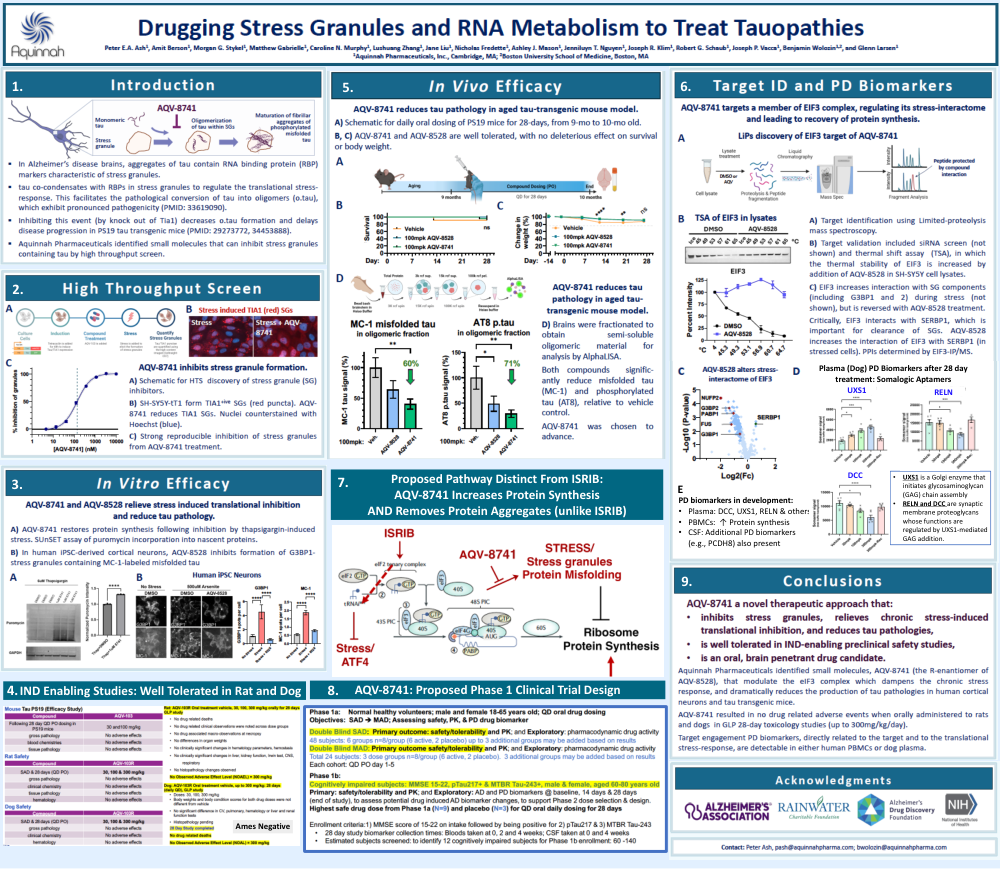
Background: Tau pathology correlates strongly with cognitive deficits in Alzheimer’s Disease (AD), making tau a promising therapeutic target. Emerging therapies using gene or antibody therapies hold great promise, but the field has been stymied in identifying effective small molecule tau therapeutics. Accumulating evidence indicates that oligomeric tau (oTau) co-localizes with RNA binding proteins (RBPs) to regulate the translational stress response. These complexes begin as stress granules but over time promote the accumulation of toxic tau pathologies. Aquinnah designed phenotypic assays to identify small molecules that could prevent this accumulation of pathological tau and provide a novel therapeutic approach for AD.
Methods: AQV-8741 emerged from a medchem pipeline based on an initial hit that prevented the association of tau with TIA1, an RBP marker and regulator of stress granules. The activity of AQV-8741 was assessed in human iPS-derived cortical neurons by immunofluorescence and in aged PS19 tau transgenic mice using AlphaLISA detection of pathological tau.
Results: Compound treatment prevented tau misfolding in human iPSC-derived neurons in response to chemical stress or following seeding with pre-formed tau fibrils. AQV-8741 also reduced brain pathological tau by up to 70% and plasma NfL by ~30% in 10-month old PS19 P301S mice following 28-days of treatment by oral gavage. Target deconvolution using mass spectrometry limited proteolysis with validation by thermal-shift assays identified the target as a member of the EIF3 RNA translation initiation complex. EIF3 immunoprecipitation/mass spectrometry studies showed that AQV-8741 acts to selectively inhibit the association of EIF3 with stress-related RBPs. AQV-8741 exhibits good drug-like attributes including brain penetration, metabolic stability, a clean CEREP safety panel, and promising preliminary 28-day rat and dog GLP safety results.
Conclusions: AQV-8741 is advancing towards IND submission and clinical trials. We hypothesize that AQV-8741 acts as a biased antagonist of the EIF3 complex that selectively regulates stress granules and RNA translation and the chronic stress response. AQV-8741 promotes removal of aggregated, toxic tau oligomers possibly by stimulating the association of oTau with disaggregases and chaperones that are part of the EIF3 complex. Targeting the chronic stress response might also have applicability to other chronic degenerative diseases.
AQV-8741 is being prepared for a 28-day Phase 1 clinical trial. The Phase 1b component will target subjects with cognitive impairment, MMSE 15-22, and employ exploratory AD biomarkers, including pTau217 and TauMTBR243. Additional exploratory biomarkers can be examined as needed.
Comments
Email is required but is not shown publicly.
Loading comments...