4,068 posters, 219 videos, 101 topics, 69 sessions, 14,365 authors, 6,128 institutions
ePostersLive by SciGen Technologies S.A. All rights reserved.
Alzheimer's Association International Conference 2026
July 12-15, 2026 | London, United Kingdom, and Online

925
Polyphenolic Gallotannins Inhibit Amyloid Aggregation And Associated Cytotoxicity Primarily By Interfering With Secondary Nucleation
Poster Presenter
Authors
Part of Topic
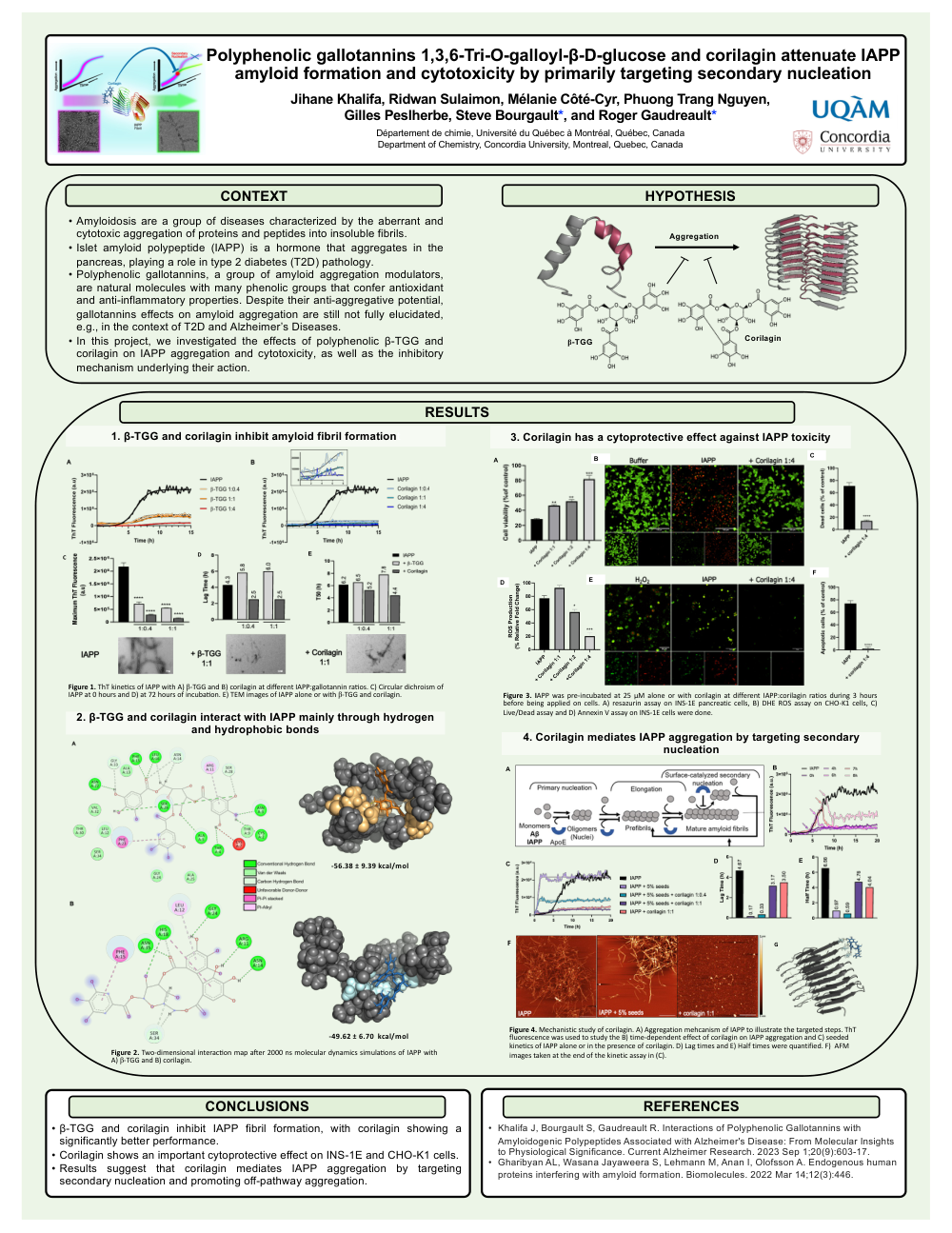
Polyphenolic gallotannins 1,3,6-Tri-O-galloyl-β-D-glucose and corilagin attenuate
IAPP amyloid formation and cytotoxicity by primarily targeting secondary
nucleation
Jihane Khalifa1,2,3, Ridwan Sulaimon4, Mélanie Côté-Cyr1,3, Phuong Trang Nguyen1,3,
Gilles Peslherbe4, Steve Bourgault1,3*, and Roger Gaudreault1,2*.
1Department of Chemistry, Université du Québec à Montréal, 2101 Jeanne-Mance Street, Montreal, QC H2X
2J6, Canada.
2Quebec Centre for Advanced Materials, QCAM, Canada
3Quebec Network for Research on Protein Function, Engineering and Applications, PROTEO, Canada
4Centre for Research in Molecular Modeling (CERMM) & Department of Chemistry and Biochemistry,
Concordia University, Montreal H4B 1R6, QC, Canada
*Corresponding authors: Bourgault.steve@uqam.ca, Gaudreault.roger@uqam.ca
ABSTRACT
Protein misfolding and subsequent aggregation into insoluble amyloid deposits are
associated with various diseases, including Alzheimer’s disease, systemic amyloidosis and
type 2 diabetes mellitus (T2DM). In T2DM, the peptide hormone islet amyloid polypeptide
(IAPP), which regulates glucose homeostasis, aggregates in the pancreas, forming soluble
cytotoxic aggregates and amyloid fibrils that contribute to β-cell dysfunction and death.
Thus, the inhibition of IAPP aggregation consists of a promising strategy for treating
T2DM. Natural gallotannins are potential amyloid modulators, though their effects on
amyloid self-assembly are not fully understood. This study examines two gallotannins,
1,3,6-tri-O-Galloyl-β-D-glucose (β-TGG) and corilagin, and their inhibitory effects on
IAPP aggregation. Using thioflavin T fluorescence, atomic force microscopy, and circular
dichroism, it was found that the gallotannins delay IAPP self-assembly and reduce the
length and quantity of amyloid fibrils. Despite structural similarity, corilagin exhibited
markedly higher anti-aggregative activity at lower concentrations compared to β-TGG.
Peptide monomer-gallotannin interactions were further investigated using all-atom explicit
solvent molecular dynamics simulations, providing valuable insight into the binding of
both gallotannins to monomeric IAPP. Furthermore, corilagin provided significant
cytoprotective effects against IAPP-induced cytotoxicity and membrane damage in
pancreatic β-cells. Mechanistic analysis revealed that corilagin exerts its effects primarily
by inhibiting secondary nucleation and facilitating off-pathway aggregation into
cytocompatible proteospecies. Together, these findings highlight the potential of both
gallotannins in inhibiting amyloid self-assembly and inspiring the development of antiaggregative
agents for neurodegenerative Alzheimer’s disease
Comments
Email is required but is not shown publicly.
Loading comments...