4,068 posters, 219 videos, 101 topics, 69 sessions, 14,365 authors, 6,128 institutions
ePostersLive by SciGen Technologies S.A. All rights reserved.
Alzheimer's Association International Conference 2026
July 12-15, 2026 | London, United Kingdom, and Online

13227
Plasma Proteomics Reveals Continuous, Region-specific Vulnerability Axes In Alzheimer’S Disease
Poster Presenter
Authors
Part of Topic
Biomarkers -> Biomarkers (non-neuroimaging) -> Differential diagnosis
Subtyping AD: Can biomarker patterns define meaningful clinical subtypes?
Plasma Proteomics Reveals Continuous, Region-Specific Vulnerability Axes in Alzheimer’s Disease
Abstract (200 word max)
Alzheimer’s disease (AD) exhibits marked clinical and biological heterogeneity that is poorly captured by existing diagnostic categories. A key challenge is determining whether biomarker data support discrete molecular subtypes of AD or instead reflect continuous axes of disease vulnerability. Leveraging large-scale plasma proteomics from the Global Neurodegeneration Proteomics Consortium (GNPC), we developed a region-informed analytical framework to characterize heterogeneity in AD at the systems level.
We first residualized plasma protein levels for global aging and health-related effects, isolating brain-relevant proteomic variation. Using predefined brain-region protein signatures, we derived region-specific principal components that capture coordinated vulnerability patterns across cortical and subcortical systems. Rather than enforcing categorical subtype assignments, we projected individuals onto these region-specific axes and evaluated their structure using unsupervised spectral clustering.
Our analyses reveal that AD heterogeneity is best described by continuous, partially overlapping vulnerability gradients affecting distinct brain regions, rather than sharply separable subtypes. These gradients show biologically interpretable patterns consistent with known regional involvement in AD, including hippocampal–limbic and cortico–striatal systems. Importantly, this framework produces patient-level embeddings that are stable, interpretable, and directly linkable to downstream genetic and clinical analyses.
By reframing AD heterogeneity as a set of continuous, region-specific vulnerability axes, this work advances a biomarker-driven approach to patient stratification that aligns with the AD Data Initiative’s mission to enable biologically grounded, clinically actionable insights for precision dementia research.
-----
Alzheimer’s disease (AD) exhibits substantial biological heterogeneity that is poorly captured by existing diagnostic labels and discrete subtype frameworks. A central open question is whether biomarker data support separable molecular subtypes or instead reflect continuous axes of regional vulnerability. Leveraging large-scale plasma proteomics from the Global Neurodegeneration Proteomics Consortium (GNPC), we developed a region-informed framework to address this challenge.
We first defined brain-region–specific protein sets using GTEx bulk RNA-seq, assigning genes to the brain region of maximal expression and requiring high tissue specificity (τ > 0.8) and sufficient expression. Plasma proteins mapping to these genes were residualized for global plasma variation, age, and sex to isolate brain-relevant signals. Within each brain region, coordinated proteomic variation was summarized using principal components (or mean z-scores for sparse regions), and region-level features were integrated using unsupervised dimensionality reduction and clustering.
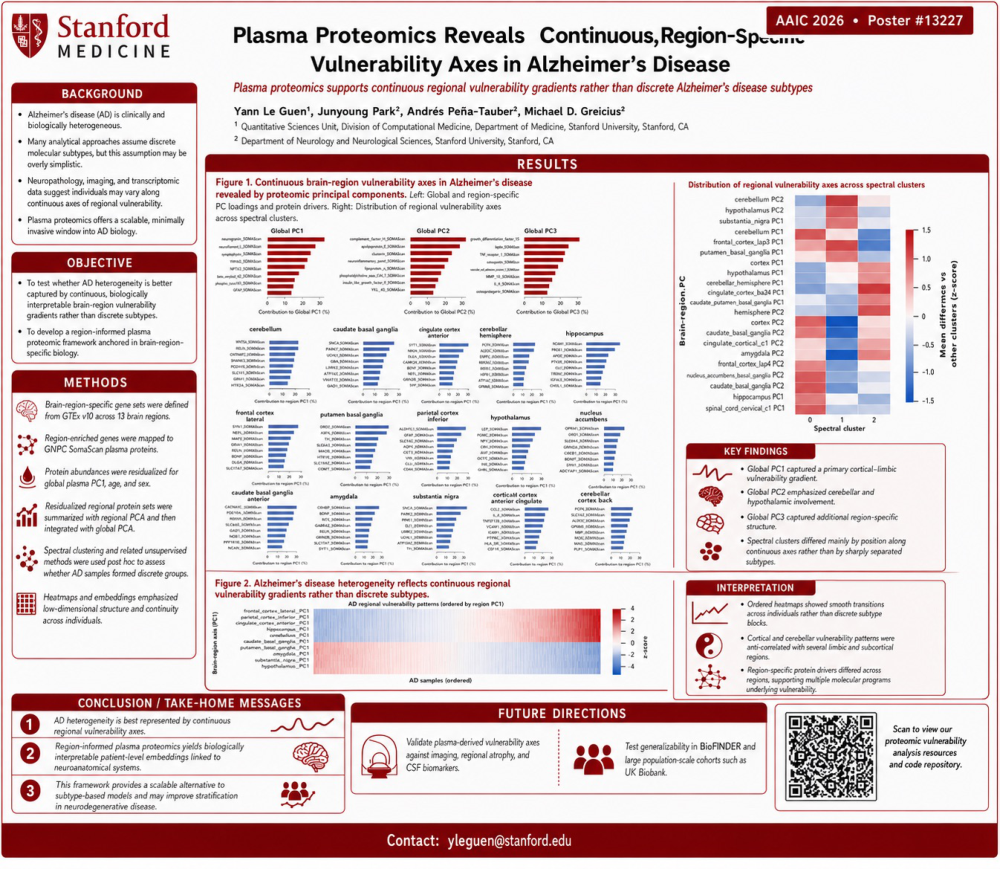
Rather than forming discrete subtypes, AD samples organized along continuous, partially overlapping vulnerability axes affecting distinct cortical and subcortical systems. These axes revealed interpretable regional patterns consistent with known neuroanatomical involvement in AD and generated stable, patient-level embeddings suitable for downstream analyses.
This work reframes AD heterogeneity as a continuum of brain-region–specific vulnerability, offering a biologically grounded, scalable strategy for patient stratification aligned with the AD Data Initiative’s goal of enabling precision approaches to dementia research.
Introduction
Alzheimer’s disease (AD) is clinically and biologically heterogeneous, yet current diagnostic frameworks largely treat it as a unitary disorder. Considerable effort has been devoted to defining molecular or biomarker-based AD subtypes, motivated by the need for improved prognostic stratification and targeted therapeutic development. However, most subtyping approaches implicitly assume that disease heterogeneity is best represented by discrete categories, an assumption that remains insufficiently tested. An alternative conceptualization is that AD heterogeneity reflects continuous axes of regional vulnerability, rather than sharply separable subtypes. Neuropathological, neuroimaging, and transcriptomic studies consistently demonstrate that AD affects brain regions in partially overlapping and variable patterns, suggesting that individuals may occupy different positions along multiple biological gradients. Capturing such gradients requires methods that preserve continuous structure while remaining biologically interpretable and scalable to large cohorts.Plasma proteomics offers a powerful, minimally invasive window into systemic and brain-related biological processes. However, plasma protein levels are strongly influenced by global aging, frailty, renal function, and other non-neurological factors, which can obscure disease-relevant signals. Moreover, most plasma-based analyses aggregate proteins without explicit consideration of brain regional biology, limiting interpretability with respect to neuroanatomical vulnerability. Here, we present a region-informed plasma proteomic framework for characterizing AD heterogeneity using data from the Global Neurodegeneration Proteomics Consortium (GNPC). We anchor plasma protein interpretation to brain-region–specific gene expression defined using GTEx, isolate brain-relevant proteomic variation by removing dominant global plasma effects, and summarize coordinated regional signals using unsupervised dimensionality reduction. Rather than enforcing categorical subtype labels, we explicitly test whether AD samples organize into discrete groups or along continuous vulnerability axes. This approach reframes AD subtyping as a problem of mapping individuals within a low-dimensional, biologically grounded vulnerability space.
Methods
Definition of Brain-Region–Specific Protein Sets
Brain-region–specific genes were defined using GTEx v10 bulk RNA-seq data across 13 brain regions. For each gene, median expression was computed per region, and genes were assigned to the brain region with maximal expression. To ensure regional specificity, we required high tissue specificity (τ > 0.8) and sufficient expression (median TPM > 5). This procedure yielded curated gene sets representing region-enriched transcriptional programs across cortical and subcortical systems.
These region-assigned genes were mapped to plasma proteins measured by SomaScan in GNPC, using both curated gene–protein mappings and gene-symbol–based matching. Regions represented by very small numbers of proteins were retained using simplified summary statistics, while regions with broader coverage supported multivariate modeling.
Plasma Proteomic Preprocessing and Residualization
Plasma protein abundances were log-transformed and harmonized across samples following standard GNPC quality control and imputation procedures. To isolate brain-relevant biological variation, we explicitly removed dominant global plasma effects by residualizing each protein on the first principal component computed across all plasma proteins, as well as age and sex. This step substantially reduced variance attributable to systemic aging, frailty, and renal clearance while preserving coordinated biological structure among brain-related proteins. Sensitivity analyses considering additional global plasma components yielded qualitatively similar results.
Construction of Region-Level Proteomic Features
Within each brain region, residualized protein values were standardized and summarized using principal component analysis (PCA). Regions represented by two proteins were summarized using mean z-scores, while regions with three or more proteins contributed one or two principal components depending on variance explained. This produced a compact set of region-level proteomic features, each capturing coordinated variation among proteins linked to a specific neuroanatomical system.
Region-level features were computed using all available samples (cognitively normal, MCI, and AD) to define stable axes of variation, while downstream analyses focused on AD and MCI individuals.
Global Integration and Unsupervised Analysis
Region-level features were concatenated into a unified feature matrix and standardized. Global PCA was applied to identify dominant axes of coordinated regional vulnerability. To explore whether these axes reflected discrete subtypes or continuous structure, we applied unsupervised clustering methods, including spectral clustering and Gaussian mixture models, and evaluated cluster stability and separation. Visualization focused on low-dimensional embeddings and heatmaps ordered by global vulnerability axes rather than cluster assignments.
Results
Brain-Region–Specific Plasma Signatures Capture Coordinated Vulnerability Patterns
GTEx-based filtering identified brain-region–specific gene sets with heterogeneous coverage across regions, ranging from cerebellar and frontal cortical systems to limbic and basal ganglia structures. Despite variable protein counts, region-level summaries revealed coherent, biologically interpretable patterns of coordinated plasma variation following residualization for global effects.
Importantly, residualization substantially reduced dominance of a single aging-related plasma axis, allowing region-specific signals to emerge. Region-level principal components reflected coordinated shifts among proteins linked to shared neuroanatomical systems rather than isolated protein effects.
AD Samples Organize Along Continuous Regional Vulnerability Axes
Global PCA of region-level features in AD samples revealed a low-dimensional structure dominated by two principal axes, explaining approximately 35% and 31% of the variance, respectively. Visualization of AD individuals along these axes demonstrated smooth, continuous gradients rather than discrete clusters. While unsupervised clustering methods could partition individuals, cluster boundaries were unstable and sensitive to model assumptions, consistent with an underlying continuum rather than separable subtypes.
Heatmap-based visualizations ordered by global vulnerability axes revealed partially overlapping regional patterns, with distinct combinations of cortical, limbic, cerebellar, and subcortical features contributing to different positions along the axes. These patterns align with known heterogeneity in neuroanatomical involvement in AD and suggest that individuals differ in the relative prominence of regional vulnerability rather than belonging to mutually exclusive subtypes.
Global Axes Reflect Contributions from Multiple Brain Regions
Inspection of loadings on the global region-feature PCs showed that no single brain region dominated the vulnerability structure. Instead, axes reflected weighted contributions from multiple regions, indicating coordinated but nonredundant involvement of distributed brain systems. This supports a systems-level model of AD heterogeneity in which multiple neuroanatomical programs vary jointly but independently across individuals.
Conclusion
In this proof-of-concept study, we demonstrate that plasma proteomics, when anchored to brain-region–specific gene expression and corrected for dominant global effects, reveals continuous, biologically interpretable axes of regional vulnerability in Alzheimer’s disease. Rather than supporting sharply defined molecular subtypes, AD heterogeneity appears better captured by overlapping gradients reflecting differential involvement of cortical and subcortical systems.
This framework offers several advantages for precision dementia research. It produces stable, patient-level embeddings that preserve continuous structure, avoids arbitrary subtype boundaries, and provides direct links to neuroanatomical biology. Importantly, the approach is scalable and compatible with downstream genetic, clinical, and imaging analyses.
Future work will extend this framework to independent cohorts with richer phenotyping. In particular, integration with BioFINDER data will enable direct validation against MRI-derived regional atrophy patterns and established CSF biomarkers, strengthening biological interpretation of the identified vulnerability axes. Application to population-scale cohorts such as UK Biobank, using Olink proteomics, will assess generalizability across platforms and protein panels. Together, these extensions will determine whether region-informed plasma proteomic gradients can serve as robust, clinically meaningful dimensions for stratifying neurodegenerative disease.
Comments
Email is required but is not shown publicly.
Loading comments...