4,068 posters, 219 videos, 101 topics, 69 sessions, 14,365 authors, 6,128 institutions
ePostersLive by SciGen Technologies S.A. All rights reserved.
Alzheimer's Association International Conference 2026
July 12-15, 2026 | London, United Kingdom, and Online

2135
Mapping Auditory Processing Heterogeneity in Dementia to Targeted Soundscape Interventions
Poster Presenter
Authors
Part of Topic
Title: Mapping Auditory Processing Heterogeneity in Dementia to Targeted Soundscape Interventions
Background: Dementia affects approximately 55 million people globally, manifesting through progressive cognitive impairments and behavioural and psychological symptoms (BPSD) that significantly impact the quality of life for individuals and caregivers. Environmental interventions represent promising non-pharmacological approaches to symptom management. Although soundscape augmentation shows promise in reducing BPSD, current soundscape applications in dementia care lack systematic frameworks that account for heterogeneous auditory processing deficits across dementia subtypes.
Objective: To develop a comprehensive theoretical framework mapping specific auditory scene analysis (ASA) deficits across different dementia types to targeted soundscape augmentation strategies, establishing evidence-based principles for acoustic environment design in dementia care settings.
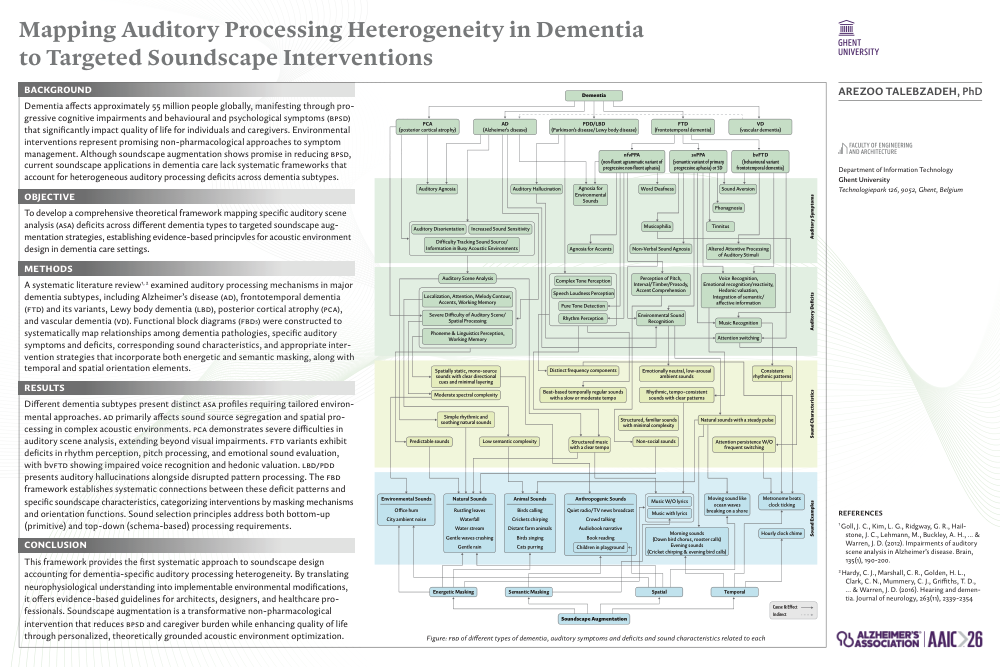
Methods: A systematic literature review examined auditory processing mechanisms in major dementia subtypes, including Alzheimer's disease (AD), frontotemporal dementia (FTD) and its variants, Lewy body dementia (LBD), posterior cortical atrophy (PCA), and vascular dementia (VD). Functional block diagrams (FBDs) were constructed to systematically map relationships among dementia pathologies, specific auditory symptoms and deficits, corresponding sound characteristics, and appropriate intervention strategies that incorporate both energetic and semantic masking, along with temporal and spatial orientation elements.
Results: Different dementia subtypes present distinct ASA profiles requiring tailored environmental approaches. AD primarily affects sound source segregation and spatial processing in complex acoustic environments. PCA demonstrates severe difficulties in auditory scene analysis, extending beyond visual impairments. FTD variants exhibit deficits in rhythm perception, pitch processing, and emotional sound evaluation, with bvFTD showing impaired voice recognition and hedonic valuation. LBD/PDD presents auditory hallucinations alongside disrupted pattern processing. The FBD framework establishes systematic connections between these deficit patterns and specific soundscape characteristics, categorizing interventions by masking mechanisms and orientation functions. Sound selection principles address both bottom-up (primitive) and top-down (schema-based) processing requirements.
Conclusions: This framework provides the first systematic approach to soundscape design accounting for dementia-specific auditory processing heterogeneity. By translating neurophysiological understanding into implementable environmental modifications, it offers evidence-based guidelines for architects, designers, and healthcare professionals. Soundscape augmentation is a transformative non-pharmacological intervention that reduces BPSD and caregiver burden while enhancing quality of life through personalized, theoretically grounded acoustic environment optimization.
Comments
Email is required but is not shown publicly.
Loading comments...