4,068 posters, 219 videos, 101 topics, 69 sessions, 14,365 authors, 6,128 institutions
ePostersLive by SciGen Technologies S.A. All rights reserved.
Alzheimer's Association International Conference 2026
July 12-15, 2026 | London, United Kingdom, and Online

3527
Addressing Dementia Risk in US Rural Communities: A Scoping Review of Interventions
Poster Presenter
Authors
Katherine Britt, Alaa Harb, Audrey Heil, Jen DeBerg, Anna Langel, Sato Ashida, Juliana Souza-Talarico
Affiliations
Part of Topic
Background: Due to health access and socioeconomic barriers, rural populations are at heightened risk for Alzheimer’s disease and related dementias (AD/ADRD), are diagnosed later, and have a faster decline compared to urban counterparts. Approximately 45% of AD/ADRD risk factors are modifiable lifestyle and behavioral factors, making them a primary target for reducing AD/ADRD risk. However, few interventions for reducing AD/ADRD risk and delaying decline are tailored to rural communities.
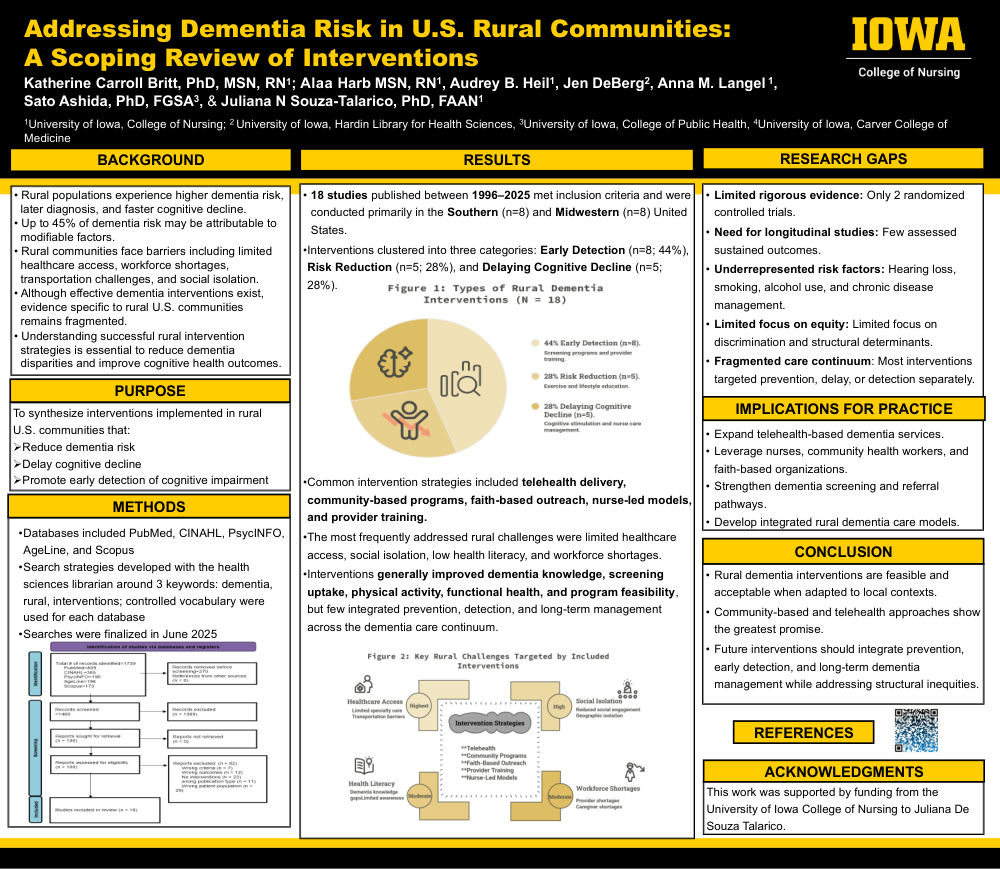
Methods: We conducted a scoping review to summarize the evidence on interventions for reducing AD/ADRD risk and delaying decline in rural U.S. settings. We systematically searched five databases (PubMed, CINAHL, PsycINFO, AgeLine, Scopus) and identified 18 original research studies published up until 2025 that included initiatives, interventions, and programs targeting rural communities focused on reducing AD/ADRD risk and delaying decline through modifiable factors (e.g., exercise, nutrition, cardiovascular health, smoking cessation, social engagement) in adults.
Results: We identified three naturally occurring categories across included studies: risk reduction (n=5), delaying decline (n=5), and cognitive screening and evaluation (n=8). The included study designs ranged from qualitative to pilot feasibility to randomized controlled trials. Studies were conducted across the US: South (N=8), Midwest (N=8), West (N=1) and one study was conducted nationally. Ten of the studies targeted rural inequities: limited healthcare access, low health literacy, workforce shortages, poverty, transportation barriers, and social isolation. Lifestyle interventions included structured exercise programs, health promotion initiatives, nutrition education, and multimodal healthy lifestyle programs. Physical activity interventions (e.g., walking groups, strength training) improved physical health indicators; nutrition and cardiovascular programs enhanced diet, blood pressure, and glucose control. Social engagement and culturally tailored education improved awareness of AD/ADRD risk factors. Rural adaptations—such as lay health advisors, telehealth, and home-based resources—helped address access barriers.
Conclusions: Interventions to prevent dementia and delay decline are feasible in rural communities to address modifiable risk factors before AD/ADRD. Scaling culturally tailored, community-driven strategies holds promise for mitigating AD/ADRD risk in underserved rural populations.
Comments
Email is required but is not shown publicly.
Loading comments...