4,068 posters, 219 videos, 101 topics, 69 sessions, 14,365 authors, 6,128 institutions
ePostersLive by SciGen Technologies S.A. All rights reserved.
Alzheimer's Association International Conference 2026
July 12-15, 2026 | London, United Kingdom, and Online

265
Sex-specific Association Of Atrial Fibrillation With Mild Cognitive Impairment: Results From The Heinz Nixdorf Recall Study
Poster Presenter
Authors
Part of Topic
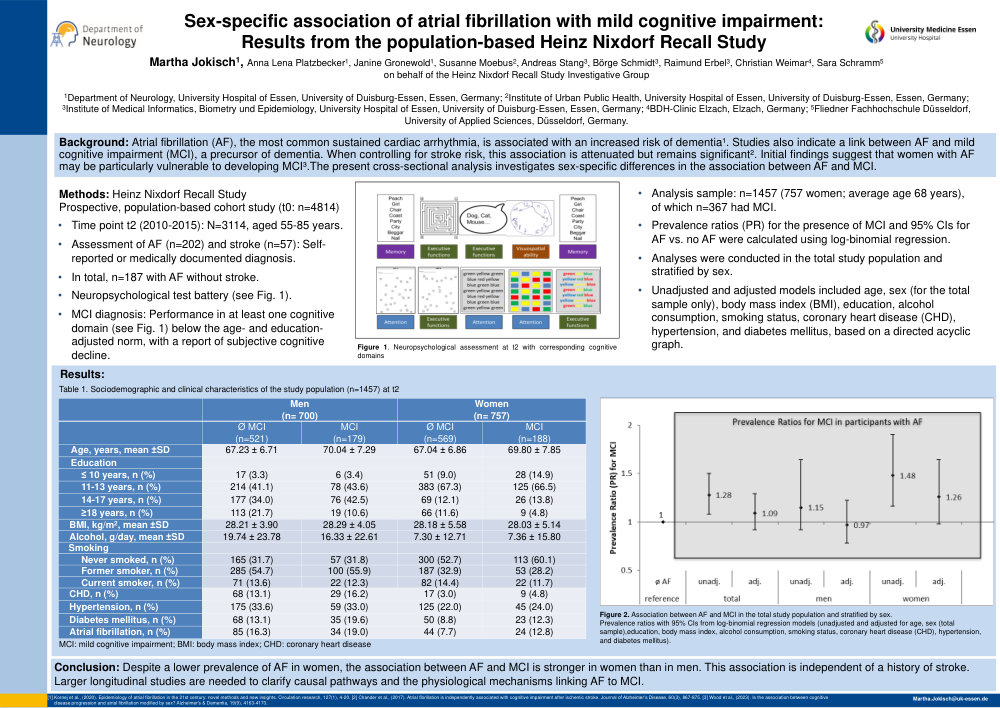
Introduction: Atrial fibrillation (AF), the most common sustained cardiac arrhythmia, is associated with an increased risk of dementia. Evidence also suggests a link between AF and mild cognitive impairment (MCI), independent of stroke risk, particularly among women. This cross-sectional analysis investigates gender-specific differences in the association between AF and MCI.
Methods: A total of 1,457 participants (757 women; mean age 68 years) from the third examination of the population-based Heinz Nixdorf Recall study (2010–2015) with complete data on AF and cognitive performance, and without dementia or prior stroke, were analyzed. MCI was defined according to Winblad et al. (2004). AF was defined as self-reported or medically documented diagnosis, corresponding medication, or ECG findings. Log-binomial regression models were used to estimate prevalence ratios (PRs) and 95% confidence intervals [CIs] for AF versus no AF (in the total study population and stratified by gender, both unadjusted and adjusted for age, gender, education, body mass index, smoking status, alcohol consumption, coronary heart disease, hypertension, and diabetes according to a directed acyclic graph).
Results: The prevalence of AF was 17% (n=119) in men and 9% (n=68) in women. Among individuals with AF, 29% (n=34) of men and 35% (n=24) of women had MCI (vs. 25% and 24%, respectively, without AF). In the total study population, the adjusted model showed no association between AF and MCI (PR=1.09 [0.92–1.29]). Among women, however, a positive association was suggested, which attenuated after adjustment (unadjusted: 1.48 [1.16–1.90]; adjusted: 1.27 [0.98–1.64]). For men, no clear association was observed (unadjusted: 1.15 [0.92–1.42]; adjusted: 0.97 [0.78–1.22]).
Conclusion: Although AF is diagnosed less frequently in women than in men, women appear to exhibit greater cognitive vulnerability in the context of AF. Longitudinal studies with larger populations are needed to identify underlying causes and better understand gender-specific pathophysiological mechanisms.
Comments
Email is required but is not shown publicly.
Loading comments...