4,068 posters, 219 videos, 101 topics, 69 sessions, 14,365 authors, 6,128 institutions
ePostersLive by SciGen Technologies S.A. All rights reserved.
Alzheimer's Association International Conference 2026
July 12-15, 2026 | London, United Kingdom, and Online

8905
Feasibility Of Using Secondary Databases For Observational Research On Amyloid-targeting Therapies
Poster Presenter
Authors
Affiliations
Part of Topic
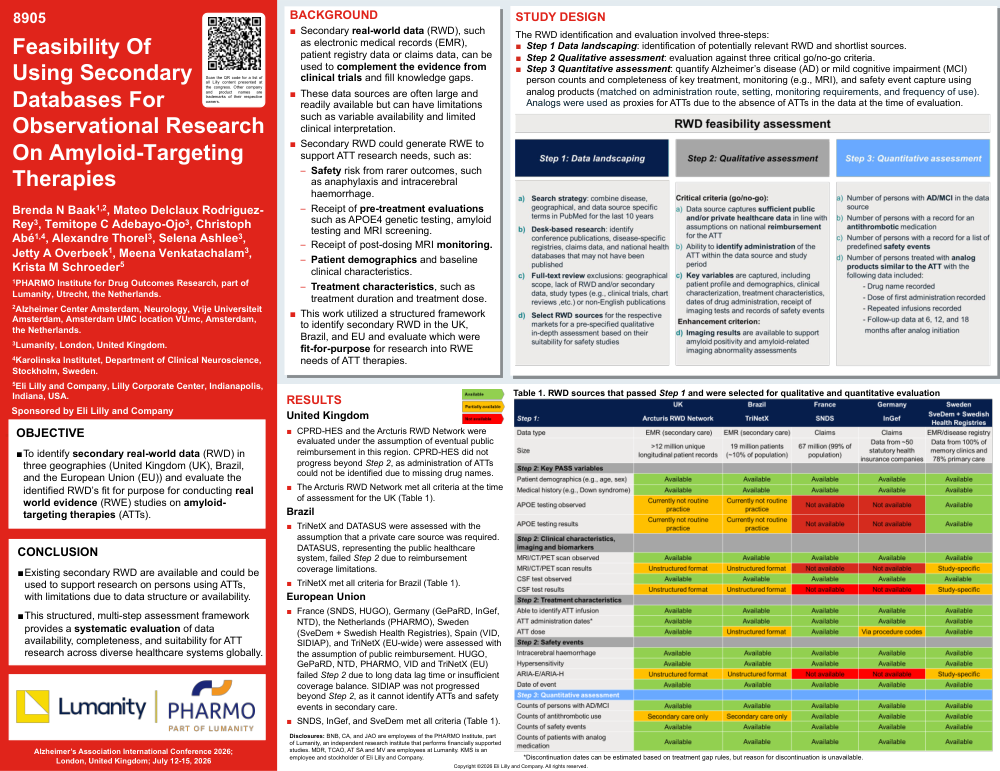
Background: Secondary real-world data (RWD) are often key data sources for post‑authorization safety studies (PASS) of new medications. For amyloid-targeting therapies, secondary RWD facilitate examining safety risk from rarer outcomes (i.e., anaphylaxis and intracerebral haemorrhage), effectiveness of risk-minimization activities, and appropriate medication use. This work describes the evaluation of secondary RWD in the United Kingdom (UK), Brazil, and the European Union (EU) for conducting PASS on amyloid-targeting therapies.
Methods: The RWD feasibility assessment involved three‑steps (outlined further in Figure 1). Step 1 (Data landscaping): identification potentially relevant RWD and shortlist sources. Step 2 (Qualitative assessment): evaluation against three critical go/no-go criteria: a) alignment with assumptions on national reimbursement, b) ability to identify administration of amyloid-targeting therapies, and c) availability of key study variables. Imaging results to support diagnosis and safety monitoring were also assessed. Step 3 (Quantitative assessment): number of AD patients in the databases, proportion of patients with antithrombotic medication use and with safety events of interest, and ability to identify patients treated with analog products (matched to amyloid-targeting therapies on administration route, setting, monitoring, and frequency) due to the absence of amyloid-targeting therapies in the data. For analog products, proportions with recorded drug name, dose, infusions, MRI before/during treatment, and follow-up were assessed.
Results: In the UK, CPRD-HES and the Arcturis RWD Network were evaluated under the assumption of eventual public reimbursement in this region. CPRD-HES did not progress beyond Step 2, as administration of amyloid-targeting therapies could not be identified due to missing drug names. The Arcturis RWD Network met all criteria at the time of assessment. In Brazil, TriNetX and DATASUS were assessed with the assumption that a private care source was required. TriNetX met all criteria, whereas DATASUS, representing the public healthcare system, failed Step 2 due to reimbursement coverage limitations. Across eligible datasets assessed, information on imaging results were not available in structured data. Assessments in the EU are ongoing.
Conclusion: Existing secondary RWD are available to support PASS on amyloid-targeting therapies. This structured, multi‑step assessment enabled systematic evaluation of data availability, completeness, and suitability across diverse healthcare systems, ensuring unbiased and consistent comparisons.
Comments
Email is required but is not shown publicly.
Loading comments...