4,068 posters, 219 videos, 101 topics, 69 sessions, 14,365 authors, 6,128 institutions
ePostersLive by SciGen Technologies S.A. All rights reserved.
Alzheimer's Association International Conference 2026
July 12-15, 2026 | London, United Kingdom, and Online

3882
Community-based Digital Screener For Early Dementia Detection In Malawi
Poster Presenter
Authors
Affiliations
null,
Part of Topic
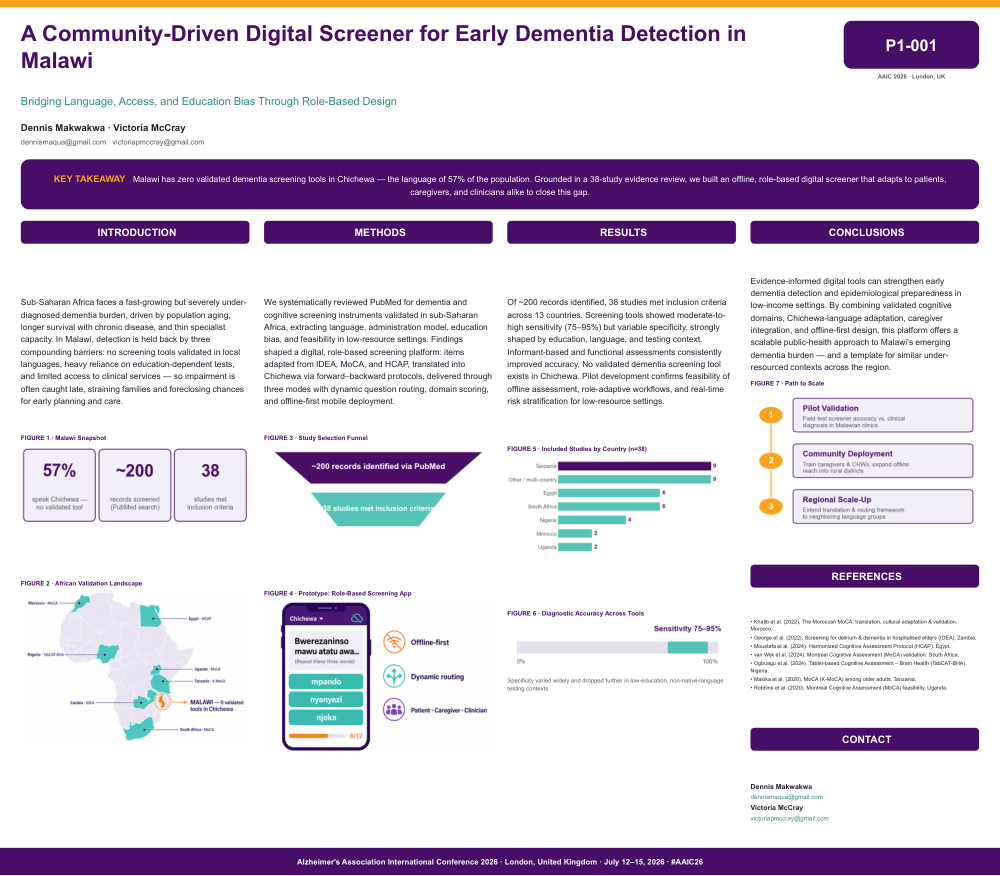
A Community-Driven Digital Screener for Early Dementia Detection in Malawi: Bridging Language, Access, and Education Bias Through Role-Based Design
Abstract
Background
Sub-Saharan Africa faces a rapidly growing but under-diagnosed burden of dementia, driven by population aging, increased survival with chronic disease, and limited specialist capacity. In Malawi, dementia detection is constrained by the absence of validated screening tools in local languages, heavy reliance on education-dependent assessments, and limited access to clinical services. As a result, cognitive impairment is often identified late, if at all, placing substantial burden on families and caregivers and limiting opportunities for prevention and planning.
Methods
We conducted a systematic literature review of dementia and cognitive screening instruments validated in sub-Saharan Africa using PubMed. Studies were included if they reported diagnostic accuracy or psychometric performance among adult populations. Data were extracted on language, administration model, education bias, and feasibility in low-resource settings. Findings from the review informed the design of a digital, role-based cognitive screening platform currently under development. The platform integrates adapted items from validated instruments (IDEA, MoCA, HCAP), translated into Chichewa using forward–backward translation protocols. The system supports three administration modes (patient self-report, caregiver proxy, clinician-administered), dynamic question routing, domain-based scoring, and offline-first deployment via a mobile application, with backend analytics designed for population-level surveillance.
Results
Of approximately 200 records identified, 38 studies met inclusion criteria. Screening tools demonstrated moderate-to-high sensitivity (75–95%) but variable specificity, with performance strongly influenced by education, language, and testing context. Informant-based and functional assessments consistently improved diagnostic accuracy. No validated dementia screening tools were identified in Chichewa, spoken by an estimated 57% of Malawians. The resulting digital screener addresses these gaps by reducing educational bias, incorporating caregiver input, and enabling scalable community-level deployment. Pilot development demonstrates feasibility of offline assessment, role-adaptive workflows, and real-time risk stratification suitable for low-resource settings.
Conclusion
This work demonstrates how evidence-informed digital tools can strengthen early dementia detection and epidemiological preparedness in low-income settings. By combining validated cognitive domains, local language adaptation, caregiver integration, and offline-first design, the platform provides a scalable public health approach to addressing the emerging dementia burden in Malawi and similar contexts.
Comments
Email is required but is not shown publicly.
Loading comments...