4,068 posters, 219 videos, 101 topics, 69 sessions, 14,365 authors, 6,128 institutions
ePostersLive by SciGen Technologies S.A. All rights reserved.
Alzheimer's Association International Conference 2026
July 12-15, 2026 | London, United Kingdom, and Online

3276
Trajectory Of Glial Fibrillary Acidic Protein (GFAP) In The 13 Years Preceding Dementia In The General Population
Poster Presenter
Authors
Audrey Pimenta de Miranda, Morgane Linard, Emanuela Martinuzzi, Jean-François Dartigues, Nicolas Glaichenhaus, Cécilia Samieri, Catherine Helmer
Affiliations
University of Bordeaux, INSERM, Bordeaux Population Health Research Center, UMR 1219, Bordeaux, France., University Côte d’Azur, CNRS, INSERM, Institut de Pharmacologie Moléculaire et Cellulaire, 06560 Valbonne, France. Clinical and Epidemiological Research Unit, INSERM CIC1401, F-33000 Bordeaux, France., University Côte d’Azur, CNRS, INSERM, Institut de Pharmacologie Moléculaire et Cellulaire, 06560 Valbonne, France.
Part of Topic
Video
CONTEXT:
Glial Fibrillary Acidic Protein (GFAP) is a biomarker of reactive astrogliosis and neuroinflammation, which plays an important role in the pathophysiology of dementia. Yet, the dynamics of reactive astrogliosis and GFAP during prodromal stages of dementia remains unclear.
Objective: to model GFAP trajectories in the years preceding dementia diagnosis in a population-based cohort
METHODS:
Study population: 3-City study, Bordeaux → n=2,104
GFAP level & risk of dementia: main study sample:
-
association between plasma GFAP and dementia risk during 13 years of follow-up
-
multivariable adjusted Cox model
GFAP trajectories in prodromal dementia: nested case-control sample:
Incidence density sampling: each case matched to up to 4 controls at diagnosis visit on age, sex, education.
→ multiple linear regression to compare the evolution of GFAP between cases and controls in the prodromal phase of dementia
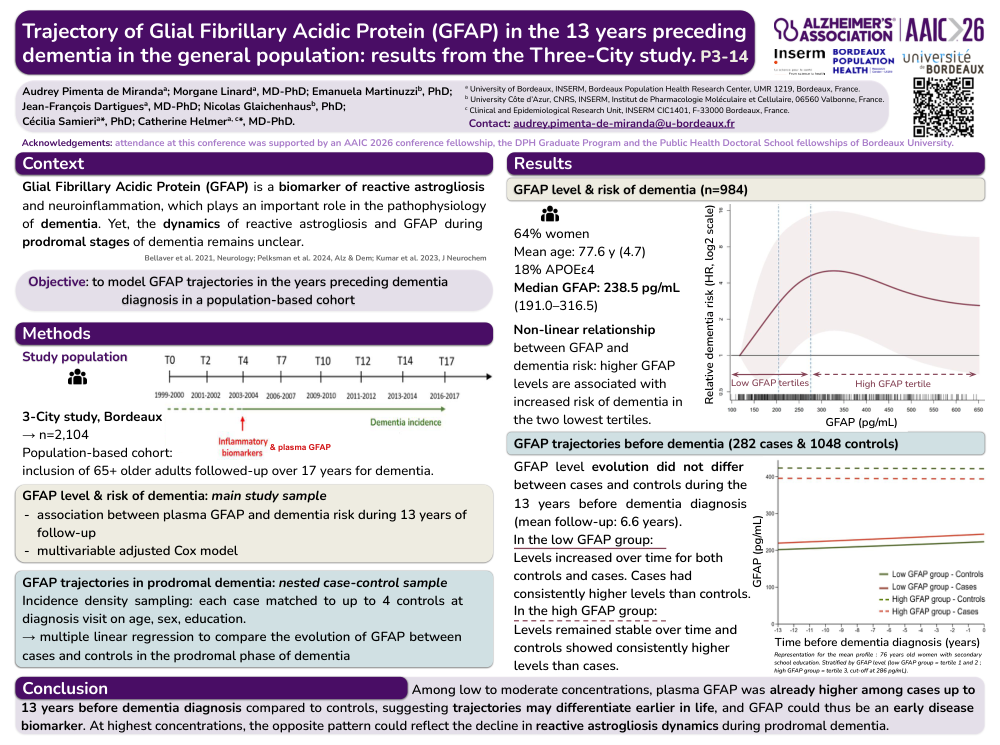
GFAP level & risk of dementia (n=984)
64% women
Mean age: 77.6 y (4.7)
18% APOEε4
Median GFAP: 238.5 pg/mL (191.0–316.5)
Non-linear relationship between GFAP and dementia risk: higher GFAP levels are associated with increased risk of dementia in the two lowest tertiles.
GFAP trajectories before dementia (282 cases & 1048 controls):
GFAP level evolution did not differ between cases and controls during the 13 years before dementia diagnosis (mean follow-up: 6.6 years).
In the low GFAP group:
Levels increased over time for both controls and cases. Cases had consistently higher levels than controls.
In the high GFAP group:
Levels remained stable over time and controls showed consistently higher levels than cases.
Among low to moderate concentrations, plasma GFAP was already higheramong cases up to 13 years before dementia diagnosis compared to controls, suggesting trajectories may differentiate earlier in life, and GFAP could thus be an early disease biomarker. At highest concentrations, the opposite pattern could reflect the decline in reactive astrogliosis dynamics during prodromal dementia.
Comments
Email is required but is not shown publicly.
Loading comments...