4,068 posters, 219 videos, 101 topics, 69 sessions, 14,365 authors, 6,128 institutions
ePostersLive by SciGen Technologies S.A. All rights reserved.
Alzheimer's Association International Conference 2026
July 12-15, 2026 | London, United Kingdom, and Online

1009
Integrating Social-environmental Determinants Into Machine Learning Algorithms In Dementia Care
Poster Presenter
Authors
Affiliations
Part of Topic
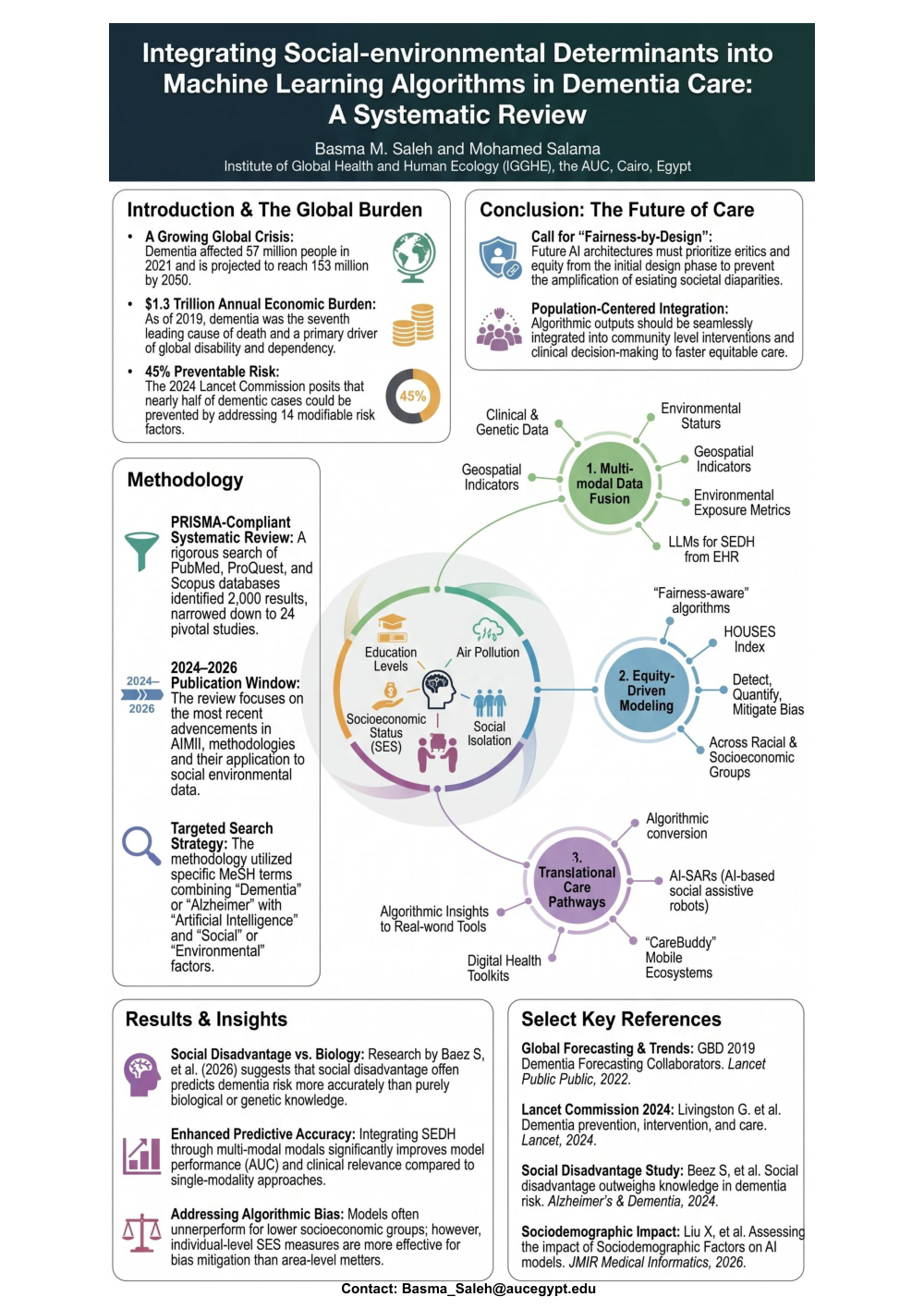
Integrating Social-environmental Determinants into Machine Learning Algorithms in Dementia Care: A Systematic Review
Authors: Basma M. Saleh and Mohamed Salama Institution: Institute of Global Health and Human Ecology (IGGHE), AUC, Cairo, Egypt
1. Introduction & The Global Burden
-
Global Crisis: Dementia affected 57 million people in 2021 → projected 153 million by 2050.
-
Economic Burden: $1.3 trillion annually (2019); dementia = 7th leading cause of death, major driver of disability/dependency.
-
Preventable Risk: 2024 Lancet Commission → 45% of dementia cases preventable via 14 modifiable risk factors.
2. Methodology
-
PRISMA-Compliant Systematic Review:
-
Databases: PubMed, ProQuest, Scopus.
-
Initial results: 2,000 → narrowed to 24 pivotal studies.
-
-
Publication Window: 2024–2026, focusing on latest AI/ML applications to social-environmental data.
-
Targeted Search Strategy: MeSH terms combining “Dementia/Alzheimer” + “Artificial Intelligence” + “Social/Environmental factors.”
3. Analytical Framework
Multi-modal Data Fusion
-
Clinical & genetic data.
-
Environmental exposure metrics (air pollution, geospatial indicators).
-
Education levels, HOUSES index.
-
LLMs for SEDH from EHR.
Equity-Driven Modeling
-
Socioeconomic status (SES).
-
Social isolation.
-
“Fairness-aware” algorithms to detect, quantify, mitigate bias.
-
Focus on racial & socioeconomic disparities.
Translational Care Pathways
-
AI-SARs (AI-based social assistive robots).
-
Algorithmic insights → real-world digital health tools.
-
Mobile ecosystems (e.g., “CareBuddy”).
4. Results & Insights
-
Social Disadvantage vs Biology: Baez S. et al. (2026) → social disadvantage predicts dementia risk more accurately than purely biological/genetic knowledge.
-
Enhanced Predictive Accuracy: Integrating SEDH via multi-modal models improves AUC and clinical relevance vs single-modality approaches.
-
Algorithmic Bias: Models underperform for lower SES groups; individual-level SES measures more effective for bias mitigation than area-level metrics.
5. Conclusion: The Future of Care
-
Fairness-by-Design: AI architectures must embed ethics & equity from design phase to avoid amplifying disparities.
-
Population-Centered Integration: Outputs should integrate into community-level interventions & clinical decision-making for equitable care.
6. Select Key References
-
Global Forecasting & Trends: GBD 2019 Dementia Forecasting Collaborators, Lancet Public Health, 2022.
-
Lancet Commission 2024: Livingston G. et al., Lancet, 2024.
-
Social Disadvantage Study: Baez S. et al., Alzheimer’s & Dementia, 2024.
-
Sociodemographic Impact: Liu X. et al., JMIR Medical Informatics, 2026.
Contact: Basma_Saleh@aucegypt.edu
Comments
Email is required but is not shown publicly.
Loading comments...