4,068 posters, 219 videos, 101 topics, 69 sessions, 14,365 authors, 6,128 institutions
ePostersLive by SciGen Technologies S.A. All rights reserved.
Alzheimer's Association International Conference 2026
July 12-15, 2026 | London, United Kingdom, and Online

2281
The Internet-Based Conversational Engagement Trial (I-CONECT)
Poster Presenter
Part of Topic
BACKGROUND
v Social isolation is a well-established risk factor for dementia based on observational studies.
v Randomized controlled trials offer a critical opportunity to investigate how and why social isolation or interaction affects cognitive function, and to solidify the evidence on whether reducing social isolation (dementia risk reduction) can enhance cognition, even in older age.
v Social interactions, specifically conversational interactions (a core component of human interactions) may stimulate brain networks and enhance cognitive function.
v The Internet-Based Conversational Engagement Clinical Trial, (I-CONECT, www.I-CONECT.org, NCT02871921, PI: Dodge) delivered online semi-structured conversation sessions to socially isolated older subjects.
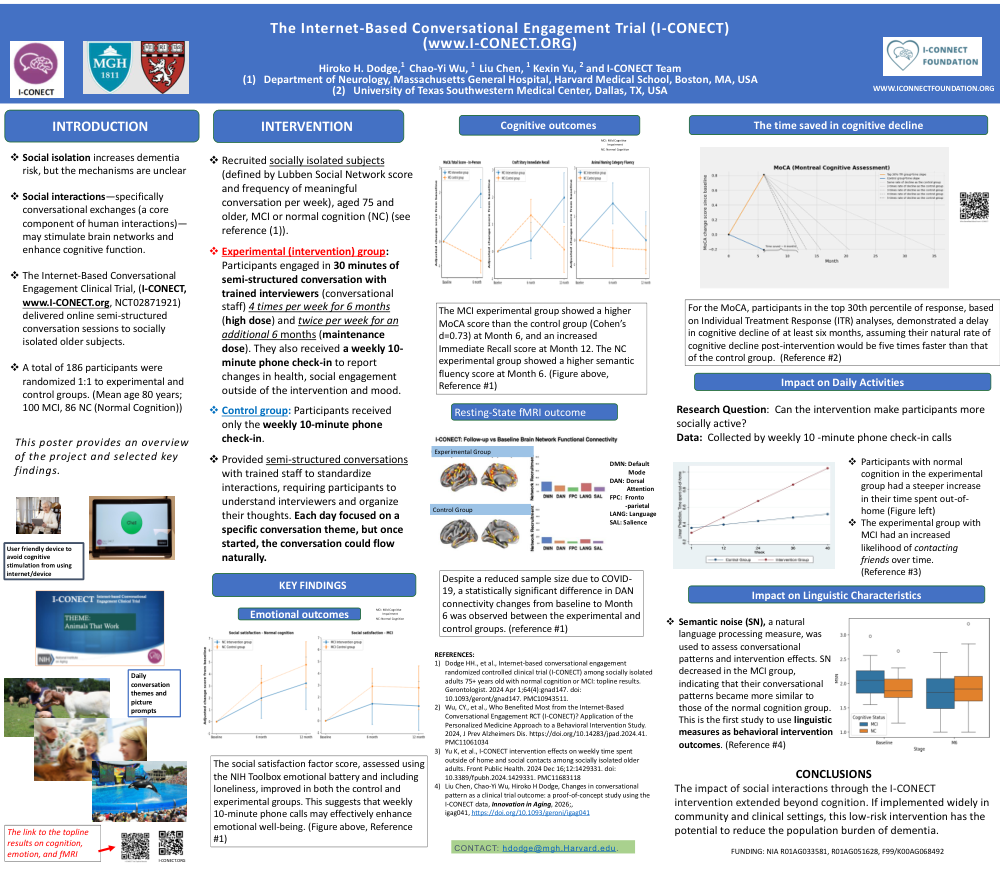
v 186 participants (mean age 80) were randomized (MCI, N=100, Normal Cognition (NC) N=86) between 2018 and 2020. The study was completed in 2022, and the topline results were published in 2024 (1).
THEORETICAL FRAMEWORK
v This study is grounded in the Cognitive Reserve Theory, which posits that increased neural connectivity mitigates the clinical impact of neurodegeneration(Park & Bischof, 2013; Stern, 2012).
INTERVENTION
v Recruited socially isolated subjects (defined by Lubben Social Network score and frequency of meaningful conversation per week), aged 75 and older, MCI or normal cognition (NC) (see reference (1)).
v Experimental (intervention) group: Participants engaged in 30 minutes of semi-structured conversation with trained interviewers (conversational staff) 4 times per week for 6 months (high dose) and twice per week for an additional 6 months (maintenance dose). They also received a weekly 10-minute phone check-in to report changes in health, social engagement outside of the intervention and mood.
v Control group: Participants received only the weekly 10-minute phone check-in.
v Provided semi-structured conversations with trained staff to standardize interactions, requiring participants to understand interviewers and organize their thoughts. Each day focused on a specific conversation theme, but once started, the conversation could flow naturally.
KEY FINDINGS
TOPLINE RESULTS PAPER (THE GERONTOLOGIST, 2024)(1) REPORTED:
v Primary outcome: The MCI experimental group showed a higher MoCA score (the primary outcome) than the control group by 1.75 points (Cohen’s d=0.73, P=0.03) at Month 6
v Secondary outcome: The NC experimental group showed higher semantic fluency scores (language-based executive function) than the control group by 2.56 points at Month 6 (P=0.03)
v Exploratory outcomes: The social satisfaction factor score assessed by the NIH Toolbox emotional battery improved in both the control and experimental groups. This suggests that weekly 10-minute phone calls may effectively enhance emotional well-being.
v Out of 5 large brain networks measured by resting state functional MRI (Default Mode, Dorsal Attention, Fronto-Parietal, Language and Salience networks), Dorsal Attention network connectivity increased among the experimental group compared with the control group, suggesting that conversational engagement may strengthen neural systems involved in goal-directed attention and cognitive control.
WU et al., (2024)(Reference #2) REPORTED:
v The top 30% of the respondents could delay the cognitive decline by at least 6 months by applying the individual treatment response (ITR) method.
YU et al., (2024)(Reference #3) REPORTED:
v Time spent outside the home—a proxy for social activity—increased during and after the intervention in the experimental group compared to the control group, suggesting that the benefits of the intervention extend beyond cognitive outcomes.
CHEN et al., (2026) (Reference #4) REPORTED:
v A natural language processing measure, semantic noise (SN), was a linguistic outcome to quantify conversational patterns and assess intervention-induced changes. SN decreased in the MCI group, indicating that their conversational patterns became more similar to those of the NC group. This study is the first to demonstrate the use of linguistic measures as behavioral intervention outcomes. (Reference #4)
CONCLUSIONS
Engaging conversations improved cognitive function, emotional well-being, and social activity in older adults. If implemented widely in community and clinical settings, this low-risk intervention has the potential to reduce the population burden of dementia.
REFERENCES:
1) Dodge HH., et al., Internet-based conversational engagement randomized controlled clinical trial (I-CONECT) among socially isolated adults 75+ years old with normal cognition or MCI: topline results. The Gerontologist. 2024 Apr 1;64(4):gnad147. doi: 10.1093/geront/gnad147. PMC10943511.
2) Wu, CY., et al., Who Benefited Most from the Internet-Based Conversational Engagement RCT (I-CONECT)? Application of the Personalized Medicine Approach to a Behavioral Intervention Study. 2024, J Prev Alzheimers Dis. https://doi.org/10.14283/jpad.2024.41. PMC11061034
3) Yu K, et al., I-CONECT intervention effects on weekly time spent outside of home and social contacts among socially isolated older adults. Front Public Health. 2024 Dec 16;12:1429331. doi: 10.3389/fpubh.2024.1429331. PMC11683118
4) Liu Chen, Chao-Yi Wu, Hiroko H Dodge, Changes in conversational pattern as a clinical trial outcome: a proof-of-concept study using the I-CONECT data, Innovation in Aging, 2026;, igag041, https://doi.org/10.1093/geroni/igag041
Comments
Email is required but is not shown publicly.
Loading comments...