4,068 posters, 219 videos, 101 topics, 69 sessions, 14,365 authors, 6,128 institutions
ePostersLive by SciGen Technologies S.A. All rights reserved.
Alzheimer's Association International Conference 2026
July 12-15, 2026 | London, United Kingdom, and Online

9428
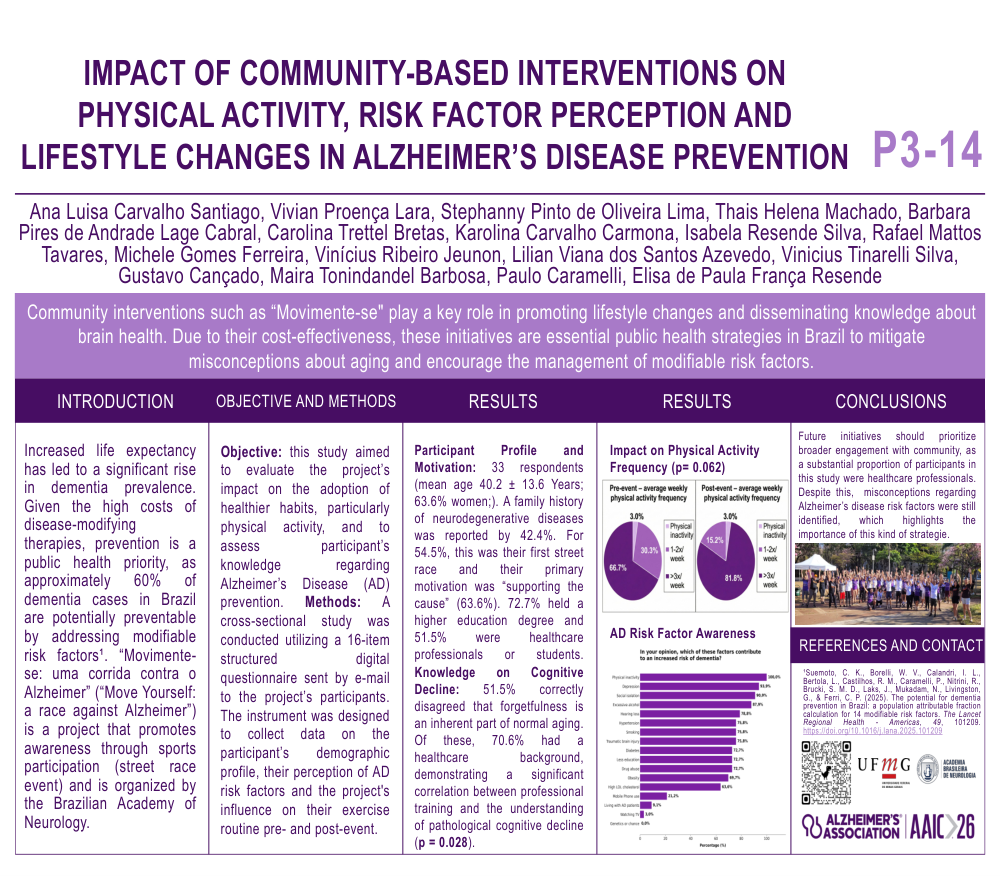
Impact of Community-Based Interventions on Physical Activity, Risk Factor Perception and Lifestyle Changes in Alzheimer's Disease Prevention
Poster Presenter
Authors
Ana Luisa Santiago, Vivian Lara, Stephanny Lima, Thaís Helena Machado, Barbara Cabral, Carolina Bretas, Karolina Carmona, Isabela Silva, Rafael Mattos, Michele Ferreira, Vinícius Jeunon, Lilian Azevedo, Vinicius Silva, Gustavo Cançado, Maira Tonindandel, Paulo Caramelli, Elisa Resende
Affiliations
Part of Topic
Background: Increased life expectancy in Brazil has led to a significant rise in dementia prevalence. Given the high costs of disease-modifying therapies, prevention is a public health priority, as approximately 60% of dementia cases in Brazil are potentially preventable by addressing modifiable risk factors. The project “Movimente-se: uma corrida contra o Alzheimer” (“Move Yourself: a race against Alzheimer”), led by the Brazilian Academy of Neurology, promotes awareness through sports participation. This study evaluated the event’s impact on the adoption of healthier habits, particularly physical activity, and participants’ knowledge regarding Alzheimer’s disease (AD) prevention.
Methods: This cross-sectional study utilized a structured digital questionnaire (16 questions) distributed to event participants. The demographic profile, perception of AD risk factors, and the event’s influence on exercise routines were analyzed.
Results: The study included 33 respondents (mean age 40.2 ± 13.6 years; 63.6% women). A family history of neurodegenerative diseases was reported by 42.4% of participants. For 54.5%, this was their first street race, and the primary motivation was "supporting the cause" (63.6%). Regarding education, 72.7% held a higher education degree, and 51.5% were healthcare professionals or students. Furthermore, 51.5% of participants disagreed that forgetfulness is an inherent part of normal aging; of these, 70.6% had a healthcare background, demonstrating a significant correlation between professional training and the understanding of pathological cognitive decline (p = 0.028). High-frequency physical activity (≥ 3 times/week) increased from 66.7% to 81.8% (p = 0.062) following the event. The most recognized risk factors were physical inactivity (100%), depression (93.9%), social isolation (90.9%), alcoholism (87.9%), and hearing loss (78.8%). Factors lacking consolidated evidence were also cited, such as illicit drug use (72.7%), mobile phone use (21.2%), and living with AD patients (9.1%). Notably, no participant attributed AD risk exclusively to genetics or chance.
Conclusion: Community interventions such as "Movimente-se" play a key role in promoting lifestyle changes and disseminating knowledge about brain health. Due to their cost-effectiveness, these initiatives are essential public health strategies in Brazil to mitigate misconceptions about aging and encourage the management of modifiable risk factors.
Comments
Email is required but is not shown publicly.
Loading comments...