4,068 posters, 219 videos, 101 topics, 69 sessions, 14,365 authors, 6,128 institutions
ePostersLive by SciGen Technologies S.A. All rights reserved.
Alzheimer's Association International Conference 2026
July 12-15, 2026 | London, United Kingdom, and Online

4356
Earlier Diagnosis Of Dementia In Parkinson’s Disease: Study Protocol For A Hybrid II Effectiveness-implementation Trial Of ‘PDCogniCare’
Poster Presenter
Authors
Deborah Brooks, Dana Pourzinal, Elton Lobo, Deepa Sriram, Tiffany Au, Leander Mitchell, John O'Sullivan, Sharon Naismith, Annette Broome, Alexander Lehn, Anna Kelder, Jackie Liddle, James King, Stuart Robinson, Neil Page, Kirstine Shrubsole, Helen Tinson, Martie-Louise Verreynne, Brian Wood, Peter Worthy, Ji Hyun Yang, Peter Nestor, Mark Chatfield, Sabrina Lenzen, Edwin Tan, Tomas Piccinini, Elizabeth Beattie, Rodney Marsh, Gerard Byrne, Nancy Pachana, Nadeeka Dissanayaka
Affiliations
The University of Sydney, The University of Queensland, Metro North Hospital and Health Services, Metro South Hospital and Health Services, OPN 365 Pty Ltd, Queensland University of Technology
Part of Topic
Abstract
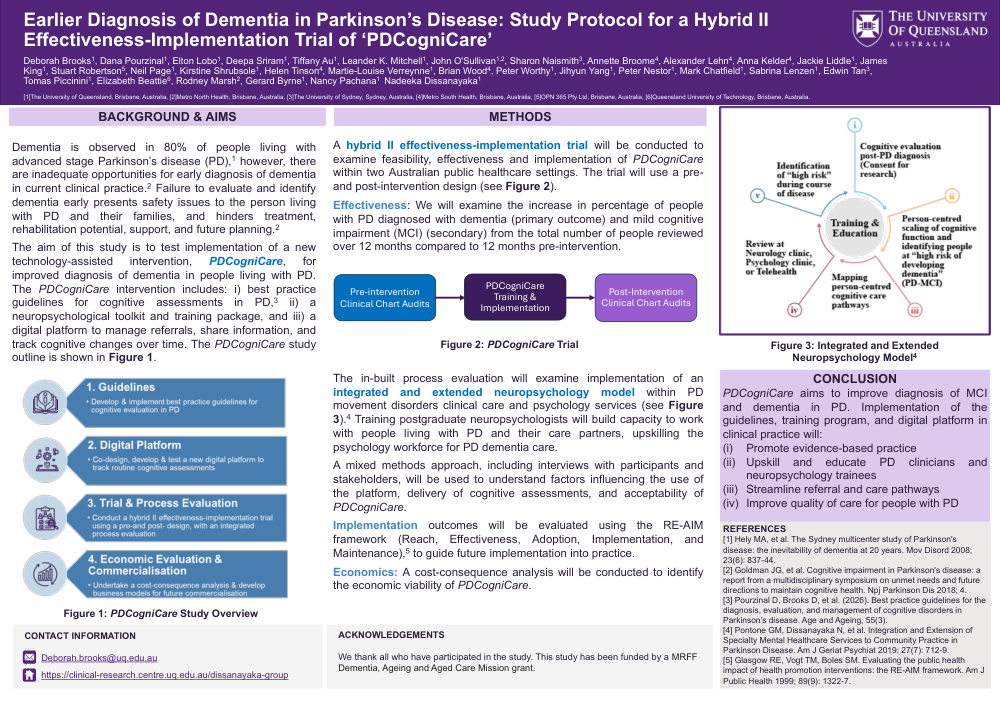
Background: Dementia is observed in 80% of people living with advanced stage Parkinson’s disease (PD), however, there are inadequate opportunities for early diagnosis of dementia in current clinical practice. This presents safety issues to the person living with PD and their families, and hinders treatment, rehabilitation potential, support, and future planning. The aim of this study is to test implementation of a new technology-assisted intervention, PDCogniCare, for improved diagnosis of dementia in people living with PD. The PDCogniCare intervention includes i) best practice guidelines for cognitive assessments in PD, ii) a neuropsychological toolkit and training package, and iii) a digital platform to manage referrals, share information, and track cognitive changes over time.
Methods: A hybrid II effectiveness-implementation trial will be conducted to examine feasibility, effectiveness and implementation of PDCogniCare within two Australian public healthcare settings. The trial will use a pre- and post-intervention design. We will examine the increase in percentage of people with PD diagnosed with dementia (primary outcome) and MCI (secondary) from the total number of people reviewed over 12 months compared to 12 months pre-intervention. In-built process evaluation will examine implementation within PD clinical care and psychology services. Training postgraduate neuropsychologists will build capacity to work with people living with PD and their care partners, upskilling the psychology workforce for PD dementia care. A mixed methods approach, including interviews with participants and stakeholders, will be used to understand factors influencing the use of the platform, delivery of cognitive assessments, and acceptability of PDCogniCare. Implementation outcomes will be evaluated using the RE-AIM framework (Reach, Effectiveness, Adoption, Implementation, and Maintenance), to guide future implementation into practice. A cost-consequence analysis will be conducted to identify the economic viability of PDCogniCare.
Conclusion: This protocol paper reports structured methods to examine feasibility, effectiveness and implementation of the PDCogniCare program within Australian public healthcare settings. In-built process evaluation will identify contextual factors including barriers and facilitators that may influence the uptake of guidelines and a digital platform, delivery of cognitive assessments, and cognitive review. Process and economic evaluations will inform future implementation of PDCogniCare in healthcare services
Comments
Email is required but is not shown publicly.
Loading comments...