4,068 posters, 219 videos, 101 topics, 69 sessions, 14,365 authors, 6,128 institutions
ePostersLive by SciGen Technologies S.A. All rights reserved.
Alzheimer's Association International Conference 2026
July 12-15, 2026 | London, United Kingdom, and Online

1580
Social Isolation's Lifespan Cascade: Linking Early Compensatory Hyperactivity To Late-life Cognitive Decline And Alzheimer's Risk.
Poster Presenter
Authors
Christine Gierke, Martina Morales, Carlos F. Navarro, Walthers Diaz-Gierke, Maria Trinidad Palisson, Nicolas Ferrer, Millaray Pizarro, Alfonso Valderrama, Rocio Diaz, Javiera Palma, Vicente Iturriaga, Francisco Del Pino
Affiliations
Neurology & Neurosurgery Service Clinical Hospital University of Chile (HCUCH); Social Isolation Research Center (SIRC), Santiago Chile; School of Psychology Diego Portales University Santiago Chile; ISOFLY Lab, NiBG Biomedical Sciences Institute (ICBM) Faculty of Medicine University of Chile, Social Isolation Research Center (SIRC), Santiago Chile; ISOFLY Lab, NiBG Biomedical Sciences Institute, Faculty of Medicine University of Chile, Social Isolation Research Center (SIRC), Santiago Chile; ISOFLY Lab, NiBG Biomedical Sciences Institute, Faculty of Medicine University of Chile; School of Psychology Adolfo Ibañez University, Social Isolation Research Center (SIRC), Santiago Chile; ISOFLY Lab, NiBG Biomedical Sciences Institute, Faculty of Medicine University of Chile; School of Psychology Los Andes University, Santiago Chile., Social Isolation Research Center (SIRC), Santiago Chile; ISOFLY Lab, NiBG Biomedical Sciences Institute, Faculty of Medicine University of Chile; School of Psychology, Las Americas University, Santiago Chile., Social Isolation Research Center (SIRC), Santiago Chile; ISOFLY Lab, NiBG Biomedical Sciences Institute, Faculty of Medicine University of Chile; School of Psychology, UCSH, Santiago Chile.
Part of Topic
Title: Social Isolation's Lifespan Cascade: Linking Early Compensatory Hyperactivity to Late-Life Cognitive Decline and Alzheimer's Risk
Poster Number: #1580
Authors: Gierke, C., Morales, M., Palisson, T.M., Díaz-Gierke, W., Navarro, C.F., Diaz, R., Valderrama, A., Pizarro, M., Palma, J., Iturriaga, V., & Francisco del Pino
Abstract / Poster Summary
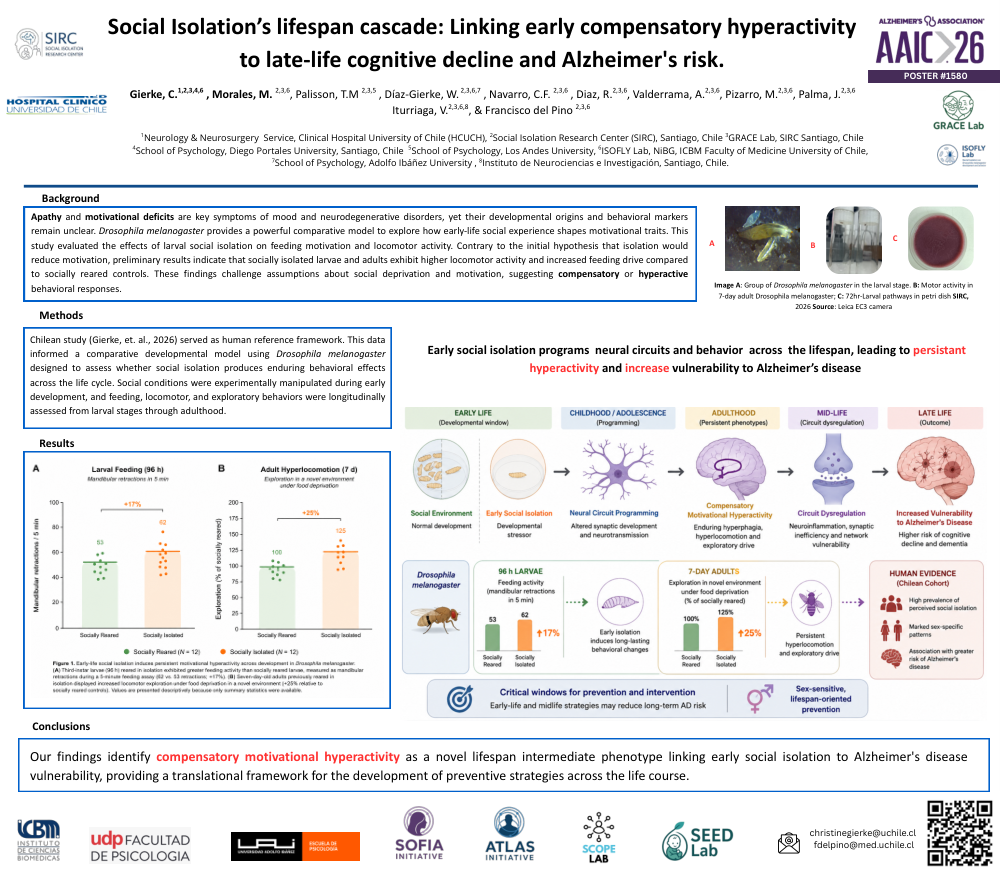
Background: Apathy and motivational deficits are hallmark symptoms of neurodegenerative disorders, yet their developmental origins remain poorly understood. Using Drosophila melanogaster as a powerful comparative model, this study explores how early-life social experience shapes motivational traits and neural circuit programming across the lifespan to influence long-term Alzheimer's disease (AD) risk.
Methods: Informed by human data from a Chilean cohort , social environments were experimentally manipulated during early development in Drosophila. Feeding, locomotor, and exploratory behaviors were longitudinally tracked from larval stages through adulthood. Larval feeding motivation was evaluated via mandibular retractions in a 5-minute assay at 96 hours , and adult hyperlocomotion was assessed via exploration in a novel environment under food deprivation at 7 days.
Results: Counter to traditional hypotheses, early-life social isolation induced a phenotype of persistent compensatory motivational hyperactivity. Socially isolated third-instar larvae exhibited a +17% increase in feeding activity compared to socially reared controls (62 vs. 53 retractions). This behavioral drive persisted into adulthood, where 7-day-old isolated flies showed a +25% increase in locomotor exploration under food deprivation.
Email: christinegierke@uchile.cl | fdelpino@med.uchile.cl
Comments
Email is required but is not shown publicly.
Loading comments...