4,068 posters, 219 videos, 101 topics, 69 sessions, 14,365 authors, 6,128 institutions
ePostersLive by SciGen Technologies S.A. All rights reserved.
Alzheimer's Association International Conference 2026
July 12-15, 2026 | London, United Kingdom, and Online

10106
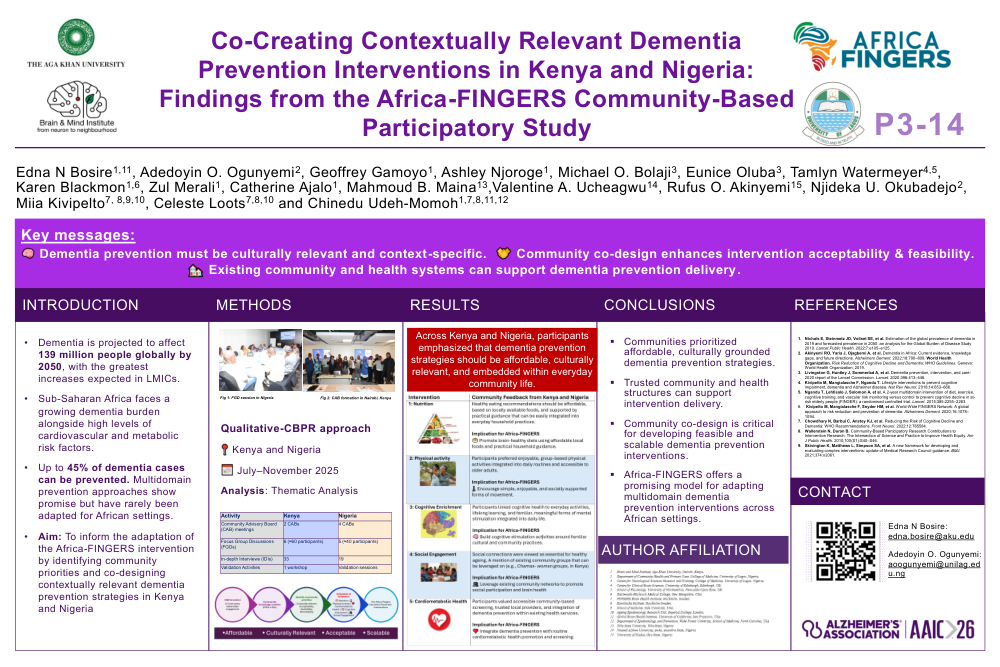
Co-creating Contextually Relevant Dementia Prevention Interventions In Kenya And Nigeria: Africa-fingers Community-based Study
Poster Presenter
Authors
Adedoyin O Ogunyemi, Adedoyin Ogunyemi, Geoffrey Gamoyo, Ashley Njoroge, Michael Bolaji, Eunice Oluba, Tamlyn Watermeyer, Karen Blackmon, Zul Merali, Catherine Ajalo, Mahmoud Maina, Valentine Ucheagwu, Rufus Akinyemi, Njideka Okubadejo, Miia Kivipelto, Celeste Loots, Chinedu Udeh-Momoh
Affiliations
Brain and Mind Institute, Aga Khan University, Nairobi, Kenya, Department of Community Health and Primary Care, College of Medicine, University of Lagos, Nigeria; Global Brain Health Institute, University of California, San Francisco, USA, Centre for Neurological Sciences Research and Training, College of Medicine, University of Lagos, Nigeria, Centre for Clinical Brain Sciences, University of Edinburgh, Edinburgh, UK; School of Psychology, University of Northumbria, Newcastle-Upon-Tyne, UK, Brain and Mind Institute, Aga Khan University, Nairobi, Kenya; Dartmouth-Hitchcock Medical College, New Hampshire, USA, Yobe State University, Yobe State Nigeria, Nnamdi Azikwe University, Awka, Anambra State, Nigeria, University of Ibadan, Oyo State, Nigeria, Department of Medicine, College of Medicine, University of Lagos, Lagos State, Nigeria; Centre for Neurological Sciences Research and Training, College of Medicine, University of Lagos, Nigeria, FINGERS Brain Health Institute, Stockholm, Sweden; Karolinska Institute, Stockholm Sweden; School of medicine, Yale University, USA; Ageing Epidemiology Research Unit, Imperial College, London, FINGERS Brain Health Institute, Stockholm, Sweden; Karolinska Institute, Stockholm Sweden; School of medicine, Yale University, USA, Brain and Mind Institute, Aga Khan University, Nairobi, Kenya; FINGERS Brain Health Institute, Stockholm, Sweden; Karolinska Institute, Stockholm Sweden; Global Brain Health Institute, University of California, San Francisco, USA ; Department of Epidemiology and Prevention, Wake Forest University, School of Medicine, North Carolina, USA
Part of Topic
Background: Dementia risk is shaped by modifiable lifestyle, social, and cardiometabolic factors, yet most prevention models have been developed in high-income settings with limited relevance for African contexts. The Africa-FINGERS Project adapts the multidomain FINGER dementia prevention model for Africa using a Community-Based Participatory Research (CBPR) approach. This study presents co-creation findings from urban and rural sites in Kenya and Nigeria to inform culturally grounded and scalable dementia prevention interventions.
Methods: Between July and November 2025, a qualitative CBPR study was conducted in Kenya and Nigeria across five intervention domains: nutrition, physical activity, cardiometabolic health, cognitive enrichment, and social engagement. In Kenya, data were collected through Community Advisory Board meetings (n=2), focus group discussions (6 FGDs; n≈60), in-depth interviews (n=33), and a validation workshop. In Nigeria, data collection included CAB meetings (n=4), FGDs (n=5; ≈40 participants), in-depth interviews (n=19), and validation activities. Participants were purposively sampled, including older adults, caregivers, health workers, providers, local leaders, and policymakers. Data were transcribed and analyzed thematically.
Findings: Across Kenya and Nigeria, communities emphasized the importance of culturally appropriate, affordable, and locally available strategies for dementia risk reduction. In Kenya, participants prioritized balanced meals using household measures, substitution of costly foods with local alternatives, and simple physical activities such as walking groups and dance, though awareness of brain-healthy diets was limited. In Nigeria, dietary practices were strongly shaped by cultural norms and social status, underscoring the need for context-sensitive nutrition guidance supported by visual tools and testimonials. Physical activity preferences in Nigeria focused on low-intensity routines integrated into daily life, with music and social acceptability influencing participation. In both settings, cognitive health was linked to familiar everyday activities and social engagement within existing community networks, though these took context-specific forms, including savings groups in Kenya and intergenerational interactions in Nigeria. For cardiometabolic health, participants in both countries highlighted the importance of accessible, community-based screening delivered through trusted local structures.
Conclusion: Co-designing dementia prevention interventions with communities enhances relevance, acceptability, and feasibility. Africa-FINGERS demonstrates the value of culturally grounded, community-led approaches for sustainable dementia prevention across diverse African settings.
Key words: Africa-FINGERS; Co-creation; Community-Based Participatory Research; Dementia prevention; Kenya; Nigeria
Comments
Email is required but is not shown publicly.
Loading comments...