4,068 posters, 219 videos, 101 topics, 69 sessions, 14,365 authors, 6,128 institutions
ePostersLive by SciGen Technologies S.A. All rights reserved.
Alzheimer's Association International Conference 2026
July 12-15, 2026 | London, United Kingdom, and Online

5423
Twenty-year Glycemia Trajectories And Risk For Cognitive Impairment (CI) In Adults With Pre-diabetes Or Type 2 Diabetes (T2D): DPPOS
Poster Presenter
Authors
Allison Shapiro, Shiyu Shu, Marinella Temprosa, Dana Dabalea, Steven Kahn, Vallabh Shah, William Knowler, Blandine Laferrere, Jose Luchsinger, Sandra Aleksic, Shihchen Kuo, Wen-Chi Hsueh, Owen Carmichael
Affiliations
, University of Michigan, Pennington Biomedical Research Center, University of Washington, Columbia University, University of Colorado, Denver, George Washington University, Harvard University
Part of Topic
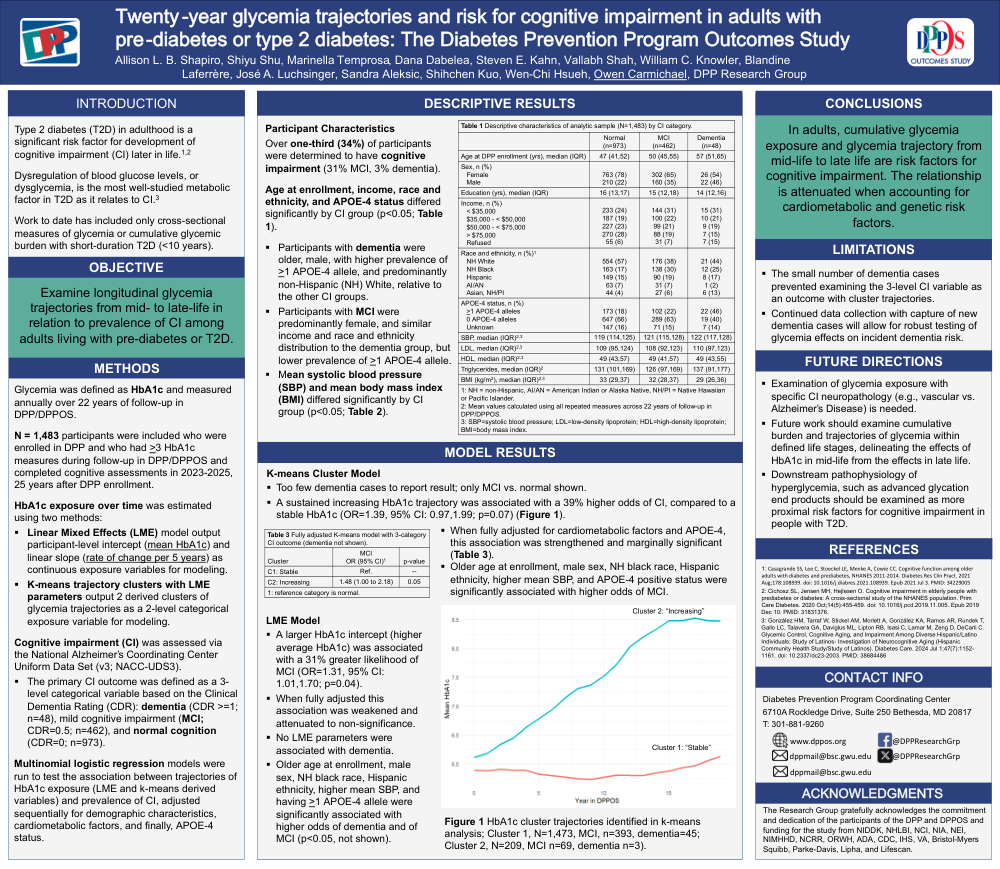
Introduction & Objective: T2D is a risk factor for CI. However, the role of glycemia changes over time in CI risk remains unclear. We investigated longitudinal glycemia trajectories in relation to CI among people living with pre-diabetes or T2Din DPPOS.
Methods: Among 1,682 middle-aged adults with pre-diabetes at enrollment (median [IQR]; age 49 [43,53]) we investigated the association of HbA1c trajectory over 20 years of follow-up with prevalent CI assessed via the National Alzheimer’s Coordinating Center Uniform Data Set (v3) 25 years after enrollment. HbA1c trajectories were characterized from a random effects model as intercept (mean HbA1c over time) and slope (rate of HbA1c change over time). CI categories were dementia (n=48), amnestic mild cognitive impairment (aMCI; n=137), non-amnestic MCI (naMCI; n=136), CI-not-MCI (n=189), and no CI (reference; n=973). Multinomial logistic models sequentially added a prioricovariates for demographics (DPP randomization group, age, sex, education, income, race and ethnicity), cardiovascular risk factors (smoking status, HDL, LDL, systolic blood pressure[SBP]), and APOE genotype.
Results: Independent of demographics, higher mean HbA1c was associated with higher risk for aMCI (OR=1.77 [95% CL: 1.06, 2.97; p=0.03]). However, in sequentially adjusted models, HbA1c parameters were not associated with risk for CI. In the fully adjusted model, older age, male sex, Black race and Hispanic ethnicity, higher SBP, and APOE copy number were associated with higher risk for CI (p<0.05, for all).
Conclusion: In the context of pre-diabetes and T2D, glycemia trajectory may not confer risk for CI that is independent of established demographic, genetic, and cardiovascular risk factors. The findings emphasize the importance of managing of multi-faceted cardiometabolic risks for CI and understanding high-CI-risk groups in the setting of pre-diabetes and T2D.
Comments
Email is required but is not shown publicly.
Loading comments...