4,068 posters, 219 videos, 101 topics, 69 sessions, 14,365 authors, 6,128 institutions
ePostersLive by SciGen Technologies S.A. All rights reserved.
Alzheimer's Association International Conference 2026
July 12-15, 2026 | London, United Kingdom, and Online

5512
Lifetime Benefits Of Ldl Control For Dementia Prevention - Findings From The Dementia Risk Pooling Project & A Computer Simulation Model
Poster Presenter
Authors
Part of Topic
Background
Neurodegenerative causes of dementia are often accompanied and exacerbated by vascular pathology. Elevated low-density lipoprotein cholesterol (LDL-C) causes cardiovascular disease (CVD) and has been linked to an increased risk of dementia. Objectives of this study were to: (i) estimate the impact of LDL-C on dementia risk, and (ii) project the long-term benefits of LDL-C control using a decision-analytic model.
Methods
We analyzed data from the Dementia Risk Pooling Project (DRPP), a pooled longitudinal cohort study (n=56,539). Cox proportional hazards models estimated the covariate-adjusted relationship between cumulative LDL-C, quantified as time-weighted average LDL-C from baseline to age 65 years, and risk of dementia. Results from this analysis were used to update the CVD Policy Model, a computer simulation model of CVD in the U.S. population, incorporating dementia outcomes. This model projected long-term changes in life years, quality-adjusted life years (QALYs), dementia cases, and incident CVD events that could be achieved by maintaining guideline-recommended LDL-C levels (≤130 mg/dL [3.36 mmol/L]).
Results
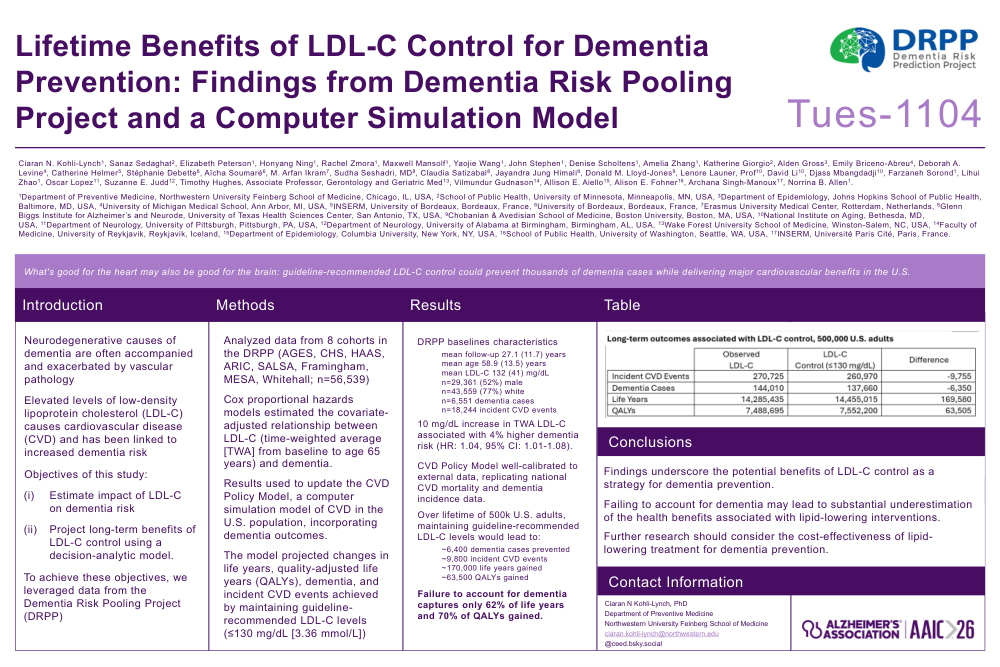
Among DRPP participants, mean age at baseline was 58.9 (13.5) years, mean LDL-C at baseline was 132 (41) mg/dL, 29,361 (52%) were male, and 43,559 (77%) were white. Mean follow-up was 27.1 (11.7) years, and 6,551 cases of dementia and 18,244 incident CVD events were observed. Each 10 mg/dL increase in time-weighted average LDL-C was associated with a 4% higher risk of dementia (HR: 1.04, 95% CI: 1.01-1.08). The decision-analytic model was well-calibrated to external data, closely replicating national CVD mortality and dementia incidence data. Across the lifetime of 500,000 U.S. adults, maintaining guideline-recommended LDL-C levels would lead to around 6,400 dementia cases prevented, 9,800 incident CVD events prevented, 170,000 life years gained, and 63,500 QALYs gained. Failure to account for dementia would capture only 62% of life years and 70% of QALYs gained.
Conclusions
These findings underscore the potential benefits of LDL-C control as a strategy for dementia prevention. Failing to account for dementia may lead to substantial underestimation of the health benefits associated with lipid-lowering interventions. Further research should consider the cost-effectiveness of lipid-lowering treatment for dementia prevention.
Table: Long-term outcomes associated with LDL-C control, 500,000 U.S. adults
|
|
Observed LDL-C |
LDL-C Control (≤130 mg/dL) |
Difference |
|
Incident CVD Events |
270,725 |
260,970 |
-9,755 |
|
Dementia Cases |
144,010 |
137,660 |
-6,350 |
|
Life Years |
14,285,435 |
14,455,015 |
169,580 |
|
QALYs |
7,488,695 |
7,552,200 |
63,505 |
Comments
Email is required but is not shown publicly.
Loading comments...