4,068 posters, 219 videos, 101 topics, 69 sessions, 14,365 authors, 6,128 institutions
ePostersLive by SciGen Technologies S.A. All rights reserved.
Alzheimer's Association International Conference 2026
July 12-15, 2026 | London, United Kingdom, and Online

6584
Dietary Fiber Intake And Incidence Of Dementia Among Community-dwelling Older Adults
Poster Presenter
Part of Topic
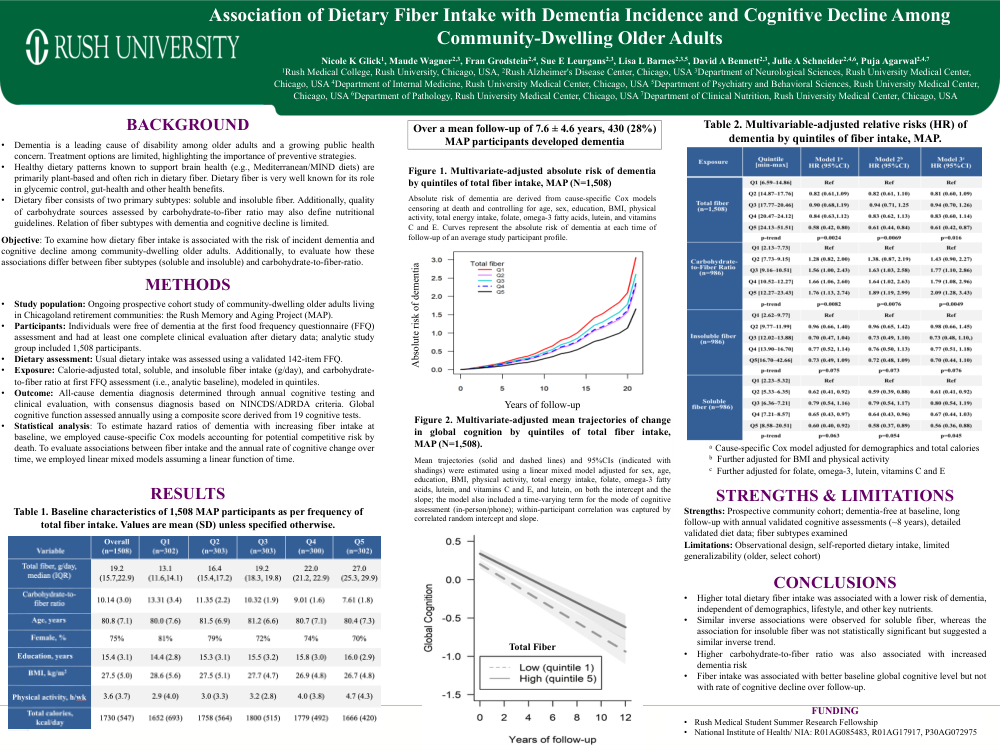
Objective: To examine the association between dietary fiber intake and dementia incidence in older adults.
Background:Dementia is a devastating cognitive disability among older adults. Healthy dietary patterns rich in fiber have been linked to lower dementia risk. Fiber may promote brain health by improving glycemic control, regulating gut-brain communication, and reducing inflammation. Fiber intake among U.S. adults is well below recommended levels, and few studies have examined the associations of fiber intake, but not specifically soluble and insoluble fiber, with incident dementia or cognitive decline.
Methods: We identified 1,508 community-dwelling older participants (80.75±7.14 years old; 75% female) from the ongoing prospective cohort study, Rush Memory and Aging Project, who had no history of dementia at the first Food Frequency Questionnaire (FFQ) assessment and at least one complete clinical evaluation after dietary data. Participants reported their usual diet by completing a validated FFQ from which calorie-adjusted total, soluble, and insoluble fiber (g/day) were calculated. Dementia was determined through annual clinical evaluations and consensus diagnosis using NINCDS/ADRDA criteria. Cox proportional hazards models of censored time to dementia were used.
Results:During 7.62 (± 4.64) years of follow-up, 430 (28%) participants were diagnosed with dementia. Compared to participants in the lowest quintile of total fiber intake, those in the highest quintile had 39% lower risk of dementia after adjusting for age, sex, education, calories, body mass index, and physical activity (Q5 vs. Q1: HR=0.61, 95%CI=0.44-0.84, p-trend=0.007). In a sub-sample (n=986) with data on fiber sub-types, soluble fiber intake (Q5 vs. Q1: HR=0.58, 95%CI 0.37-0.91, p-trend=0.89, p-trend=0.054) was associated with lower dementia risk, but associations with higher insoluble fiber intake were not established (Q5 vs. Q1: HR=0.72, 95%CI 0.48-1.09, p-trend=0.073). After further adjusting for vitamin C, vitamin E, folate, omega-3, and lutein, these protective associations with reduced dementia risk were maintained for total and soluble fiber intake. In secondary analyses, fiber intake was not associated with rateof cognitive decline.
Conclusion: Higher fiber intake, particularly soluble fiber intake, was associated with lower hazard for incident dementia. These findings highlight the potential protective role of dietary fiber in promoting brain health. Further studies are warranted to confirm these associations and explore underlying mechanisms.
Comments
Email is required but is not shown publicly.
Loading comments...