4,068 posters, 219 videos, 101 topics, 69 sessions, 14,365 authors, 6,128 institutions
ePostersLive by SciGen Technologies S.A. All rights reserved.
Alzheimer's Association International Conference 2026
July 12-15, 2026 | London, United Kingdom, and Online

5893
Cognitive Function Predicts Subsequent Sleep Quality But Not Vice Versa Among Older Adults In India
Poster Presenter
Authors
Part of Topic
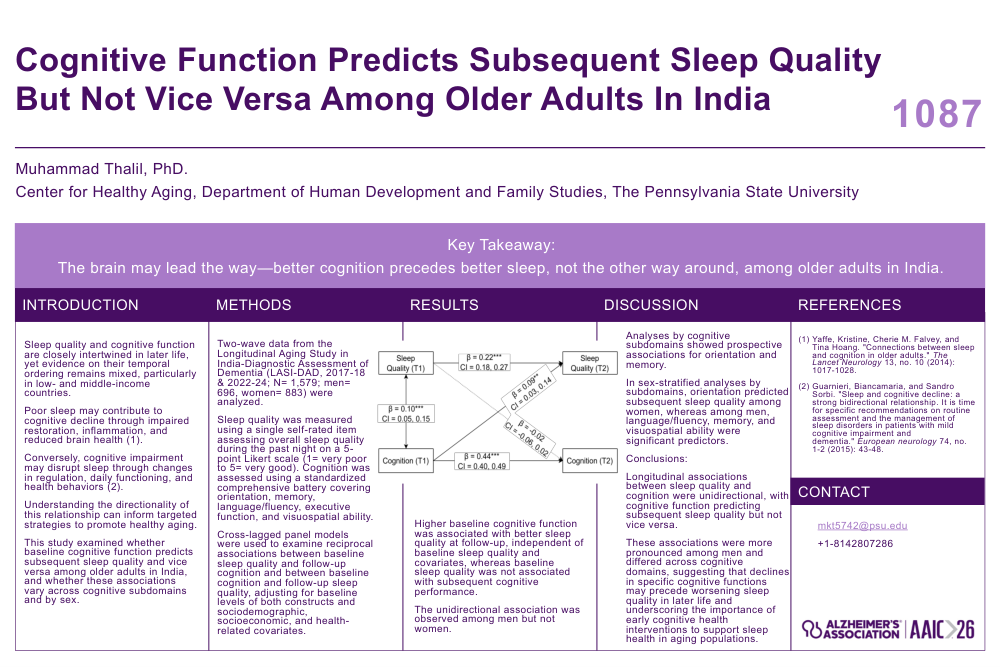
Sleep quality and cognitive function are closely intertwined in later life, yet evidence on their temporal ordering remains mixed, particularly in low- and middle-income countries. Poor sleep may contribute to cognitive decline through impaired restoration, inflammation, and reduced brain health. Conversely, cognitive impairment may disrupt sleep through changes in regulation, daily functioning, and health behaviors. Understanding the directionality of this relationship can inform targeted strategies to promote healthy aging. This study examined whether baseline cognitive function predicts subsequent sleep quality and vice versa among older adults in India, and whether these associations vary across cognitive subdomains and by sex. Two-wave data from the Longitudinal Aging Study in India-Diagnostic Assessment of Dementia (LASI-DAD, 2017-18 & 2022-24; N= 1,579; men= 696, women= 883) were analyzed. Sleep quality was measured using a single self-rated item assessing overall sleep quality during the past night on a 5-point Likert scale (1= very poor to 5= very good). Cognition was assessed using a standardized comprehensive battery covering orientation, memory, language/fluency, executive function, and visuospatial ability. Cross-lagged panel models were used to examine reciprocal associations between baseline sleep quality and follow-up cognition and between baseline cognition and follow-up sleep quality, adjusting for baseline levels of both constructs and sociodemographic, socioeconomic, and health-related covariates. Higher baseline cognitive function was associated with better sleep quality at follow-up, independent of baseline sleep quality and covariates, whereas baseline sleep quality was not associated with subsequent cognitive performance. The unidirectional association was observed among men but not women. Analyses by cognitive subdomains showed prospective associations for orientation and memory. In sex-stratified analyses by subdomains, orientation predicted subsequent sleep quality among women, whereas among men, language/fluency, memory, and visuospatial ability were significant predictors. Longitudinal associations between sleep quality and cognition were unidirectional, with cognitive function predicting subsequent sleep quality but not vice versa. These associations were more pronounced among men and differed across cognitive domains, suggesting that declines in specific cognitive functions may precede worsening sleep quality in later life and underscoring the importance of early cognitive health interventions to support sleep health in aging populations.
Comments
Email is required but is not shown publicly.
Loading comments...