4,068 posters, 219 videos, 101 topics, 69 sessions, 14,365 authors, 6,128 institutions
ePostersLive by SciGen Technologies S.A. All rights reserved.
Alzheimer's Association International Conference 2026
July 12-15, 2026 | London, United Kingdom, and Online

9711
Changes In Cognitively Healthy Life Expectancy And Associated Factors Among Older Adults In China
Poster Presenter
Authors
Longbing Ren, Guoquan Lin, Shaojie Li, Yang Hu, Yifei Wu, Yi Zeng, Yao Yao
Affiliations
Department of Neurology and Neurological Rehabilitation, Shanghai Disabled Persons’Federation Key Laboratory of Intelligent Rehabilitation Assistive Devices and Technologies, Shanghai Yangzhi Rehabilitation Hospital (Shanghai Sunshine Rehabilitation Center), School of Medicine, Tongji University, School of Medicine, Tongji University, Center for Healthy Aging Transdisciplinary Sciences, China Center for Health Development Studies, and School of Public Health, Peking University, Center for Healthy Aging and Development Studies, National School of Development, Peking University
Part of Topic
Changes In Cognitively Healthy Life Expectancy And Associated Factors among Older Adults In China
INTRODUCTION
Population aging has led to a rapid increase in the number of older adults at risk of cognitive impairment and dementia worldwide. While life expectancy has continued to rise in China, it remains unclear whether these gains have translated into more years lived with preserved cognitive function or longer periods of cognitive impairment. Moreover, evidence on secular changes in cognitively healthy life expectancy and their associated determinants remains limited. This study aimed to examine changes in cognitively healthy life expectancy and life expectancy with cognitive impairment among older Chinese adults over the past two decades and to identify factors associated with maintaining cognitive health.
METHODS
Data were drawn from the Chinese Longitudinal Healthy Longevity Survey (CLHLS) from 2002 to 2022. Two cohorts were established using the 2002 and 2011/2012 waves as baseline, with each cohort followed for up to 10 years. Participants aged 65–100 years at baseline with at least one follow-up interview or mortality record were included. Cognitive impairment was defined as a Mini-Mental State Examination (MMSE) score <18. Sex-specific cognitively healthy life expectancy and life expectancy with cognitive impairment were estimated using a three-state continuous-time Markov model, and the effects of sociodemographic characteristics, lifestyle behaviors, and socioeconomic factors on maintaining cognitive health were examined.
RESULTS
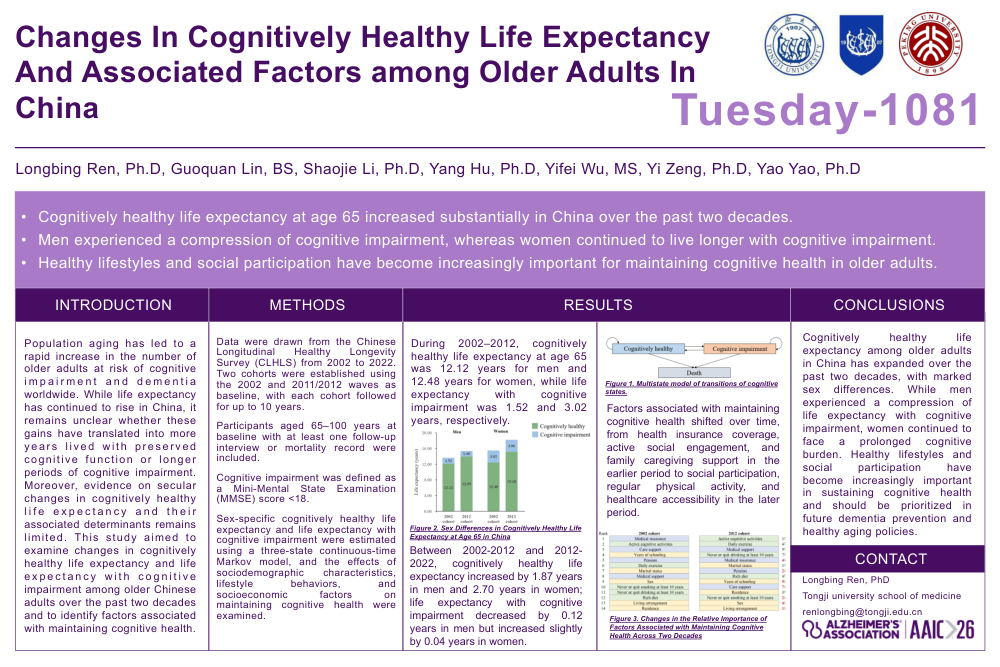
During 2002–2012, cognitively healthy life expectancy at age 65 was 12.12 years for men and 12.48 years for women, while life expectancy with cognitive impairment was 1.52 and 3.02 years, respectively. Between 2002-2012 and 2012-2022, cognitively healthy life expectancy increased by 1.87 years in men and 2.70 years in women; life expectancy with cognitive impairment decreased by 0.12 years in men but increased slightly by 0.04 years in women. Factors associated with maintaining cognitive health shifted over time, from health insurance coverage, active social engagement, and family caregiving support in the earlier period to social participation, regular physical activity, and healthcare accessibility in the later period.
CONCLUSIONS
Cognitively healthy life expectancy among older adults in China has expanded over the past two decades, with marked sex differences. While men experienced a compression of life expectancy with cognitive impairment, women continued to face a prolonged cognitive burden. Healthy lifestyles and social participation have become increasingly important in sustaining cognitive health and should be prioritized in future dementia prevention and healthy aging policies.
Comments
Email is required but is not shown publicly.
Loading comments...