4,068 posters, 219 videos, 101 topics, 69 sessions, 14,365 authors, 6,128 institutions
ePostersLive by SciGen Technologies S.A. All rights reserved.
Alzheimer's Association International Conference 2026
July 12-15, 2026 | London, United Kingdom, and Online

429
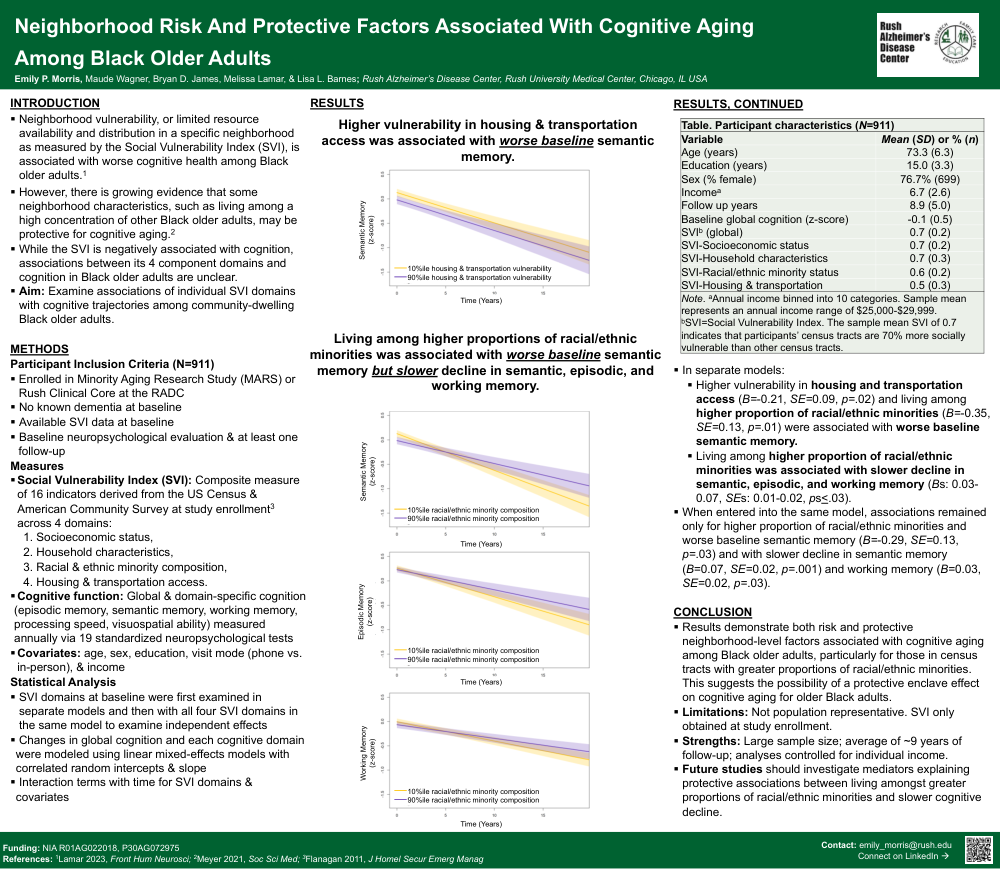
Neighborhood Risk And Protective Factors Associated With Cognitive Aging Among Black/African American Older Adults
Poster Presenter
Authors
Part of Topic
Background: Amidst growing research investigating neighborhood conditions and cognitive aging, the Social Vulnerability Index (SVI), a measure that captures social disadvantage across four domains by census tract (socioeconomic status, household characteristics, housing/transportation, racial/ethnic composition), has demonstrated associations between greater neighborhood vulnerability and worse cognitive health. While prior studies suggest that overall neighborhood vulnerability is associated with worse cognitive health and higher ADRD risk among Black older adults, less is known about which specific domains of neighborhood vulnerability contribute to worse cognitive health. Identifying the aspects of neighborhood vulnerability most relevant to cognitive health among a community-based cohort of Black older adults may point to specific prevention targets to reduce disproportionate ADRD burden in this population.
Methods: Participants (n=911; mean age=73.3 years, mean education=15.0 years, 77% female) with at least two cognitive assessments over time from the Minority Aging Research Study and Rush Clinical Core were included. Linear mixed effects models were fit with multiplicative interaction terms for each SVI domain by time (first in separate models, then with all four SVI domains by time in the same model) to examine longitudinal effects of baseline neighborhood vulnerability on cognitive trajectories. Covariates included age, sex, education, individual income, and visit mode (in-person or phone).
Results: When modeled separately, greater vulnerability in housing and transportation access (e.g., crowding, no vehicle, multifamily homes) was associated with worse initial semantic memory (B=-0.21, SE=0.09, p=.02); greater proportion of any racial/ethnic minorities was associated with worse initial semantic memory (B=-0.35, SE=0.13, p<.01) but slower annual decline in semantic, episodic, and working memory (Bs 0.03-0.07, SEs 0.01-0.02, ps<.03). When modeled simultaneously, associations remained only between greater proportion of racial/ethnic minorities and worse initial semantic memory but slower annual decline in semantic and working memory.
Conclusion: Results demonstrate both risk and protective neighborhood-level factors associated with cognitive aging among Black older adults, particularly for those in census tracts with greater proportions of racial/ethnic minorities. This suggests the possibility of a protective enclave effect on cognitive aging for older Black adults. Future studies should examine potential mechanisms, such as lower depressive symptoms or decreased discrimination, underlying this protective effect.
Comments
Email is required but is not shown publicly.
Loading comments...