4,068 posters, 219 videos, 101 topics, 69 sessions, 14,365 authors, 6,128 institutions
ePostersLive by SciGen Technologies S.A. All rights reserved.
Alzheimer's Association International Conference 2026
July 12-15, 2026 | London, United Kingdom, and Online

5585
Alzheimer’s Disease Discordance In Monozygotic Twins: An Amyloid-confirmed Case Illustrating Divergent Life-course Exposure Profiles
Poster Presenter
Part of Topic
Alzheimer’s disease discordance in monozygotic twins: An amyloid-confirmed case illustrating divergent life-course exposure profiles
Roncero, C.; Seixas-Lima, B.; Lahiri, D.; Dori, D.; Levinoff, E.; Chertkow, H.
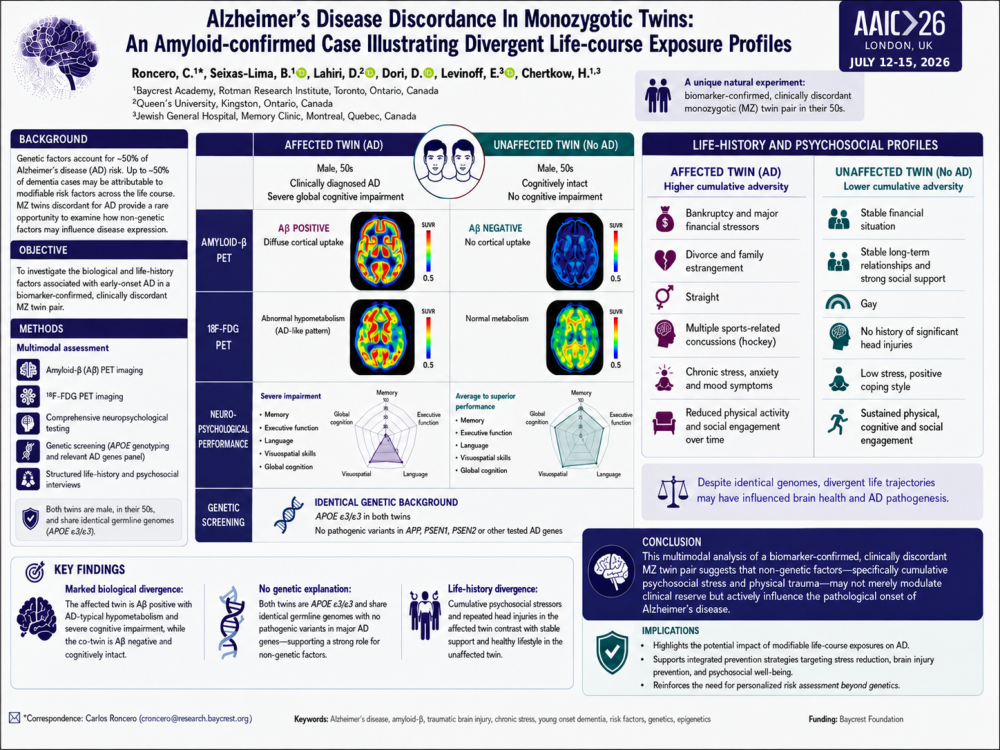
Background: Alzheimer’s disease is influenced by both genetic and non-genetic factors. Monozygotic twins discordant for Alzheimer’s disease provide a rare opportunity to examine how life-course exposures may contribute to divergent disease expression despite a shared germline genome.
Objective: This case study investigated biological, cognitive, genetic, neuroimaging, and life-history factors in a biomarker-confirmed, clinically discordant monozygotic twin pair.
Methods: Male monozygotic twins in their 50s underwent multimodal assessment, including amyloid-β PET imaging, review of FDG-PET imaging, comprehensive neuropsychological testing, APOE genotyping, screening for relevant Alzheimer’s disease genes, and structured life-history and psychosocial interviews.
Results: The affected twin was clinically diagnosed with Alzheimer’s disease and showed severe global cognitive impairment. He was amyloid-β positive, demonstrated an Alzheimer’s disease-like pattern of hypometabolism on FDG-PET, and had severe impairment across memory, executive function, language, visuospatial abilities, and global cognition. In contrast, the unaffected twin remained cognitively intact, was amyloid-β negative, and showed no clinical evidence of Alzheimer’s disease.
Genetic findings did not explain the discordance. Both twins shared an identical germline background and carried the APOE ε3/ε3 genotype. No pathogenic variants were identified in APP, PSEN1, PSEN2, or other tested Alzheimer’s disease-related genes.
The twins showed marked divergence in adult life-course exposures. The affected twin, who is straight, experienced higher cumulative adversity, including bankruptcy, major financial stressors, divorce, family estrangement, chronic stress, anxiety and mood symptoms, reduced physical and social engagement over time, and multiple sports-related concussions from hockey. The unaffected twin, who is gay, reported lower cumulative adversity, stable long-term relationships lasting many years, strong social support, no history of significant head injuries, low stress, positive coping style, and sustained physical, cognitive, and social engagement.
Conclusion: This biomarker-confirmed case of Alzheimer’s disease discordance in monozygotic twins suggests that non-genetic factors—particularly cumulative psychosocial stress and sports-related head trauma—may not merely modulate clinical reserve, but may influence the timing and pathological expression of Alzheimer’s disease. Although causality cannot be inferred from a single case, the findings support the importance of integrating biological, psychosocial, and life-course models of Alzheimer’s disease risk.
Implications: This case highlights the potential importance of modifiable life-course exposures, including stress reduction, brain injury prevention, sustained cognitive and physical engagement, and psychosocial well-being. It also reinforces the need for personalized Alzheimer’s disease risk assessment beyond genetics alone.
Comments
Email is required but is not shown publicly.
Loading comments...