4,068 posters, 219 videos, 101 topics, 69 sessions, 14,365 authors, 6,128 institutions
ePostersLive by SciGen Technologies S.A. All rights reserved.
Alzheimer's Association International Conference 2026
July 12-15, 2026 | London, United Kingdom, and Online

2691
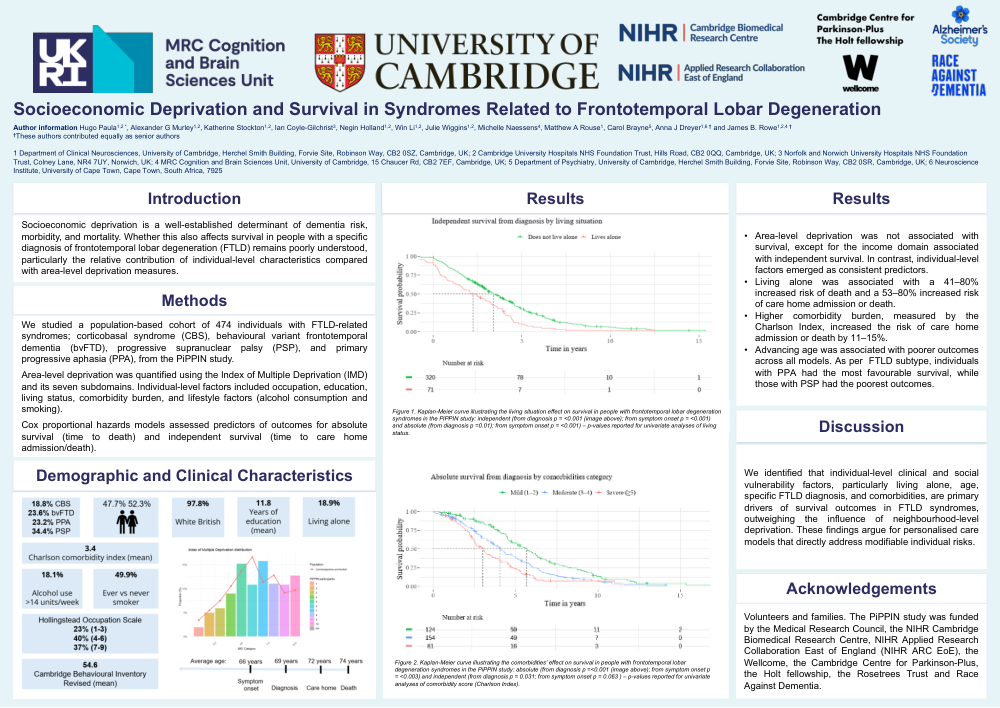
The Association Of Socioeconomic Deprivation And Survival In Syndromes Related To Frontotemporal Lobar Degeneration
Poster Presenter
Authors
Hugo Paula, Alexander G Murley, Katherine Stockton, Ian Coyle-Gilchrist, Negin Holland, Win Li, Julie Wiggins, Michelle Naessens, Matthew Rouse, Carol Brayne, Anna J Dreyer, James Rowe
Affiliations
Department of Clinical Neurosciences, University of Cambridge, Herchel Smith Building, Forvie Site, Robinson Way, CB2 0SZ, Cambridge, UK, Norfolk and Norwich University Hospitals NHS Foundation Trust, Colney Lane, NR4 7UY, Norwich, UK, MRC Cognition and Brain Sciences Unit, University of Cambridge, 15 Chaucer Rd, CB2 7EF, Cambridge, UK, Department of Psychiatry, University of Cambridge, Herchel Smith Building, Forvie Site, Robinson Way, CB2 0SR, Cambridge, UK, Neuroscience Institute, University of Cape Town, Cape Town, South Africa, 7925
Part of Topic
Socioeconomic deprivation is a well-established determinant of dementia risk, morbidity, and mortality. Whether this also affects survival in people with a specific diagnosis of frontotemporal lobar degeneration (FTLD) remains poorly understood, particularly the relative contribution of individual-level characteristics compared with area-level deprivation measures.
We identified that individual-level clinical and social vulnerability factors, particularly living alone, age, specific FTLD diagnosis, and comorbidities, are primary drivers of survival outcomes in FTLD syndromes, outweighing the influence of neighbourhood-level deprivation. These findings argue for personalised care models that directly address modifiable individual risks.
Comments
Email is required but is not shown publicly.
Loading comments...