4,068 posters, 219 videos, 101 topics, 69 sessions, 14,365 authors, 6,128 institutions
ePostersLive by SciGen Technologies S.A. All rights reserved.
Alzheimer's Association International Conference 2026
July 12-15, 2026 | London, United Kingdom, and Online

7048
Understanding The Barriers To Recruiting Patients With Cognitive Impairment For A Pragmatic Blood-based Biomarker Study.
Poster Presenter
Authors
Jordan Stengel, Ardeshir Hashmi, Hiba Khan, Holly Renner, Jacqueline Fox, Toyomi Goto, Deborah Latham, Carson Campola, Emma Wensink, Saket Saxena
Affiliations
Part of Topic
Understanding The Barriers To Recruiting Patients With Cognitive Impairment For A Pragmatic Blood-based Biomarker Study.
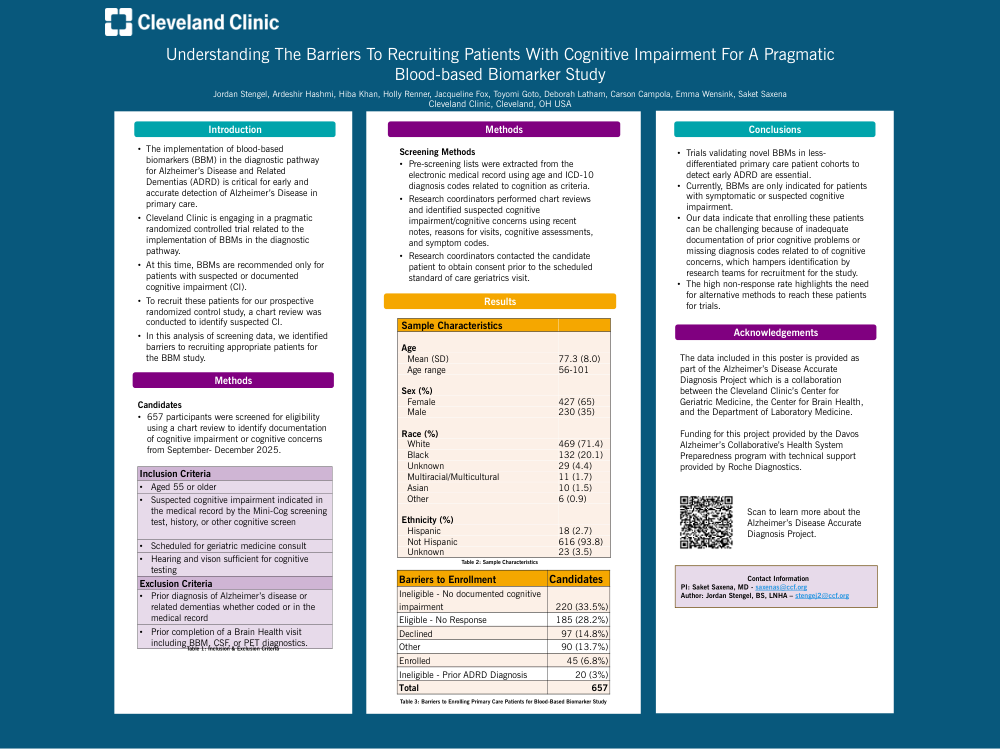
Background: The implementation of Blood-Based Biomarkers (BBM) in the diagnostic pathway for Alzheimer’s Disease and Related Dementias (ADRD) is critical for early and accurate detection of Alzheimer’s Disease in primary care. At this time, BBMs are recommended only for patients with suspected or documented cognitive impairment (CI). To recruit such patients for our prospective randomized control study, a chart review was conducted to identify suspected CI. Research Coordinators (RC) then contacted the candidate patients to obtain consent. In this study, we identify and report the barriers to recruiting appropriate patients for the pragmatic BBM study.
Methods: The inclusion criteria for this randomized controlled study included participants aged 55 years or older with documented cognitive concerns but no documented ADRD diagnosis. Pre-screening lists were extracted from the electronic medical record using age and ICD-10 codes for ADRD diagnoses as criteria. RCs performed chart reviews and identified suspected CI by using recent notes, reasons for visits, cognitive assessments, and symptom codes.
Results: 657 patients were screened over the first 75 days of the study. The most significant barriers were a lack of documentation of cognitive concerns (33.5%) and low patient engagement (28%). 15% of patients declined to participate, and 6.8% were enrolled. Table1
Conclusion: Trials validating novel BBMs in less-differentiated primary care patient cohorts to detect early ADRD are essential. Currently, BBMs are indicated for patients with symptomatic or suspected cognitive impairment. Our data indicate that enrolling these patients can be challenging because of inadequate documentation of prior cognitive problems or missing ICD-10 diagnoses of cognitive concerns, which hampers identification by research teams for recruitment for the study. The high non-response rate highlights the need for alternative methods to reach these patients for trials.
Comments
Email is required but is not shown publicly.
Loading comments...