4,068 posters, 219 videos, 101 topics, 69 sessions, 14,365 authors, 6,128 institutions
ePostersLive by SciGen Technologies S.A. All rights reserved.
Alzheimer's Association International Conference 2026
July 12-15, 2026 | London, United Kingdom, and Online

3783
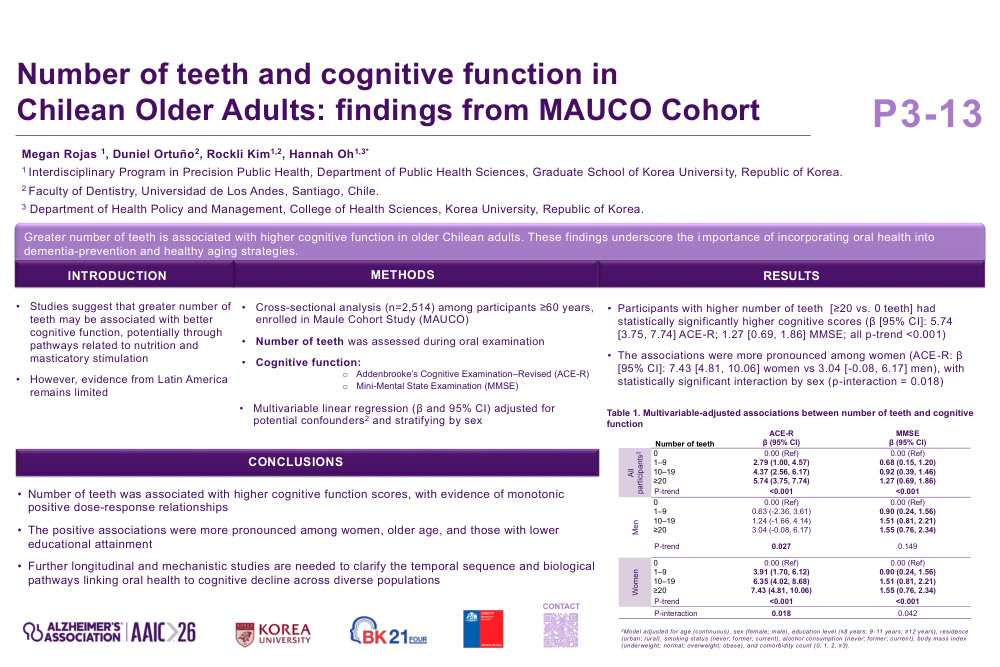
Number of teeth And Cognitive Function In Chilean Older Adults: Findings From MAUCO Cohort
Poster Presenter
Authors
Affiliations
Interdisciplinary Program in Precision Public Health, Department of Public Health Sciences, Graduate School of Korea University, Republic of Korea., Faculty of Dentistry, Universidad de Los Andes, Santiago, Chile., Department of Health Policy and Management, College of Health Sciences, Korea University, Republic of Korea., Interdisciplinary Program in Precision Public Health, Department of Public Health Sciences, Graduate School of Korea University, Republic of Korea. Department of Health Policy and Management, College of Health Sciences, Korea University, Republic of Korea.
Part of Topic
Number of teeth and cognitive function in
Chilean Older Adults: findings from MAUCO Cohort
Megan Rojas 1, Duniel Ortuño2, Rockli Kim1,2, Hannah Oh1,3*
1 Interdisciplinary Program in Precision Public Health, Department of Public Health Sciences, Graduate School of Korea University, Republic of Korea.
2 Faculty of Dentistry, Universidad de Los Andes, Santiago, Chile.
3 Department of Health Policy and Management, College of Health Sciences, Korea University, Republic of Korea.
Greater number of teeth is associated with higher cognitive function in older Chilean adults. These findings underscore the importance of incorporating oral health into dementia-prevention and healthy aging strategies.
Introduction:
Comments
Email is required but is not shown publicly.
Loading comments...