4,068 posters, 219 videos, 101 topics, 69 sessions, 14,365 authors, 6,128 institutions
ePostersLive by SciGen Technologies S.A. All rights reserved.
Alzheimer's Association International Conference 2026
July 12-15, 2026 | London, United Kingdom, and Online

4182
Clinical And Sociodemographic Factors Associated With Underlying Dementia In Treatment-resistant Late-life Depression
Poster Presenter
Authors
Beatriz Pozuelo Moyano, Vasiliki Orgeta, Armin von Gunten, Pierre Vandel, Ruimin Ma, Robert Stewart, Christoph Mueller
Affiliations
Division of Psychiatry, Faculty of Brain Sciences, University College London, London, UK, Service of Old Age Psychiatry, Department of Psychiatry, Lausanne University Hospital (CHUV) and University of Lausanne, Prilly, Switzerland, King's College London, Institute of Psychiatry, Psychology and Neuroscience, London, UK
Part of Topic
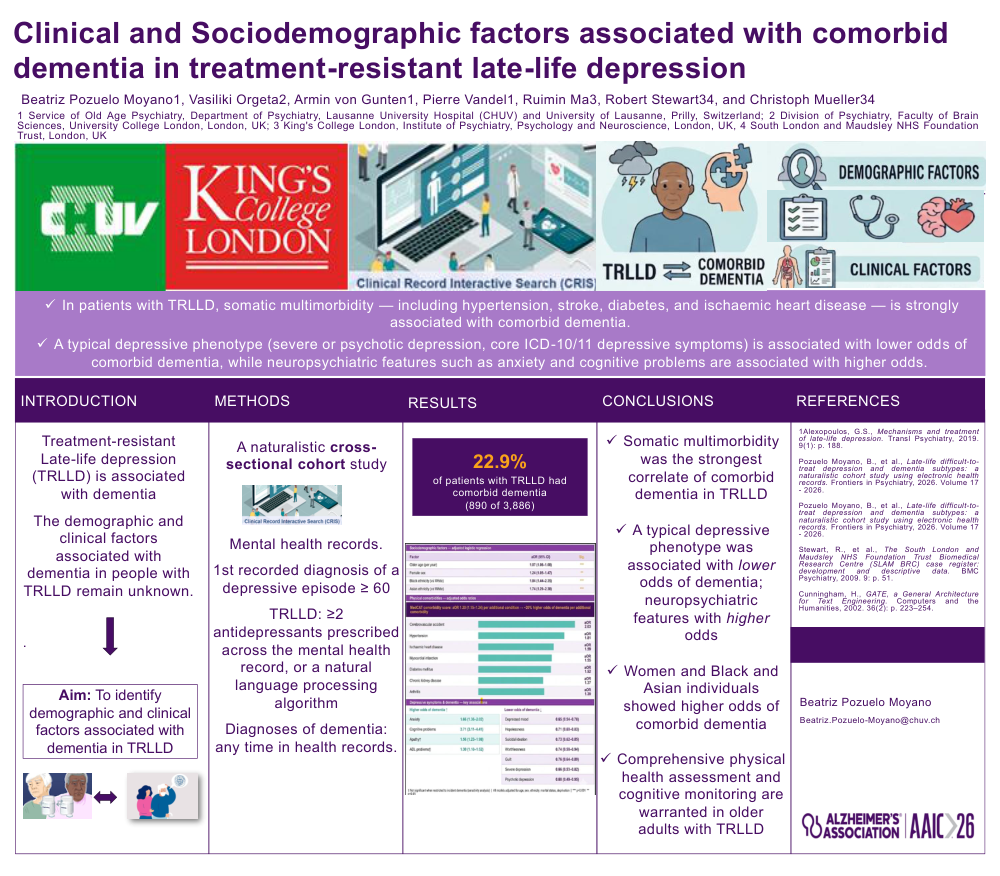
Objectives: Treatment-resistant late-life depression (TRLLD) is associated with dementia, but the specific factors associated with comorbid dementia in this population remain unknown. We aimed to identify sociodemographic and clinical factors associated with comorbid dementia in patients with TRLLD.
Design & Setting: Cross-sectional study using electronic mental health records from a large south London mental healthcare provider.
Participants: Patients aged ≥60 years with a first recorded depressive episode between 2008 and 2023, meeting criteria for TRLLD (n=3,886).
Measurements: TRLLD was defined as ≥2 antidepressants prescribed or a natural language processing (NLP) algorithm indicating treatment resistance. Dementia was ascertained using ICD-10 codes. Sociodemographic characteristics, depressive symptoms, and physical health conditions were collected around the index episode. Multivariable logistic regression was used. A sensitivity analysis restricted dementia to diagnoses recorded more than three months after the index episode.
Results: Of 3,886 patients with TRLLD, 890 (22.9%) had dementia. Older age, female sex, and Black and Asian ethnicity were associated with higher odds of dementia (aOR 1.07, 1.24, 1.84 and 1.74 respectively). Somatic multimorbidity, cardiovascular and cerebrovascular conditions were also associated with higher odds. Anxiety (aOR 1.66) and cognitive problems (aOR 3.71) showed positive associations, while severe or psychotic depression and core ICD-10/11 depressive symptoms showed negative associations. Findings were largely consistent in the sensitivity analysis; apathy and ADL problems were the main exceptions.
Conclusions: Somatic multimorbidity, cardiovascular conditions, anxiety, and cognitive problems are associated with comorbid dementia in TRLLD, highlighting the importance of comprehensive physical and neuropsychiatric assessment in this population.
Comments
Email is required but is not shown publicly.
Loading comments...