4,068 posters, 219 videos, 101 topics, 69 sessions, 14,365 authors, 6,128 institutions
ePostersLive by SciGen Technologies S.A. All rights reserved.
Alzheimer's Association International Conference 2026
July 12-15, 2026 | London, United Kingdom, and Online

6658
Association Between Oral Hormone Therapy And Dementia-related Outcomes In Postmenopausal Women: A Real-world Analysis
Part of Topic
Title: Association Between Oral Hormone Therapy And Dementia-related Outcomes In Postmenopausal Women: A Real-world Analysis
Authors: Ana Carolina Gomes¹,², Sephora Almeida, M.D.¹,²
Affiliations: ¹Hospital Alemão Oswaldo Cruz, São Paulo, Brazil. ²Centro de Cognição Paulista (CECOP), Santa Casa de Misericórdia de São Paulo, São Paulo, Brazil.
INTRODUCTION
The relationship between menopausal hormone therapy (HT) and long-term cognitive outcomes remains unresolved. Inconsistencies across observational studies reflect variability in timing, formulation, and outcome ascertainment. Underdiagnosis of dementia in real-world settings may further obscure true associations, supporting the use of complementary outcome definitions. This study evaluated the association between oral HT and incident dementia-related outcomes in postmenopausal women, applying both diagnosis-based and treatment-based outcome definitions.
METHODS
Retrospective cohort study using the TriNetX Global Collaborative Network. Women ≥45 years with natural menopause were included; those with prior dementia, major neurological disorders, cerebrovascular disease, epilepsy, intracranial injury, pregnancy, or neoplasms were excluded. Two cohorts were defined by oral estrogen and/or progestogen exposure versus no exposure, with the index event set at the first recorded menopause diagnosis. Propensity score matching balanced baseline clinical characteristics. Outcomes were assessed after a 180-day wash-in period. The primary outcome was a composite of dementia and related neurocognitive diagnoses; a sensitivity analysis incorporated cholinesterase inhibitor prescriptions as a proxy for treated cognitive impairment.
RESULTS
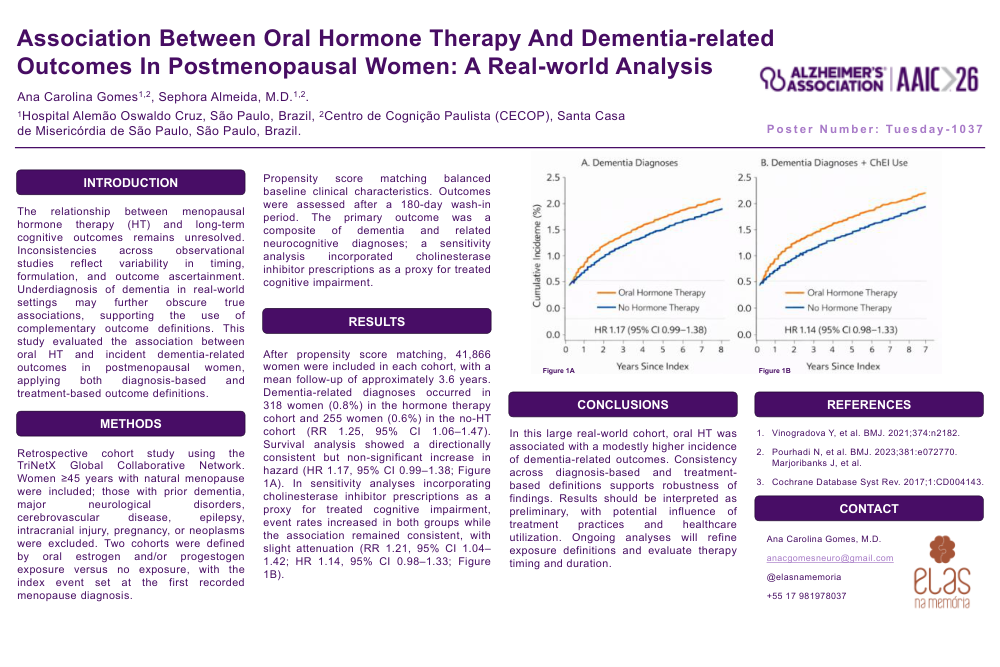
After propensity score matching, 41,866 women were included in each cohort, with a mean follow-up of approximately 3.6 years. Dementia-related diagnoses occurred in 318 women (0.8%) in the hormone therapy cohort and 255 women (0.6%) in the no-HT cohort (RR 1.25, 95% CI 1.06–1.47). Survival analysis showed a directionally consistent but non-significant increase in hazard (HR 1.17, 95% CI 0.99–1.38; Figure 1A). In sensitivity analyses incorporating cholinesterase inhibitor prescriptions as a proxy for treated cognitive impairment, event rates increased in both groups while the association remained consistent, with slight attenuation (RR 1.21, 95% CI 1.04–1.42; HR 1.14, 95% CI 0.98–1.33; Figure 1B).
CONCLUSIONS
In this large real-world cohort, oral HT was associated with a modestly higher incidence of dementia-related outcomes. Consistency across diagnosis-based and treatment-based definitions supports robustness of findings. Results should be interpreted as preliminary, with potential influence of treatment practices and healthcare utilization. Ongoing analyses will refine exposure definitions and evaluate therapy timing and duration.
REFERENCES
- Vinogradova Y, Coupland C, Hippisley-Cox J. Use of hormone replacement therapy and risk of dementia: nested case-control studies using QResearch and CPRD databases. BMJ. 2021;374:n2182.
- Pourhadi N, Mørch LS, Holm EA, Torp-Pedersen C, Meaidi A. Menopausal hormone therapy and dementia: nationwide, nested case-control study. BMJ. 2023;381:e072770.
- Marjoribanks J, Farquhar C, Roberts H, Lethaby A, Lee J. Long-term hormone therapy for perimenopausal and postmenopausal women. Cochrane Database Syst Rev. 2017;1:CD004143.
CONTACT
Ana Carolina Gomes, M.D. — anacgomesneuro@gmail.com — @elasnamemoria — +55 17 981978037
Comments
Email is required but is not shown publicly.
Loading comments...