4,068 posters, 219 videos, 101 topics, 69 sessions, 14,365 authors, 6,128 institutions
ePostersLive by SciGen Technologies S.A. All rights reserved.
Alzheimer's Association International Conference 2026
July 12-15, 2026 | London, United Kingdom, and Online

800
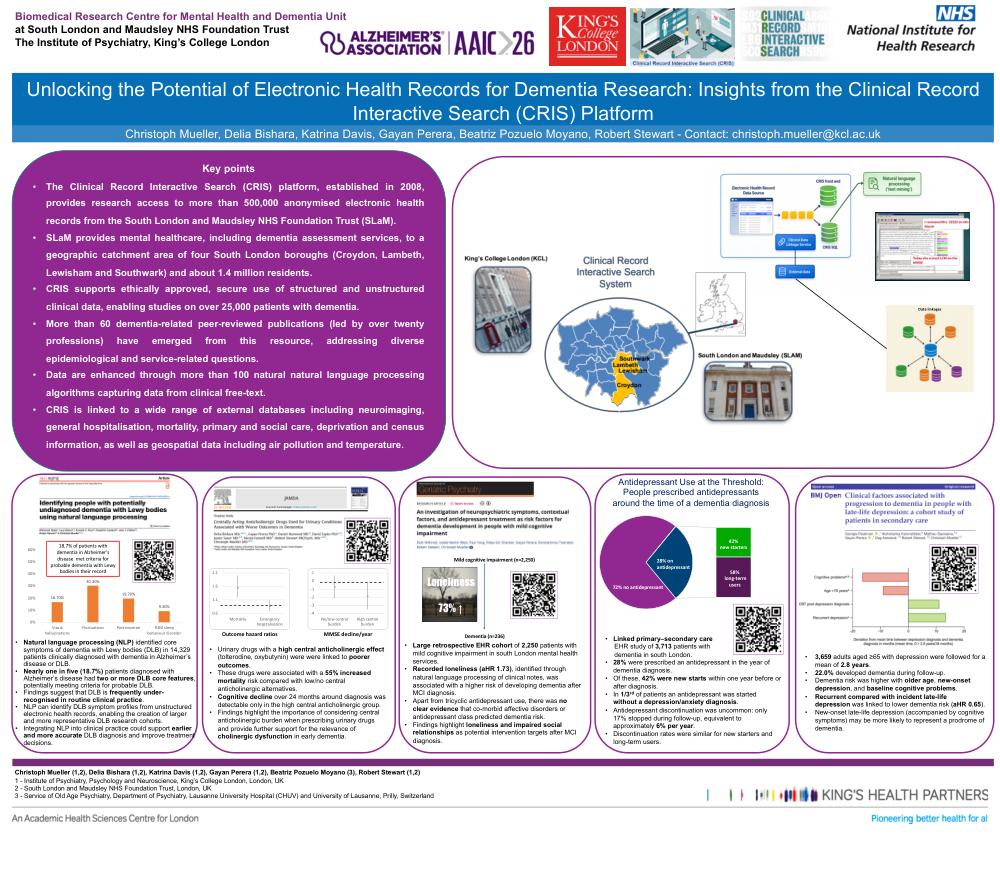
Unlocking the Potential of Electronic Health Records for Dementia Research: Insights from the Clinical Record Interactive Search (CRIS) Platform
Poster Presenter
Part of Topic
Unlocking the Potential of Electronic Health Records for Dementia Research: Insights from the Clinical Record Interactive Search (CRIS) Platform
Key points:
• The Clinical Record Interactive Search (CRIS) platform, established in 2008, provides research access to more than 500,000 anonymised electronic health records from the South London and Maudsley NHS Foundation Trust (SLaM).
• SLaM provides mental healthcare, including dementia assessment services, to a geographic catchment area of four South London boroughs (Croydon, Lambeth, Lewisham and Southwark) and about 1.4 million residents.
• CRIS supports ethically approved, secure use of structured and unstructured clinical data, enabling studies on over 25,000 patients with dementia.
• More than 60 dementia-related peer-reviewed publications (led by over twenty professions) have emerged from this resource, addressing diverse epidemiological and service-related questions.
• Data are enhanced through more than 100 natural natural language processing algorithms capturing data from clinical free-text.
• CRIS is linked to a wide range of external databases including neuroimaging, general hospitalisation, mortality, primary and social care, deprivation and census information, as well as geospatial data including air pollution and temperature.
Example CRIS studies:
1. Identifying people with potentially undiagnosed dementia with Lewy bodies using natural language processing
Methods: NLP algorithms were applied to routine electronic health record free text to identify the four core features of dementia with Lewy bodies (DLB) in 14,329 patients diagnosed with Alzheimer’s disease dementia or DLB.
Main findings: DLB core features were much more common in clinically diagnosed DLB, but 18.7% of patients diagnosed with Alzheimer’s disease dementia had two or more DLB core features, suggesting a substantial group who may warrant diagnostic review.
Short ref: Heybe et al., npj Aging, 2025.
2. Centrally acting anticholinergic drugs used for urinary conditions associated with worse outcomes in dementia
Methods: This retrospective cohort study examined 540 people with dementia prescribed bladder medications, comparing drugs with high central anticholinergic burden against drugs with low/no central burden, using linked mortality, hospitalisation and MMSE data.
Main findings: High central anticholinergic bladder drugs, particularly tolterodine and oxybutynin, were associated with a 55% increased mortality risk; cognitive decline was detectable in this group, although between-group cognitive trajectories and emergency hospitalisation did not differ significantly.
Short ref: Bishara et al., JAMDA, 2021.
3. Neuropsychiatric symptoms, contextual factors and antidepressants as risk factors for dementia in mild cognitive impairment
Methods: A naturalistic retrospective cohort of 2,250 patients with mild cognitive impairment was assembled from South London mental healthcare records, with Cox models used to examine demographic, clinical, neuropsychiatric, contextual and antidepressant-related predictors of subsequent dementia.
Main findings: Overall, 236 patients developed dementia; loneliness and impaired social relationships were independent predictors of progression, while affective disorders and most antidepressant classes were not, apart from tricyclic antidepressant use.
Short ref: Willmott et al., Int J Geriatr Psychiatry, 2024.
4. Antidepressant use at the threshold of dementia diagnosis
Methods: Linked primary care and specialist mental health electronic records were used to characterise 3,713 people with dementia in South London, distinguishing new antidepressant starts within one year before or after dementia diagnosis from longstanding prescribing.
Main findings: Twenty-eight percent were prescribed antidepressants in the year of dementia diagnosis and 42% of these were new starts; new starters were more likely to be female and have vascular dementia, while deprescribing was uncommon in both new and longstanding prescription groups.
Short ref: Heybe et al., Age and Ageing, 2026 / medRxiv, 2025.
5. Clinical factors associated with progression to dementia in late-life depression
Methods: This retrospective cohort study used SLaM CRIS data from 3,659 patients aged 65+ with late-life depression, examining demographic factors, HoNOS65+ clinical ratings, depression recurrence and treatments as predictors of incident dementia.
Main findings: In total, 806 patients developed dementia over a mean 2.7 years; older age and cognitive problems strongly predicted dementia, while recurrent/past depression and receipt of CBT were associated with lower dementia risk.
Short ref: Peakman et al., BMJ Open, 2020.
Comments
Email is required but is not shown publicly.
Loading comments...