4,068 posters, 219 videos, 101 topics, 69 sessions, 14,365 authors, 6,128 institutions
ePostersLive by SciGen Technologies S.A. All rights reserved.
Alzheimer's Association International Conference 2026
July 12-15, 2026 | London, United Kingdom, and Online

10581
Blood Pressure, Serious Life Events, And Cognitive Aging Among Older Black Americans In The Health ABC Study
Poster Presenter
Authors
Affiliations
Part of Topic
Background: High blood pressure is a well-documented risk factor for cognitive decline, yet the role of stressful life events in modifying this relationship remains underexplored, particularly among Black Americans. This study examined whether high blood pressure predicts changes in cognitive functioning over time and whether stressful life events moderate this relationship. It is critical to understand the psychosocial factors that may buffer this association, as Black Americans are disproportionately affected by both hypertension and cognitive decline.
Methods: Data were derived from 770 Black Americans (aged 68–95) in The Dynamics of Health, Aging, and Body Composition Study (Health ABC), with data collection conducted over 11-years. Cognition was assessed using the Digit Symbol Substitution Test (DSST) and measured at baseline and at follow-up years 5, 8, 10 and 11. Objective blood pressure (BP) measures of systolic and diastolic were taken. Participants were asked if they had experienced any of 7 serious life events in the past year (yes/no response). Sample items include “serious accident or illness in a close friend or family member; death of a partner/spouse; child, grandchild, close friend, or relative.” Possible number of negative life events ranged from 0 (none) to 7 (all events). This variable was categorized as 0,1, 2 and 3 or more life events. Data were analyzed using mixed effects models, controlling for covariates.
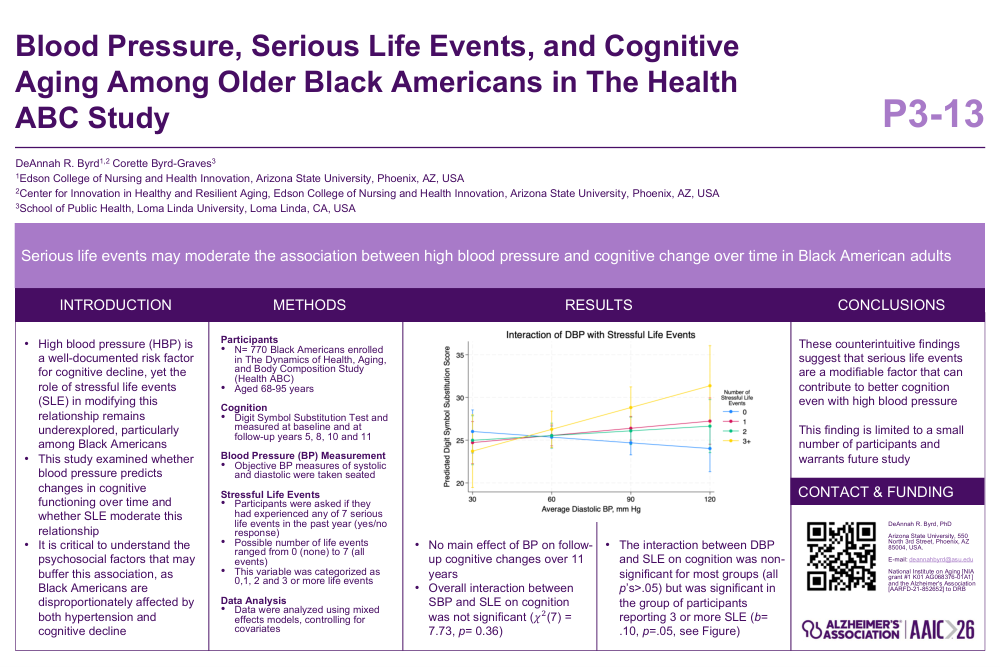
Results: Findings revealed no main effect of BP on follow-up cognitive changes. We fit a linear mixed model to account for the longitudinal structure of the data, treating participants as a random effect. Although the omnibus fixed interaction between serious life events (SLE) and diastolic BP did not reach significance (χ^2(7) = 10.10, p= 0.18), we decomposed the interaction to examine the simple slopes for each categorical level of SLE. This analysis revealed that the relationship between DBP and the outcome was non-significant for most groups (all p’s>.05) but was statistically significant in the group of participants reporting 3 or more SLE [DB1.1][DB1.2](b= .10, p=.05, see Figure 1). We ran the same model with systolic BP, and the overall interaction was not significant (χ^2(7) = 7.73, p= 0.36) nor was the group reporting 3 or more SLE.
Conclusions: These counterintuitive findings suggest that serious life events are a modifiable factor that can contribute to better cognition even with high blood pressure. This finding is limited to a small number of participants and warrants future study. Our study was limited in using a single cognitive measure. Black Americans are at higher risk for hypertension-related health disparities. Future research should continue to explore the role of serious life events in the BP-cognition relationship as these are preliminary findings that require further investigation.
Comments
Email is required but is not shown publicly.
Loading comments...