4,068 posters, 219 videos, 101 topics, 69 sessions, 14,365 authors, 6,128 institutions
ePostersLive by SciGen Technologies S.A. All rights reserved.
Alzheimer's Association International Conference 2026
July 12-15, 2026 | London, United Kingdom, and Online

10053
Informants’ And Patients’ Direct Reporting Of Subjective Cognitive Symptoms During The Detection Of Dementia In Southern Tanzania
Poster Presenter
Authors
Part of Topic
Informants’ and patients’ direct reporting of subjective Cognitive Symptoms during the Detection of Dementia in Southern Tanzania
Mbwele B*1,2, Massawe V1,2, Kisoli. A3. Mwahi, B.G1,2, Leonard L. P1,2, Mahinnyila, O 1,2, Kalaria, R4, Walker R. W5, Paddick, S-M*4
1. University of Dar es Salaam, Mbeya College of Health Sciences, Tanzania
2. Vijiji Tanzania, Block T, Mbeya, Tanzania
3 Kilimanjaro Clinical Research institute
4. Newcastle University, UK
5. Northumbria NHS FT, UK
* Developed the idea and the settings definition of the research project
Background: Dementia remains under-recognized in many low-resource settings, where routine cognitive assessment is limited and reliance on informant reports is often essential for early detection. In the Southern Highlands of Tanzania, use of the Identification and Dementia in Elderly Africans (IDEA) Screening Tool for dementia provides a practical approach to identifying cognitive impairment, but the relationship with subjective cognitive impairment and those reported by informants are not well documented. We aimed to describe patterns of subjectively reported cognitive problems and compare participant versus informant reports with the IDEA screening tool outcome.
Methods: A cross-sectional study was conducted for older adults aged 60 and over attending clinics of 2 referral hospitals from different regions of Southern Highlands of Tanzania. General cognition was assessed using the IDEA screening tool, with a score of 7/15 used to denote ‘probable dementia’. Associations between ‘probable dementia’ and key self-reported cognitive impairments of memory, decision-making, concentration, word-finding, and hearing) were examined using chi-square tests. Informant reports were also collected for comparison.
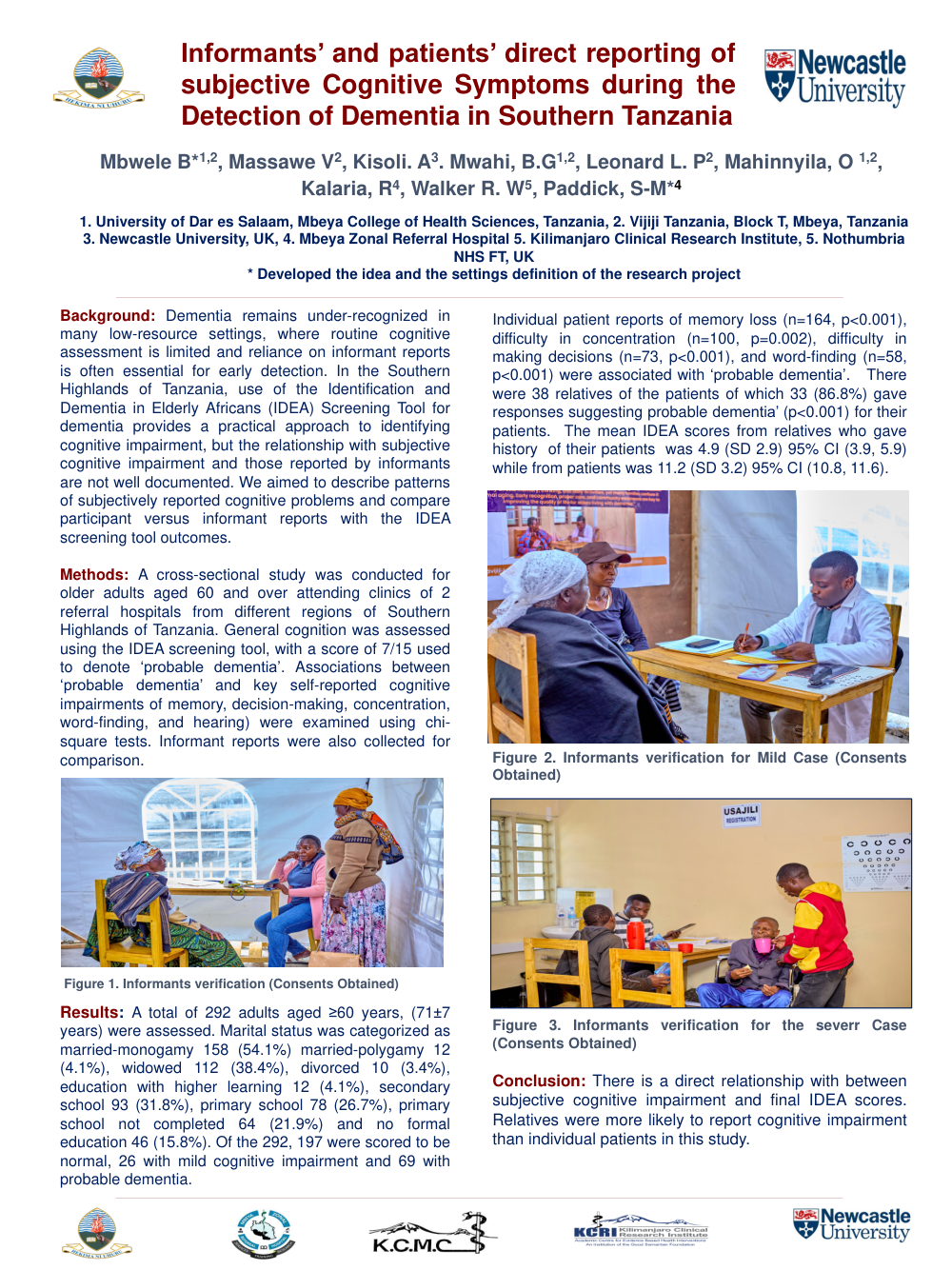
Results: A total of 292 adults aged ≥60 years, (71±7 years) were assessed. Marital status was categorized as married-monogamy 158 (54.1%) married-polygamy 12 (4.1%), widowed 112 (38.4%), divorced 10 (3.4%), education with higher learning 12 (4.1%), secondary school 93 (31.8%), primary school 78 (26.7%), primary school not completed 64 (21.9%) and no formal education 46 (15.8%). Of the 292, 197 were scored to be normal, 26 with mild cognitive impairment and 69 with probable dementia. Individual patient reports of memory loss (n=164, p<0.001), difficulty in concentration (n=100, p=0.002), difficulty in making decisions (n=73, p<0.001), and word-finding (n=58, p<0.001) were associated with ‘probable dementia’. There were 38 relatives of the patients of which 33 (86.8%) gave responses suggesting probable dementia’ (p<0.001) for their patients. The mean IDEA scores from relatives who gave history of their patients was 4.9 (SD 2.9) 95% CI (3.9, 5.9) while from patients was 11.2 (SD 3.2) 95% CI (10.8, 11.6).
Conclusion: There is a direct relationship with between subjective cognitive impairment and final IDEA scores. Relatives were more likely to report cognitive impairment than individual patients in this study.
Comments
Email is required but is not shown publicly.
Loading comments...