4,068 posters, 219 videos, 101 topics, 69 sessions, 14,365 authors, 6,128 institutions
ePostersLive by SciGen Technologies S.A. All rights reserved.
Alzheimer's Association International Conference 2026
July 12-15, 2026 | London, United Kingdom, and Online

1147
Building A Community Of Practice For Dementia Care In Ghana
Poster Presenter
Authors
Part of Topic
Abstract
Background:
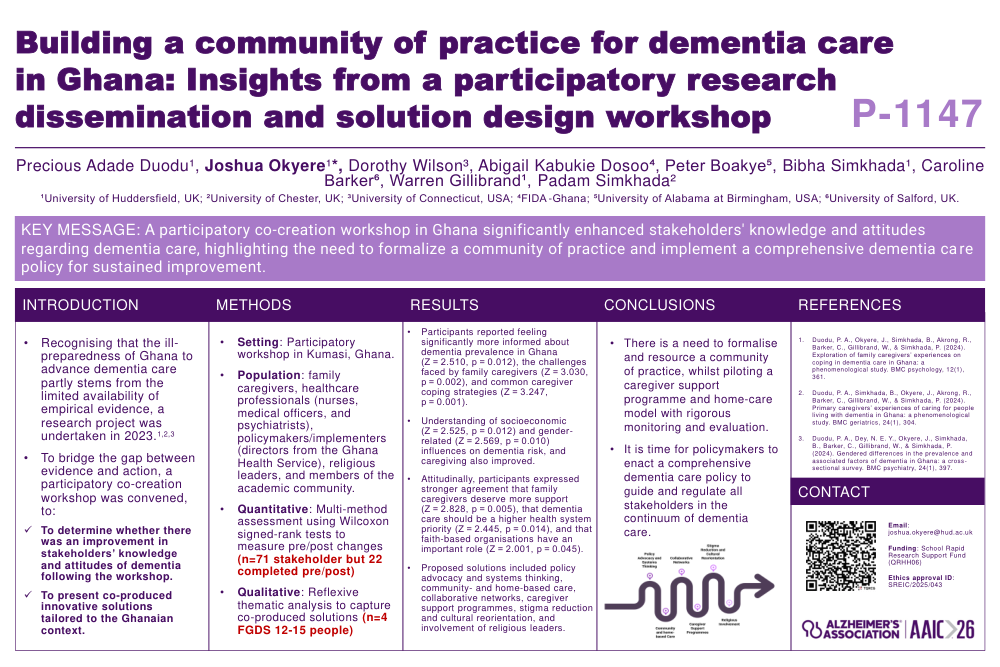
Knowledge confined within academic or clinical silos has limited utility to influence policy. To bridge the gap between evidence and action, a participatory, co-creation workshop was convened of persons living with dementia, family carers, healthcare professionals, policy actors, spiritual or faith-based leaders, and community advocates in a collective process of dialogue, reflection, and solution design.
Objectives:
The research aimed to determine whether stakeholders’ knowledge and attitudes towards dementia improved following the workshop.
Methods:
Data were drawn from a multi-method assessment from a participatory research dissemination and co-creation workshop held in Kumasi, Ghana. A non-parametric Wilcoxon signed-rank test was selected as the primary analytical tool for the pre–post-test. A reflexive thematic analysis was implemented for the qualitative data.
Results:
Following the workshop, participants reported feeling significantly more informed about dementia prevalence in Ghana (Z = 2.510, p = 0.012), the challenges faced by family caregivers (Z = 3.030, p = 0.002), and common caregiver coping strategies (Z = 3.247, p = 0.001). Understanding of socioeconomic (Z = 2.525, p = 0.012) and gender-related (Z = 2.569, p = 0.010) influences on dementia risk, and caregiving also improved. Attitudinally, participants expressed stronger agreement that family caregivers deserve more support (Z = 2.828, p = 0.005), that dementia care should be a higher health system priority (Z = 2.445, p = 0.014), and that faith-based organisations have an important role (Z = 2.001, p = 0.045). Proposed solutions included policy advocacy and systems thinking, community- and home-based care, collaborative networks, caregiver support programmes, stigma reduction and cultural reorientation, and involvement of religious leaders.
Conclusion:
There is a need to formalise and resource a community of practice, thus ensuring sustained collaboration, structured knowledge exchange, collective action across sectors, whilst piloting a caregiver support programme and home-care model with rigorous monitoring and evaluation. It is time for policymakers to enact a comprehensive dementia care policy to guide and regulate all stakeholders in the continuum of dementia care.
Comments
Email is required but is not shown publicly.
Loading comments...