4,068 posters, 219 videos, 101 topics, 69 sessions, 14,365 authors, 6,128 institutions
ePostersLive by SciGen Technologies S.A. All rights reserved.
Alzheimer's Association International Conference 2026
July 12-15, 2026 | London, United Kingdom, and Online

2149
Healthcare Provider Perceptions Of The New Primary Care-based Memory Clinics Across Three Canadian Provinces
Poster Presenter
Authors
Linda Lee, Loretta Hillier, Michael Lee, Tejal Patel, Carrie McAiney
Affiliations
MINT Memory Clinic, Kitchener, ON; McMaster University, Hamilton, ON; Schlegel-UW Research Institute for Aging, GERAS Centre for Aging Research, Hamilton, ON, MINT Memory Clinic, Kitchener, ON, University of Waterloo, Waterloo, ON; Schlegel-UW Research Institute for Aging
Part of Topic
Healthcare provider perceptions of the new primary care-based memory clinics across three Canadian provinces
Linda Lee MD, CCFP (COE), FCFP,1,2,3 Loretta M. Hillier MA,4 Michael Lee MPI,1 Tejal Patel PharmD,1,3,5 and Carrie McAiney.3,5
1MINT Memory Clinic, Kitchener, ON; 2Master University, Hamilton, ON; 3Schlegel-UW Research Institute for Aging; 4GERAS Centre for Aging Research, Hamilton, ON; 5University of Waterloo, Waterloo, ON;
Background
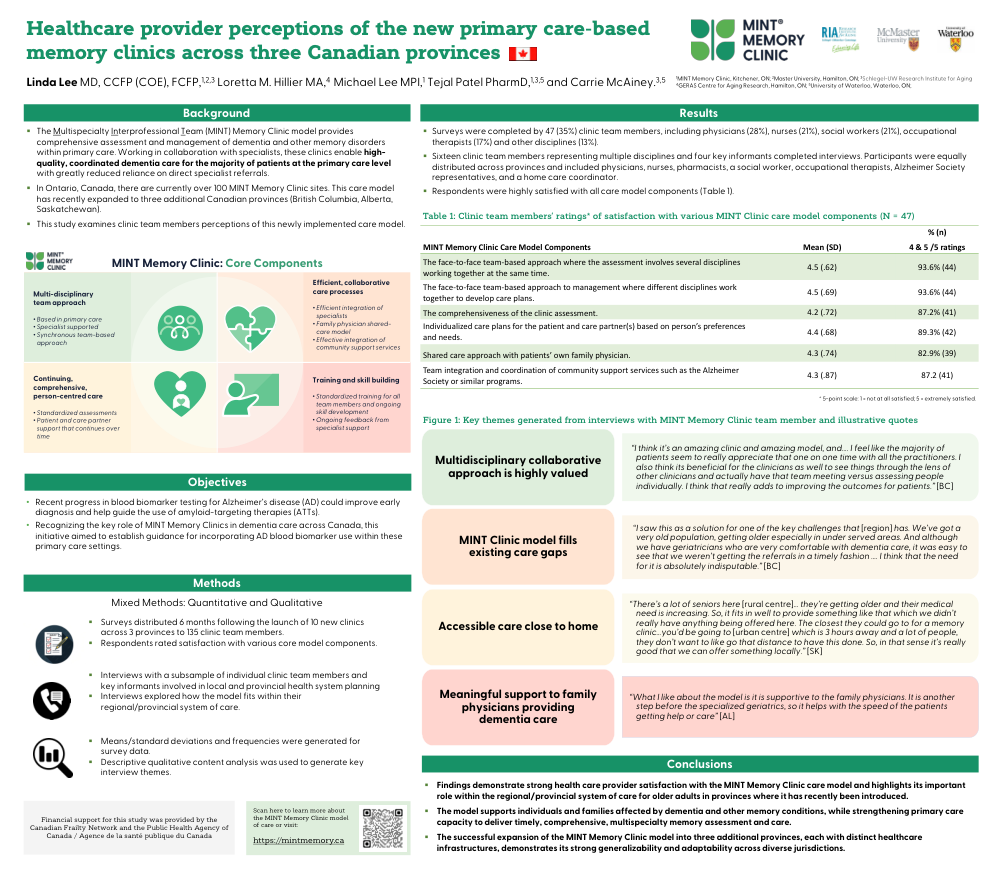
The Multispecialty Interprofessional Team (MINT) Memory Clinic model provides comprehensive assessment and management of dementia and other memory disorders within primary care. Working in collaboration with specialists, these clinics enable high-quality, coordinated dementia care for the majority of patients at the primary care level with greatly reduced reliance on direct specialist referrals.
In Ontario, Canada, there are currently over 100 MINT Memory Clinic sites. This care model has recently expanded to three additional Canadian provinces (British Columbia, Alberta, Saskatchewan).
This study examines clinic team members perceptions of this newly implemented care model.
Objectives
Recent progress in blood biomarker testing for Alzheimer’s disease (AD) could improve early diagnosis and help guide the use of amyloid-targeting therapies (ATTs).
Recognizing the key role of MINT Memory Clinics in dementia care across Canada, this initiative aimed to establish guidance for incorporating AD blood biomarker use within these primary care settings.
Methods
Mixed Methods: Quantitative and Qualitative
Surveys distributed 6 months following the launch of 10 new clinics across 3 provinces to 135 clinic team members.
Respondents rated satisfaction with various core model components.
Interviews with a subsample of individual clinic team members and key informants involved in local and provincial health system planning
Interviews explored how the model fits within their regional/provincial system of care.
Means/standard deviations and frequencies were generated for survey data.
Descriptive qualitative content analysis was used to generate key interview themes.
Results
Surveys were completed by 47 (35%) clinic team members, including physicians (28%), nurses (21%), social workers (21%), occupational therapists (17%) and other disciplines (13%).
Sixteen clinic team members representing multiple disciplines and four key informants completed interviews. Participants were equally distributed across provinces and included physicians, nurses, pharmacists, a social worker, occupational therapists, Alzheimer Society representatives, and a home care coordinator.
Respondents were highly satisfied with all care model components (Table 1).
Table 1: Clinic team members’ ratings* of satisfaction with various MINT Clinic care model components (N = 47)
Figure 1: Key themes generated from interviews with MINT Memory Clinic team member and illustrative quotes
Multidisciplinary collaborative approach is highly valued
“I think it’s an amazing clinic and amazing model, and…. I feel like the majority of patients seem to really appreciate that one on one time with all the practitioners. I also think its beneficial for the clinicians as well to see things through the lens of other clinicians and actually have that team meeting versus assessing people individually. I think that really adds to improving the outcomes for patients.” [BC]
MINT Clinic model fills existing care gaps
“I saw this as a solution for one of the key challenges that [region] has. We’ve got a very old population, getting older especially in under served areas. And although we have geriatricians who are very comfortable with dementia care, it was easy to see that we weren’t getting the referrals in a timely fashion …. I think that the need for it is absolutely indisputable.” [BC]
Accessible care close to home
“There’s a lot of seniors here [rural centre]… they’re getting older and their medical need is increasing. So, it fits in well to provide something like that which we didn’t really have anything being offered here. The closest they could go to for a memory clinic…you’d be going to [urban centre] which is 3 hours away and a lot of people, they don’t want to like go that distance to have this done. So, in that sense it’s really good that we can offer something locally.” [SK]
Meaningful support to family physicians providing dementia care
“What I like about the model is it is supportive to the family physicians. It is another step before the specialized geriatrics, so it helps with the speed of the patients getting help or care” [AL]
Conclusions
Findings demonstrate strong health care provider satisfaction with the MINT Memory Clinic care model and highlights its important role within the regional/provincial system of care for older adults in provinces where it has recently been introduced.
The model supports individuals and families affected by dementia and other memory conditions, while strengthening primary care capacity to deliver timely, comprehensive, multispecialty memory assessment and care.
The successful expansion of the MINT Memory Clinic model into three additional provinces, each with distinct healthcare infrastructures, demonstrates its strong generalizability and adaptability across diverse jurisdictions.
Financial support for this study was provided by the Canadian Frailty Network and the Public Health Agency of Canada / Agence de la santé publique du Canada
Scan here to learn more about the MINT Memory Clinic model of care or visit: https://mintmemory.ca
Comments
Email is required but is not shown publicly.
Loading comments...