4,068 posters, 219 videos, 101 topics, 69 sessions, 14,365 authors, 6,128 institutions
ePostersLive by SciGen Technologies S.A. All rights reserved.
Alzheimer's Association International Conference 2026
July 12-15, 2026 | London, United Kingdom, and Online

1157
Supporting people at Genetic Risk of Familial Frontotemporal Dementia and Familial Alzheimers Disease – The IWARF intervention and RCT.
Poster Presenter
Part of Topic
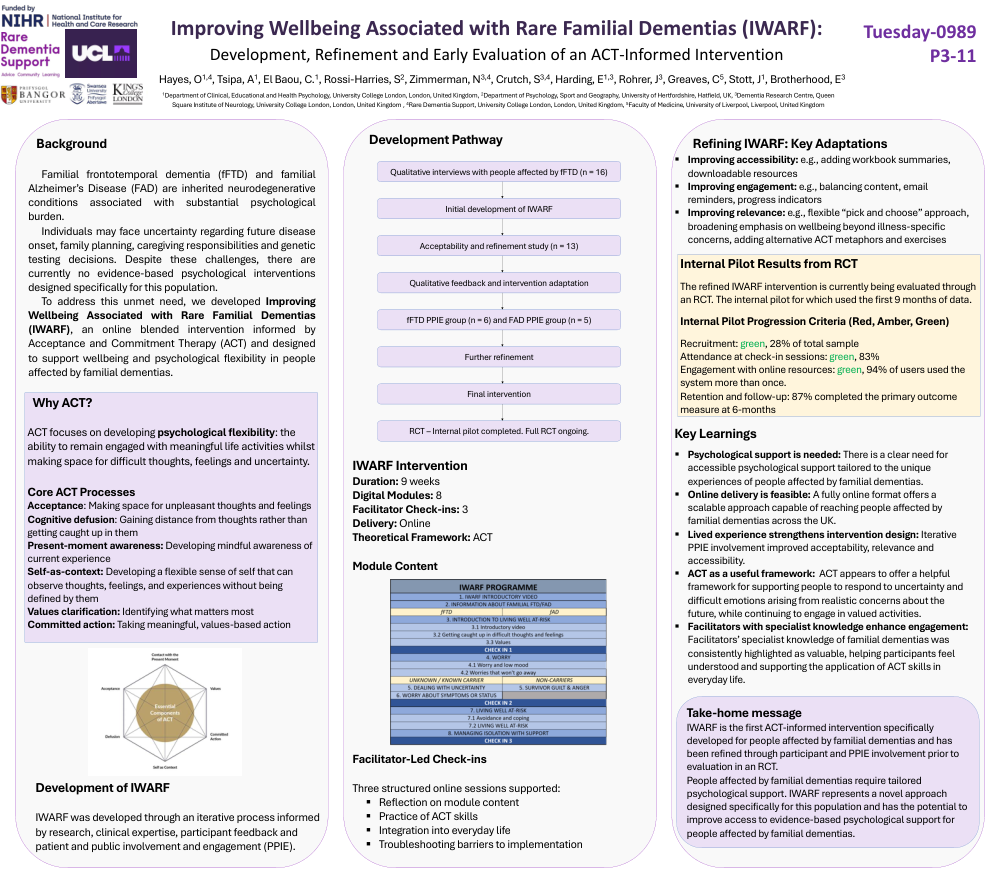
Improving Wellbeing Associated with Rare Familial Dementias (IWARF): Development, Refinement and Early Evaluation of an ACT‑Informed Intervention
Background
Familial frontotemporal dementia (fFTD) and familial Alzheimer’s Disease (FAD) are inherited neurodegenerative conditions associated with substantial psychological burden.
Individuals may face uncertainty regarding future disease onset, family planning, caregiving responsibilities and genetic testing decisions. Despite these challenges, there are currently no evidence-based psychological interventions designed specifically for this population.
To address this unmet need, we developed Improving Wellbeing Associated with Rare Familial Dementias (IWARF), an online blended intervention informed by Acceptance and Commitment Therapy (ACT) and designed to support wellbeing and psychological flexibility in people affected by familial dementias.
Why ACT?
ACT focuses on developing psychological flexibility: the ability to remain engaged with meaningful life activities whilst making space for difficult thoughts, feelings and uncertainty.
Core ACT Processes
Acceptance: Making space for unpleasant thoughts and feelings
Cognitive defusion: Gaining distance from thoughts rather than getting caught up in them
Present-moment awareness: Developing mindful awareness of current experience
Self-as-context: Developing a flexible sense of self that can observe thoughts, feelings, and experiences without being defined by them
Values clarification: Identifying what matters most
Committed action: Taking meaningful, values-based action
Development of IWARF
IWARF was developed through an iterative process informed by research, clinical expertise, participant feedback and patient and public involvement and engagement (PPIE).
Qualitative interviews with people affected by fFTD (n = 16) --> Initial development of IWARF --> Acceptability and refinement study (n = 13) --> Qualitative feedback and intervention adaptation --> fFTD PPIE group (n = 6) and FAD PPIE group (n = 5) --> Further refinement --> Final intervention --> RCT – Internal pilot completed. Full RCT ongoing.
IWARF Intervention
Duration: 9 weeks
Digital Modules: 8
Facilitator Check-ins: 3
Delivery: Online
Theoretical Framework: ACT
Module Content
Informational videos on fFTD/fAD
Worry and low mood
Values
Getting caught up in difficult thoughts and feelings
Avoidance and coping
Worries that won’t go away
Uncertainty
Worry about symptoms or status
Survivor guilt and anger
Living well at-risk
Managing isolation with support
Facilitator-Led Check-ins
Three structured online sessions supported:
Internal Pilot Results from RCT
The refined IWARF intervention is currently being evaluated through an RCT. The internal pilot for which used the first 9 months of data.
Internal Pilot Progression Criteria (Red, Amber, Green)
Recruitment: green, 28% of total sample
Attendance at check-in sessions: green, 83%
Engagement with online resources: green, 94% of users used the system more than once.
Retention and follow-up: 87% completed the primary outcome measure at 6-months
Comments
Email is required but is not shown publicly.
Loading comments...