4,068 posters, 219 videos, 101 topics, 69 sessions, 14,365 authors, 6,128 institutions
ePostersLive by SciGen Technologies S.A. All rights reserved.
Alzheimer's Association International Conference 2026
July 12-15, 2026 | London, United Kingdom, and Online

3025
Feasibility And Acceptability Of A Nutritional Care Intervention For People Living With Dementia Receiving Home Care: TOMATO Study
Poster Presenter
Authors
Part of Topic
Abstract:
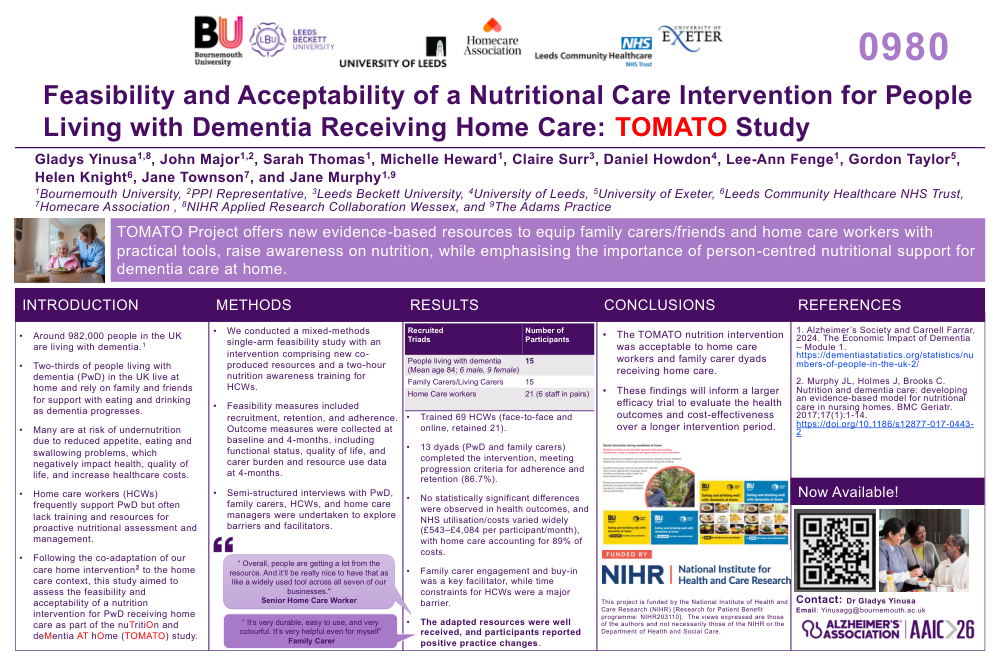
Background: Two-thirds of people living with dementia (PwD) in the UK live at home and rely on family and friends for support with eating and drinking as dementia progresses. Many are at risk of undernutrition due to reduced appetite, eating and swallowing problems, which negatively impact health, quality of life, and increase healthcare costs. Home care workers (HCWs) frequently support PwD but often lack training and resources for proactive nutritional assessment and management. Following the co-adaptation of our care home intervention (http://www.bournemouth.ac.uk/nutrition-dementia) to the home care context, this study aimed to assess the feasibility and acceptability of a nutrition intervention for PwD receiving home care as part of the nuTritiOn and deMentia AT hOme (TOMATO) study (funded by the National Institute of Health and Care Research NIHR203110).
Methods: We conducted a mixed-methods single-arm feasibility study with an intervention comprising new co-produced resources and a two-hour nutrition awareness training for HCWs. Feasibility measures included recruitment, retention, and adherence. Outcome measures were collected at baseline and 4-months, including functional status, quality of life, and carer burden and resource use data at 4-months. Semi-structured interviews with PwD, family carers, HCWs, and home care managers was used to explore barriers and facilitators. Data were analysed using framework analysis guided by Normalisation Process Theory.
Results: We trained 69 HCWs (face-to-face and online) and recruited 51 participants (PwD: n=15; carers: n=15; HCWs: n=21) from diverse ethnic backgrounds. Thirteen dyads completed the intervention, meeting progression criteria for adherence and retention (86.7%). No statistically significant differences were observed in health outcomes, and NHS utilisation/costs varied widely (£543-£4,084 per participant/month), with home care accounting for 89% of costs. Family carer engagement and buy-in was a key facilitator, while time constraints for HCWs were a major barrier. The adapted resources [https://gck.fm/qopgx] were well received, and participants reported positive practice changes.
Conclusion: This study demonstrates the feasibility and acceptability of the TOMATO intervention for PwD receiving home care. These findings will inform a larger efficacy trial to evaluate the health outcomes and cost-effectiveness over a longer intervention period.
Comments
Email is required but is not shown publicly.
Loading comments...