4,068 posters, 219 videos, 101 topics, 69 sessions, 14,365 authors, 6,128 institutions
ePostersLive by SciGen Technologies S.A. All rights reserved.
Alzheimer's Association International Conference 2026
July 12-15, 2026 | London, United Kingdom, and Online

348
Burden And Support Needs Of Informal Caregivers Of People Living With Alzheimer’s Disease In Three Countries
Part of Topic
BACKGROUND
Care partners are crucial in providing informal care
to people with Alzheimer’s disease1. The literature
demonstrates that challenges associated with caring for a
person with Alzheimer’s or other dementias, such as stress,
burden and loneliness, can have a detrimental impact on
mental and physical health and wellbeing across the care
partnership dyad1–4. The literature indicates cultural and
structural variation in caregiving5, yet there are few multicountry
studies exploring the experiences of care partners
across different cultural norms and support systems.
OBJECTIVE
In partnership with Alzheimer’s Disease International (ADI)
and Roche, this study explored (1) wellbeing and burden,
(2) satisfaction with support, and (3) support needs, among
care partners from three different continents (Europe, North
America, and South America).
METHODS
An online survey, administered to participants from the
US, UK and Brazil, investigated care partners’ anxiety
and depression, using the Patient Health Questionnaire6,
loneliness, using the UCLA Loneliness Scale7, burden,
using the Caregiver Burden Inventory time-dependence
subscale8, and satisfaction with and need for pre-defined
categories of support. Data were collected between April
2022 and March 2023. Recruitment was through existing
carer networks and social channels, led by ADI member
organisations in each country, and research portals in the UK
and US. Descriptive statistics were calculated using SPSS,
and multivariate analyses examined factors predicting care
partner wellbeing, burden, satisfaction with and need for
each support domain.
RESULTS
SAMPLE CHARACTERISTICS
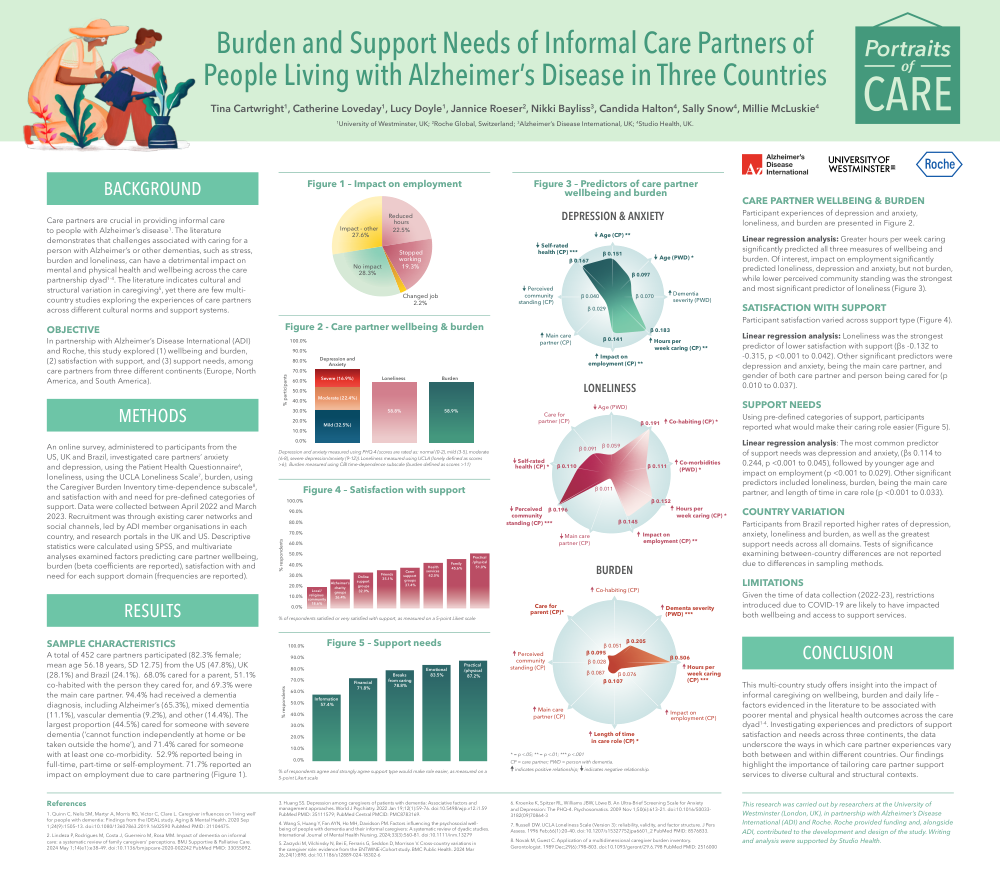
A total of 452 care partners participated (82.3% female;
mean age 56.18 years, SD 12.75) from the US (47.8%), UK
(28.1%) and Brazil (24.1%). 68.0% cared for a parent, 51.1%
co-habited with the person they cared for, and 69.3% were
the main care partner. 94.4% had received a dementia
diagnosis, including Alzheimer’s (65.3%), mixed dementia
(11.1%), vascular dementia (9.2%), and other (14.4%). The
largest proportion (44.5%) cared for someone with severe
dementia (‘cannot function independently at home or be
taken outside the home’), and 71.4% cared for someone
with at least one co-morbidity. 52.9% reported being in
full-time, part-time or self-employment. 71.7% reported an
impact on employment due to care partnering (Figures 1-2).
CARE PARTNER WELLBEING & BURDEN
Participants reported experiencing depression and anxiety
(mild 32.5%, moderate 22.4%, severe 16.9%), loneliness
(58.8%) and burden (58.9%).
Linear regression analysis: Greater hours per week caring
significantly predicted all three measures of wellbeing and
burden. Of interest, impact on employment significantly
predicted loneliness, depression and anxiety, but not burden,
while lower perceived community standing was the strongest
and most significant predictor of loneliness (Figure 3).
SATISFACTION WITH SUPPORT
Participant satisfaction varied across support type (Figure 4).
Linear regression analysis: Loneliness was the strongest
predictor of lower satisfaction with support (βs -0.132 to
-0.315, p <0.001 to 0.042). Other significant predictors were
depression and anxiety, being the main care partner, and
gender of both care partner and person being cared for (p
0.010 to 0.037).
SUPPORT NEEDS
Using pre-defined categories of support, participants
reported what would make their caring role easier (Figure 5).
Linear regression analysis: The most common predictor
of support needs was depression and anxiety, (βs 0.114 to
0.244, p <0.001 to 0.045), followed by younger age and
impact on employment (p <0.001 to 0.029). Other significant
predictors included loneliness, burden, being the main care
partner, and length of time in care role (p <0.001 to 0.033).
COUNTRY VARIATION
Participants from Brazil reported higher rates of depression,
anxiety, loneliness and burden, as well as the greatest
support needs across all domains. Tests of significance
examining between-country differences are not reported
due to differences in sampling methods.
LIMITATIONS
Given the time of data collection (2022-23), restrictions
introduced due to COVID-19 are likely to have impacted
both wellbeing and access to support services.
CONCLUSIONS
This multi-country study offers insight into the impact of
informal caregiving on wellbeing, burden and daily life –
factors evidenced in the literature to be associated with
poorer mental and physical health outcomes across the care
dyad1-4. Investigating experiences and predictors of support
satisfaction and needs across three continents, the data
underscore the ways in which care partner experiences vary
both between and within different countries. Our findings
highlight the importance of tailoring care partner support
services to diverse cultural and structural contexts.
This research was carried out by researchers at the University of
Westminster (London, UK), in partnership with Alzheimer’s Disease
International (ADI) and Roche. Roche provided funding and, alongside
ADI, contributed to the development and design of the study. Writing
and analysis were supported by Studio Health.
Comments
Email is required but is not shown publicly.
Loading comments...