4,068 posters, 219 videos, 101 topics, 69 sessions, 14,365 authors, 6,128 institutions
ePostersLive by SciGen Technologies S.A. All rights reserved.
Alzheimer's Association International Conference 2026
July 12-15, 2026 | London, United Kingdom, and Online

6042
Examining The Joint Effects Of Positive Spousal Social Support And Closeness On Dementia Risk Using Causal Survival Analysis
Poster Presenter
Authors
Part of Topic
BACKGROUND
• Little is known about how the quality of spousal relationships shape dementia risk.
OBJECTIVE
• We evaluated the independent and joint associations of two measures of spousal relationship quality with dementia risk and considered heterogeneity by sex/gender
METHODS
• Weuseddataonmarried/partneredU.S. Health and Retirement Survey (HRS, 2006- 2020) respondents aged 50+ years without prevalent dementia or mild cognitive impairment (MCI) or dementia at analytic baseline.
-
Spousalcloseness:“Howcloseisyour relationship with your partner or spouse?”
-
Spousalsupport:“Howmuchdothey really understand the way you feel about
things?”, “How much can you rely on them if you have a serious problem”, and “How much can you open up to them if you need to talk about your worries,”
-
Weevaluatedassociationswithincident MCI/dementia using pooled logistic regression and evaluated differences by sex/gender.
• Weusedg-computationmethodsto predict survival probabilities at each person-time observation under four counterfactual scenarios:
-
Thepotentialconfounderswereall measured at baseline: sex, age, race and ethnicity, depression, education, chronic disease number, ongoing chronic stress, personality traits.
• Wealsoincludedhighphysicalactivity, financial strain, and income-poverty ratio to increase the precision of our estimates.
RESULTS
-
40% (34% women,48% men) reported very supported from their spouse.
-
60% (55% women, 65% men) reported very close to their spouse.
-
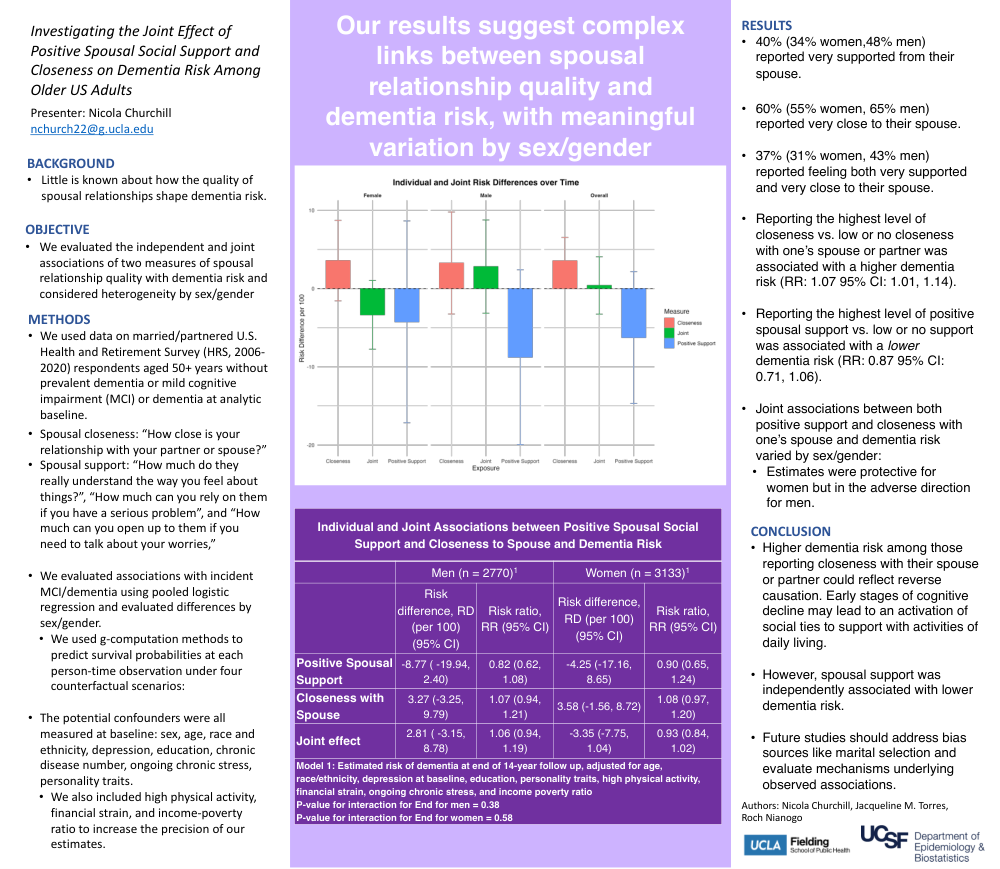
37% (31% women, 43% men) reported feeling both very supported and very close to their spouse.
-
Reporting the highest level of closeness vs. low or no closeness with one’s spouse or partner was associated with a higher dementia risk (RR: 1.07 95% CI: 1.01, 1.14).
-
Reporting the highest level of positive spousal support vs. low or no support was associated with a lower dementia risk (RR: 0.87 95% CI: 0.71, 1.06).
-
Joint associations between both positive support and closeness with one’s spouse and dementia risk varied by sex/gender:
• Estimates were protective for women but in the adverse direction for men.
CONCLUSION
-
Higher dementia risk among those reporting closeness with their spouse or partner could reflect reverse causation. Early stages of cognitive decline may lead to an activation of social ties to support with activities of daily living.
-
However, spousal support was independently associated with lower dementia risk.
-
Future studies should address bias sources like marital selection and evaluate mechanisms underlying observed associations.
-
Comments
Email is required but is not shown publicly.
Loading comments...