4,068 posters, 219 videos, 101 topics, 69 sessions, 14,365 authors, 6,128 institutions
ePostersLive by SciGen Technologies S.A. All rights reserved.
Alzheimer's Association International Conference 2026
July 12-15, 2026 | London, United Kingdom, and Online

2204
Rehabilitation Outcomes Linking Family Ties To Subjective Well Being
Part of Topic
Rehabilitation Outcomes Linking Family Ties To Subjective Well Being:
Author Block:JOOMAN YUN, Chaeyoung Lee, Ickpyo Hong.
Department of Occupational Therapy, Graduate School, Yonsei university, Wonju-si, Korea, Republic of.
Abstract:
Background: Family ties are widely recognized as important social determinants of well-being in later life. This study aimed to examine the mechanisms through which family ties are associated with subjective well-being among older adults who have received rehabilitation services, focusing on whether rehabilitation-related functional outcomes mediate this association.
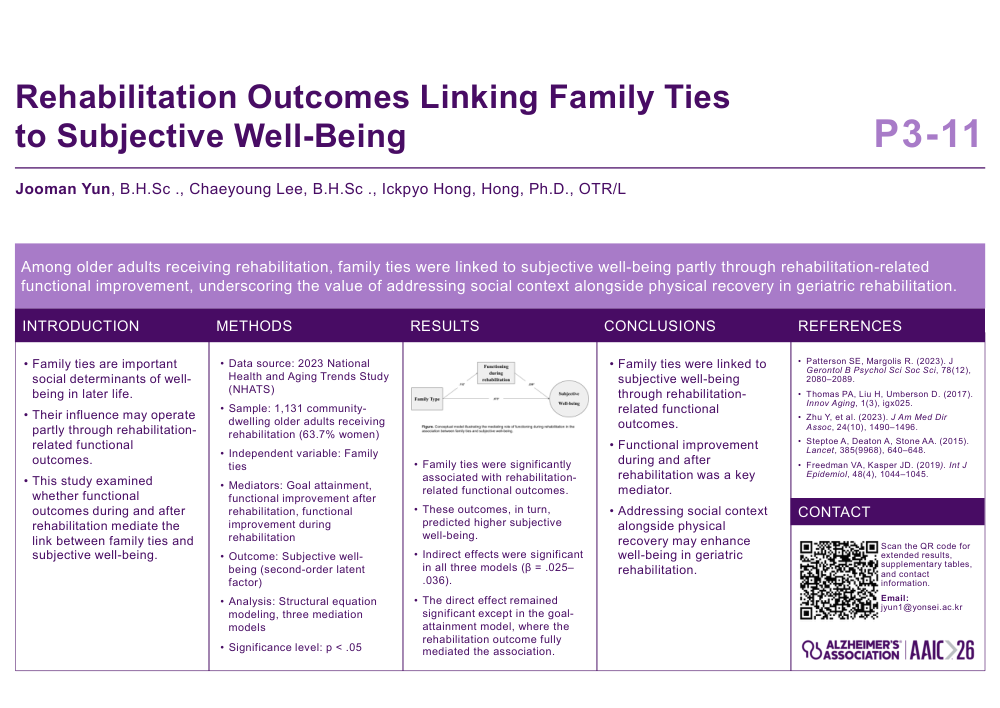
Methods: We conducted a cross-sectional analysis using data from the 2023 National Health and Aging Trends Study (NHATS). We identified an analytic sample of 1,131 community-dwelling older adults who reported receiving rehabilitation services. We employed structural equation modeling to test three separate mediation models, each including one rehabilitation-related functional outcome as a mediator.
Results: The analytic sample consisted of 1,131 community-dwelling older adults, with the largest proportion aged 75-79 years, and 63.7% were women. Hierarchical confirmatory factor analysis indicated a second-order factor structure of subjective well-being. Across all three mediation models, family ties were significantly associated with rehabilitation-related functional outcomes, which were, in turn, significantly associated with the subjective well-being. The indirect effects were statistically significant for goal attainment after rehabilitation (β = 0.036, 95% CI [0.01, 0.06]), functional improvement after rehabilitation (β = 0.025, 95% CI [0.00, 0.05]), and functional improvement during rehabilitation (β = 0.026, 95% CI [0.01, 0.05]). The direct effects of family ties on subjective well-being were significant in all models, except for the model in which goal attainment after rehabilitation was specified as a mediator.
Conclusion: Among older adults who received rehabilitation services, family ties were associated with subjective well-being through rehabilitation-related functional outcomes in this study. In particular, functional improvement during and after rehabilitation was identified as an important mediator that explains the association between family ties and subjective well-being. These findings underscore the importance of considering social contextual factors alongside physical recovery in geriatric rehabilitation.
Keywards: Family ties; Subjective well-being; Rehabilitation outcomes; Older adults; National Health and Aging Trends Study
Comments
Email is required but is not shown publicly.
Loading comments...