4,068 posters, 219 videos, 101 topics, 69 sessions, 14,365 authors, 6,128 institutions
ePostersLive by SciGen Technologies S.A. All rights reserved.
Alzheimer's Association International Conference 2026
July 12-15, 2026 | London, United Kingdom, and Online

5043
Process Evaluation Of A Digital-human Intervention For Behavioural Variant Frontotemporal Dementia Caregivers
Poster Presenter
Authors
Part of Topic
Process Evaluation of a Digital-human Intervention for Behavioural Variant Frontotemporal Dementia (bvFTD) Caregivers
Dillan Assad, Rayo Ariyo, Elena Bantoft, Isobel Thomas, Suman Khurana, Nikki Zimmermann, Valerie Mansfield, Sam Rossi-Harries, Oliver Hayes, Aida Suárez-González, Emilie V. Brotherhood, Joshua Stott
Background:
Behavioural variant frontotemporal dementia (bvFTD) is characterised by changes in behaviour, personality, empathy, judgement and executive functioning. These symptoms can be difficult for families to understand as neurological in origin and may create distinctive emotional and relational challenges for carers. Most dementia carer interventions are designed around memory-led dementias and may not address bvFTD-specific needs.
BELIDE:
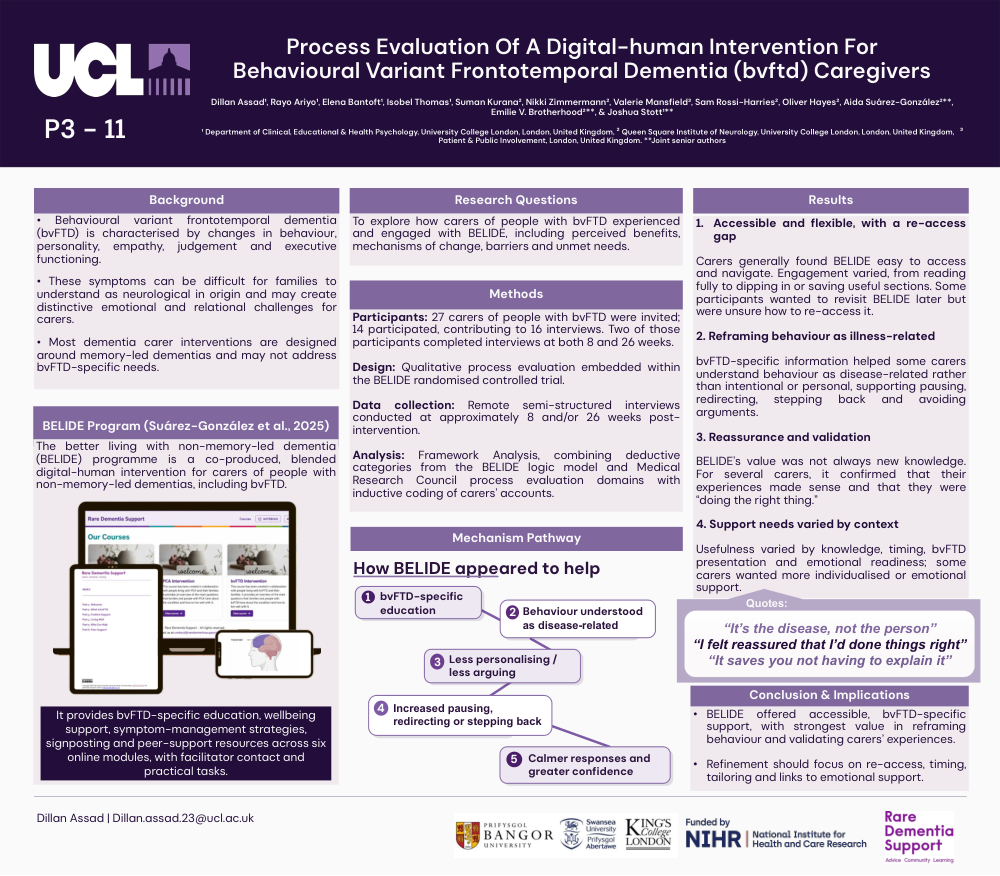
The Better Living with Non-memory-led Dementia (BELIDE) programme is a co-produced, blended digital-human intervention for carers of people with non-memory-led dementias, including bvFTD. It provides bvFTD-specific education, wellbeing support, symptom-management strategies, signposting and peer-support resources across six online modules, with facilitator contact and practical tasks.
Research question:
To explore how carers of people with bvFTD experienced and engaged with BELIDE, including perceived benefits, mechanisms of change, barriers and unmet needs.
Methods:
Twenty-seven carers of people with bvFTD were invited; 14 participated, contributing 16 interviews. Two participants completed interviews at both 8 and 26 weeks. This was a qualitative process evaluation embedded within the BELIDE randomised controlled trial. Remote semi-structured interviews were conducted at approximately 8 and/or 26 weeks post-intervention. Data were analysed using Framework Analysis, combining deductive categories from the BELIDE logic model and Medical Research Council process evaluation domains with inductive coding of carers’ accounts.
Results:
1. Accessible and flexible, with a re-access gap. Carers generally found BELIDE easy to access and navigate. Engagement varied, from reading fully to dipping in or saving useful sections. Some participants wanted to revisit BELIDE later but were unsure how to re-access it.
2. Reframing behaviour as illness-related. bvFTD-specific information helped some carers understand behaviour as disease-related rather than intentional or personal, supporting pausing, redirecting, stepping back and avoiding arguments.
3. Reassurance and validation. BELIDE’s value was not always new knowledge. For several carers, it confirmed that their experiences made sense and that they were “doing the right thing.”
4. Support needs varied by context. Usefulness varied by knowledge, timing, bvFTD presentation and emotional readiness; some carers wanted more individualised or emotional support.
Mechanism pathway:
bvFTD-specific education helped carers understand behaviour as disease-related. This supported less personalising and less arguing, increased pausing, redirecting or stepping back, and calmer responses with greater confidence.
Conclusion and implications:
BELIDE offered accessible, bvFTD-specific support, with strongest value in reframing behaviour and validating carers’ experiences. Refinement should focus on re-access, timing, tailoring and links to emotional support.
Keywords:
behavioural variant frontotemporal dementia; bvFTD; carers; caregivers; dementia; digital intervention; process evaluation; BELIDE; qualitative research; Framework Analysis; symptom management; carer support.
Comments
Email is required but is not shown publicly.
Loading comments...