4,068 posters, 219 videos, 101 topics, 69 sessions, 14,365 authors, 6,128 institutions
ePostersLive by SciGen Technologies S.A. All rights reserved.
Alzheimer's Association International Conference 2026
July 12-15, 2026 | London, United Kingdom, and Online

5508
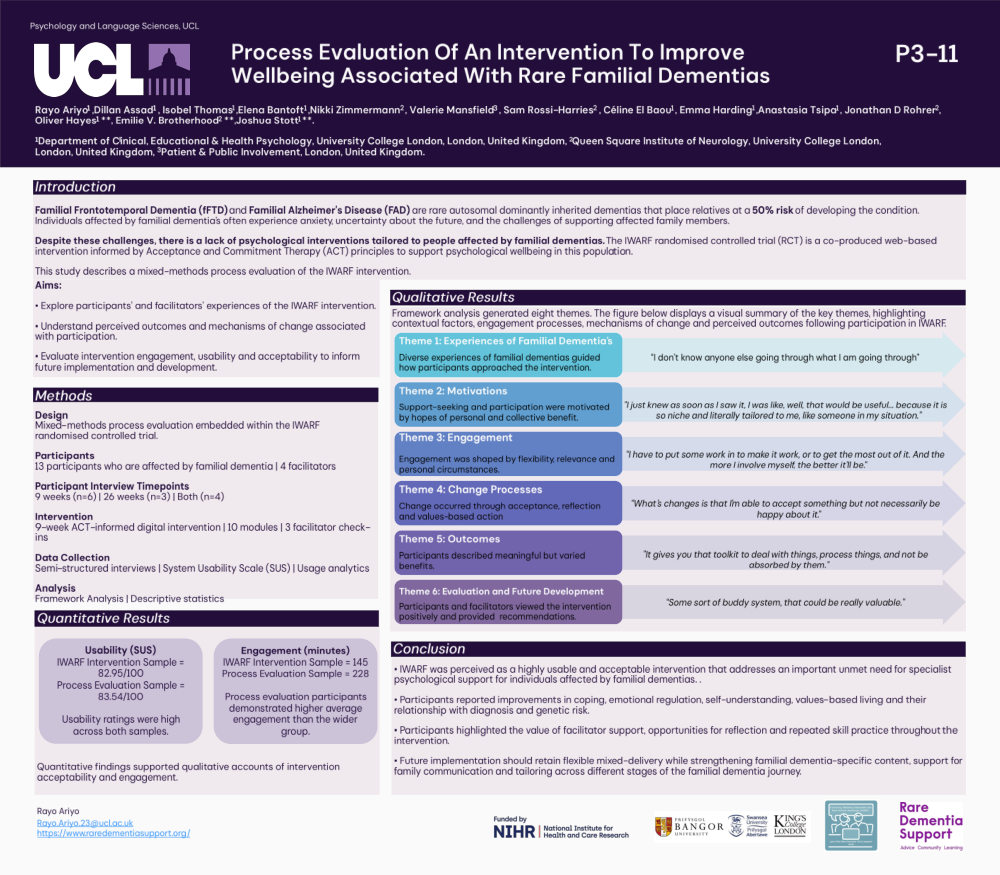
Process Evaluation Of An Intervention To Improve Wellbeing Associated With Rare Familial Dementias
Poster Presenter
Authors
Part of Topic
Process Evaluation Of An Intervention To Improve Wellbeing Associated With Rare Familial Dementias
Rayo Ariyo¹, Dillan Assad¹, Isobel Thomas¹, Elena Bantoft¹, Nikki Zimmermann², Valerie Mansfield³, Sam Rossi-Harries², Céline El Baou¹, Emma Harding¹, Anastasia Tsipa¹, Jonathan D. Rohrer², Oliver Hayes¹**, Emilie V. Brotherhood²**, Joshua Stott¹***.
¹Department of Clinical, Educational & Health Psychology, University College London, London, United Kingdom
²Queen Square Institute of Neurology, University College London, London, United Kingdom
³Patient & Public Involvement, London, United Kingdom
INTRODUCTION
Familial Frontotemporal Dementia (fFTD) and Familial Alzheimer's Disease (FAD) are rare autosomal dominantly inherited dementias that place relatives at a 50% risk of developing the condition. Individuals affected by familial dementias often experience anxiety, uncertainty about the future, and the challenges of supporting affected family members.
Despite these challenges, there is a lack of psychological interventions tailored to people affected by familial dementias. The IWARF randomised controlled trial (RCT) is a co-produced web-based intervention informed by Acceptance and Commitment Therapy (ACT) principles to support psychological wellbeing in this population.
This study describes a mixed-methods process evaluation of the IWARF intervention.
Aims
• Explore participants' and facilitators' experiences of the IWARF intervention.
• Understand perceived outcomes and mechanisms of change associated with participation.
• Evaluate intervention engagement, usability and acceptability to inform future implementation and development.
METHODS
Design
Mixed-methods process evaluation embedded within the IWARF randomised controlled trial.
Participants
13 participants who are affected by familial dementia | 4 facilitators
Participant Interview Timepoints
9 weeks (n=6) | 26 weeks (n=3) | Both (n=4)
Intervention
9-week ACT-informed digital intervention | 10 modules | 3 facilitator check-ins
Data Collection
Semi-structured interviews | System Usability Scale (SUS) | Usage analytics
Analysis
Framework Analysis | Descriptive statistics
QUALITATIVE RESULTS
Framework analysis generated eight themes. The figure below displays a visual summary of the key themes, highlighting contextual factors, engagement processes, mechanisms of change and perceived outcomes following participation in IWARF.
Theme 1: Experiences of Familial Dementia
Diverse experiences of familial dementias guided how participants approached the intervention.
"I don't know anyone else going through what I am going through."
Theme 2: Motivations
Support-seeking and participation were motivated by hopes of personal and collective benefit.
"I just knew as soon as I saw it, I was like, well, that would be useful... because it is so niche and literally tailored to me, like someone in my situation."
Theme 3: Engagement
Engagement was shaped by flexibility, relevance and personal circumstances.
"I have to put some work in to make it work, or to get the most out of it. And the more I involve myself, the better it'll be."
Theme 4: Change Processes
Change occurred through acceptance, reflection and values-based action.
"What's changes is that I'm able to accept something but not necessarily be happy about it."
Theme 5: Outcomes
Participants described meaningful but varied benefits.
"It gives you that toolkit to deal with things, process things, and not be absorbed by them."
Theme 6: Evaluation and Future Development
Participants and facilitators viewed the intervention positively and provided recommendations.
"Some sort of buddy system, that could be really valuable."
QUANTITATIVE RESULTS
Quantitative findings supported qualitative accounts of intervention acceptability and engagement.
Usability (SUS)
IWARF Intervention Sample = 82.95/100
Process Evaluation Sample = 83.54/100
Usability ratings were high across both samples.
Engagement (minutes)
IWARF Intervention Sample = 145
Process Evaluation Sample = 228
Process evaluation participants demonstrated higher average engagement than the wider group.
CONCLUSION
• IWARF was perceived as a highly usable and acceptable intervention that addresses an important unmet need for specialist psychological support for individuals affected by familial dementias.
• Participants reported improvements in coping, emotional regulation, self-understanding, values-based living and their relationship with diagnosis and genetic risk.
• Participants highlighted the value of facilitator support, opportunities for reflection and repeated skill practice throughout the intervention.
• Future implementation should retain flexible mixed-delivery while strengthening familial dementia-specific content, support for family communication and tailoring across different stages of the familial dementia journey.
Contact
Rayo Ariyo
Rayo.Ariyo.23@ucl.ac.uk
https://www.raredementiasupport.org/
Comments
Email is required but is not shown publicly.
Loading comments...