4,068 posters, 219 videos, 101 topics, 69 sessions, 14,365 authors, 6,128 institutions
ePostersLive by SciGen Technologies S.A. All rights reserved.
Alzheimer's Association International Conference 2026
July 12-15, 2026 | London, United Kingdom, and Online

3422
Social Isolation, Informal Care Gaps, And Dementia Risk Among Older Adults In Urban Ghana
Poster Presenter
Authors
Affiliations
Part of Topic
Video
BACKGROUND
Ghana's older adult population is expanding rapidly, yet formal long-term care and dementia services remain virtually absent. The family and community serve as the de facto care system, an arrangement increasingly under pressure from urbanisation, migration of adult children, and economic stress. International evidence demonstrates that social isolation increases dementia risk by approximately 50%, a magnitude comparable to physical inactivity and low educational attainment (NASEM, 2020). Ghana-specific evidence shows that loneliness is associated with nearly double the odds of mild cognitive impairment after adjustment for confounders (Abukuri, 2025). Sub-Saharan Africa nonetheless remains conspicuously underrepresented in systematic reviews on social isolation and cognitive decline.
STUDY OBJECTIVES
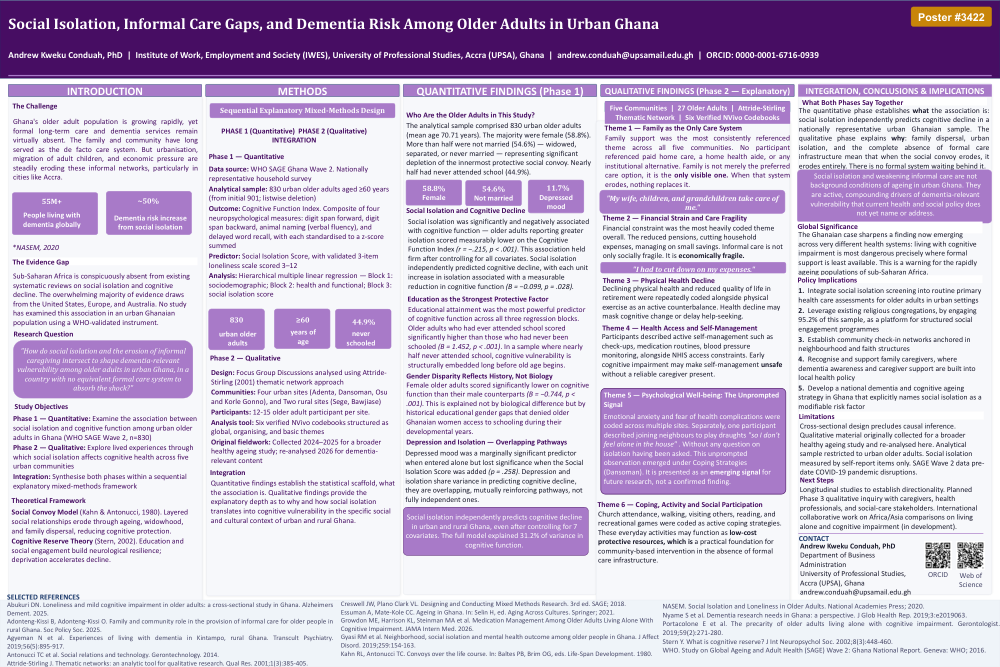
This study examines how social isolation and the erosion of informal caregiving intersect to shape dementia-relevant vulnerability among older adults in urban Ghana, in a setting with no equivalent of a well-developed formal long-term care system. It is framed as a sequential explanatory mixed-methods study. Phase 1 (quantitative) draws on the WHO Study on Global Ageing and Adult Health (SAGE) Ghana Wave 2 to examine the statistical association between social isolation and cognitive function among 830 urban older adults aged 60 years and above. Phase 2 (qualitative) uses focus group discussions across five urban Accra communities to explain the mechanisms and lived experiences through which social isolation translates into cognitive vulnerability. A third phase involving qualitative inquiry with caregivers, health professionals, and social-care stakeholders is planned as an immediate next step following this conference presentation.
METHODS
Phase 1 drew on the WHO SAGE Ghana Wave 2, which is a nationally representative cross-sectional household survey. The analytical sample comprised 830 urban older adults aged 60 years and above. The Cognitive Function Index was constructed from four neuropsychological measures: digit span forward, digit span backwards, animal naming, and delayed word recall. Social isolation was measured using a validated three-item loneliness scale. Hierarchical multiple linear regression was used across three blocks of predictors. Phase 2 drew on focus group discussions conducted across five urban Accra communities, namely Adenta, Dansoman, Osu, Korle Gonno, and Sege, with 27 older adult participants, originally collected in 2023–2024 and re-analysed in 2026 for dementia-relevant content using six verified NVivo codebooks structured on Attride-Stirling's (2001) thematic network approach. The theoretical framework integrates the Social Convoy Model (Kahn & Antonucci, 1980) and Cognitive Reserve Theory (Stern, 2002).
RESULTS
The analytical sample comprised 830 urban older adults (mean age 70.71 years). The majority were female (58.8%), more than half were not married (54.6%), and nearly half had never attended school (44.9%). Social isolation was significantly and negatively associated with cognitive function (r = −.215, p < .001). Social isolation independently predicted cognitive decline after controlling for seven covariates, which are age, sex, marital status, educational attainment, self-rated health, functional impairment, and depressed mood (B = −0.099, p = .028). Educational attainment was the strongest protective factor (B = 1.452, p < .001), with female older adults scoring significantly lower than their male counterparts, thus reflecting historical educational gender gaps rather than biological differences (B = −0.744, p < .001). Depressed mood lost significance when social isolation was added (p = .258), indicating overlapping and mutually reinforcing pathways. The full model explained 31.2% of the variance in cognitive function. Six qualitative organising themes further explained these patterns: family as the only visible care infrastructure; financial strain and care fragility; physical health decline masking cognitive change; health self-management becoming unsafe without caregiver support; an unprompted emerging signal of subjective isolation under Coping Strategies; and everyday community and faith activities functioning as low-cost protective resources.
CONCLUSIONS
Social isolation and weakening informal care are not background conditions of ageing in urban Ghana. The quantitative and qualitative evidence, situated within the broader literature, identifies them as active, compounding contributors to dementia-relevant vulnerability that current health and social policy does not yet name or address. The Ghanaian case sharpens an emerging international concern: living with cognitive impairment is most dangerous precisely where formal support is least available, and family care is already under strain. Three policy implications follow: integrate cognitive screening with visible social risk markers; strengthen low-cost community support systems anchored in neighbourhood and faith structures; and formally recognise and support family caregivers within local health and social policy frameworks.
Comments
Email is required but is not shown publicly.
Loading comments...