4,068 posters, 219 videos, 101 topics, 69 sessions, 14,365 authors, 6,128 institutions
ePostersLive by SciGen Technologies S.A. All rights reserved.
Alzheimer's Association International Conference 2026
July 12-15, 2026 | London, United Kingdom, and Online

6586
Current Practices in Detecting Cognitive Impairment in Outpatient Settings
Poster Presenter
Authors
Deanna Willis, Diana Summanwar, Dustin Hammers, Zina Ben Miled, Emily Webber, Jared Brosch, Nicole Fowler
Affiliations
Indiana University School of Medicine Department of Family Medicine, Indiana University School of Medicine Department of Neurology, Lamar University Phillip M. Drayer Department of Electrical and Computer Engineering, Indiana University School of Medicine Department of Pediatrics, Indiana University School of Medicine Department of Medicine
Part of Topic
Video
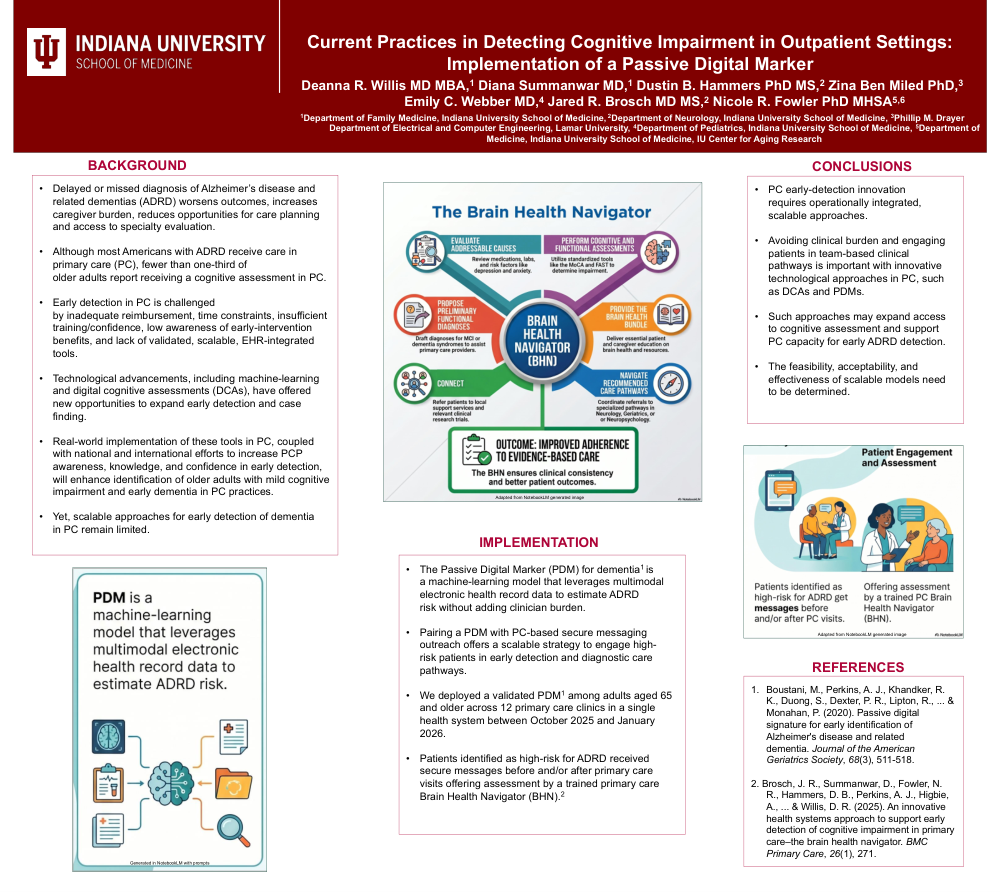
Current Practices in Detecting Cognitive Impairent in Outpatient Settings: Implementing a Passive Digital Marker
Delayed or missed diagnosis of Alzheimer’s disease and related dementias (ADRD) worsens outcomes, increases caregiver burden, reduces opportunities for care planning and access to specialty evaluation. Although most Americans with ADRD receive care in primary care (PC), fewer than one-third of olderadults report receiving a cognitive assessment in PC.Early detection in PC is challenged byinadequate reimbursement, time constraints,insufficient training/confidence, low awareness of early-intervention benefits, and lack of validated, scalable, EHR-integrated tools.
Technological advancements, including machine-learning and digital cognitive assessments (DCAs), have offered new opportunities to expand early detection and case finding. Real-world implementation of these tools in PC, coupled with national and international efforts to increase PCP awareness, knowledge, and confidence in early detection, will enhance identification of older adults with mild cognitive impairment and early dementia in PC practices.Yet,scalable approaches for early detection of dementia in PC remain limited.
The Passive Digital Marker (PDM) for dementia1 is aa machine-learning model that leveragesmultimodal electronic health record data to estimate ADRD risk without adding clinician burden.Pairing a PDM with PC-based secure messaging outreach offers a scalable strategy to engage high-risk patients in early detection and diagnostic care pathways. We deployed a validated PDM1among adults aged ≥65 across 12PC clinicsin a single health systembetween October 2025 and January 2026. Patients identified as high-risk for ADRD receivedsecure messages before and/or after PC visits offering assessment by a trained PCBrain Health Navigator (BHN).2
PC early-detection innovation requires operationally integrated, scalable approaches.Avoiding clinical burden and engaging patients in team-based clinical pathways is important with innovative technological approaches in PC, such as DCAs and PDMs.Suchapproachesmay expand access to cognitive assessment and support PC capacity for early ADRD detection. The feasibility, acceptability, and effectiveness of scalable models need to be determined.
-
Boustani M etal. Passive digital signature for early identification of Alzheimer's disease and related dementia. J Am Geriatr Soc 2020;68(3):511-18.
-
Brosch J etal. "An innovative health systems approach to support early detection of cognitive impairment in primary care–the brain health navigator." BMC PrimaryCare 26.1(2025):271.
Comments
Email is required but is not shown publicly.
Loading comments...