4,068 posters, 219 videos, 101 topics, 69 sessions, 14,365 authors, 6,128 institutions
ePostersLive by SciGen Technologies S.A. All rights reserved.
Alzheimer's Association International Conference 2026
July 12-15, 2026 | London, United Kingdom, and Online

237
Dementia Care Knowledge And Experiences Of Family Carers In Thai General Hospitals
Poster Presenter
Authors
Kanthee Anantapong, Nahathai Wongpakaran, Suwanna Setthawatcharawanich, Sirinapa Aphisitphinyo, Nopdanai Sirimaharaj, Chatchawan Rattanabannakit, Pongsatorn Paholpak, Aimorn Jiraphan, Pakawat Wiwattanaworaset, Warut Aunjitsakul, Napakkawat Buathong, Pattharee Paholpak, Kritta Supanimitamorn, Kitikan Thana-udom, Pornjira Pariwatcharakul, Tinakon Wongpakaran, Huali Wang
Affiliations
Department of Psychiatry, Faculty of Medicine, Prince of Songkla University, Hat Yai, Thailand, Department of Psychiatry, Faculty of Medicine, Chiang Mai University, Chiang Mai, Thailand, Department of Internal Medicine, Faculty of Medicine, Prince of Songkla University, Hat Yai, Thailand, Department of Psychiatry, Faculty of Medicine, Khon Kaen University, Khon Kaen, Thailand, Neurology Division, Internal Medicine Faculty of Medicine, Chiang Mai University, Chiang Mai, Thailand, Division of Neurology, Department of Internal Medicine, Faculty of Medicine Siriraj Hospital, Mahidol University, Bangkok, Thailand, Department of Family and Preventive Medicine, Faculty of Medicine, Prince of Songkla University, Hat Yai, Thailand, Department of Psychiatry, Faculty of Medicine Siriraj Hospital, Mahidol University, Bangkok, Thailand, Dementia Care & Research Center, Peking University Institute of Mental Health No. 51 Huayuanbei Road, Beijing, China
Part of Topic
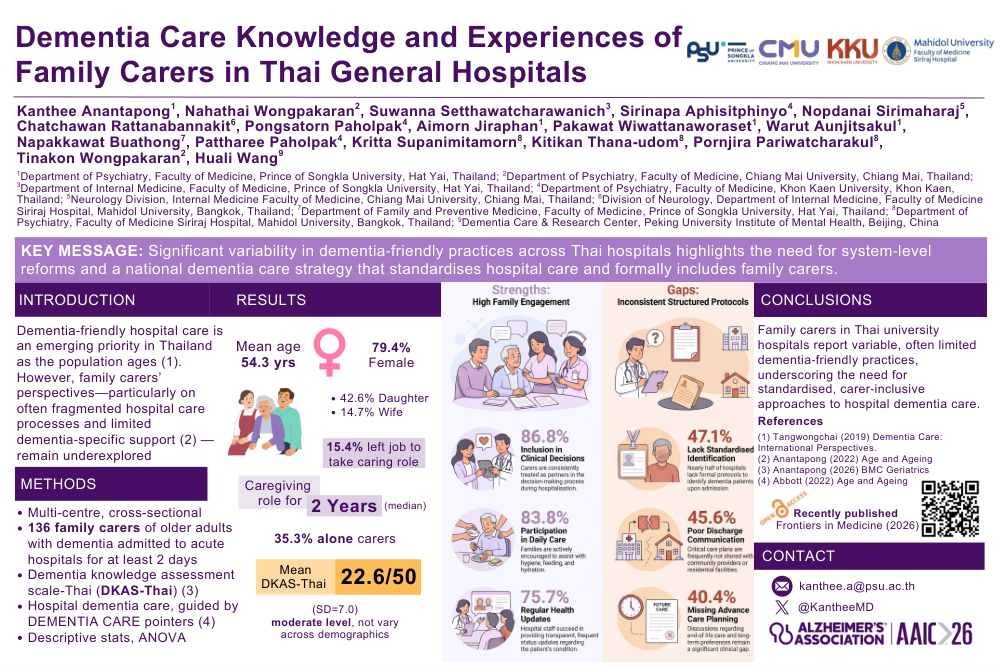
Background: The quality of hospital care for people with dementia depends on the understanding and engagement of family carers as well as institutional practices. Evidence regarding these factors within Thai hospital settings is scarce. In this study, we aimed to investigate the demographic characteristics, dementia knowledge, and inpatient care experiences of family carers of older adults with dementia in Thai general hospitals.
Methods: A multicentre cross-sectional study was undertaken involving 136 family carers of hospitalised older adults with dementia, each of whom had experienced at least a two-day admission within the past year at four major Thai university hospitals across four regions. Structured face-to-face interviews gathered data on carer demographics, dementia knowledge (assessed by the Dementia Knowledge Assessment Scale (DKAS)-Thai), experiences within specific hospital care domains, reasons for hospitalisation, and utilisation of external support services.
Results: Most carers were female (79.4%) with a mean age of 54.3 years, predominantly daughters (42.6%) or wives (14.7%), and had provided care for a median of two years, primarily at home. Their dementia knowledge was moderate, with an overall mean DKAS-Thai score of 22.6 (SD = 7.0) and showed no significant association with the perceived quality of hospital supportive care. Hospitals demonstrated strengths in promoting family involvement, communication, and participation in daily care. However, notable deficiencies remained in dementia recognition, documentation of patient preferences, discharge planning, and access to advanced or palliative care services. Common reasons for admission included behavioural symptoms, infections, and gastrointestinal problems. Only one-quarter of carers had received formal external support, and most (44.1%) perceived little change in the patient’s health following discharge, while 36.0% reported improvement and 19.9% deterioration.
Conclusions: Thai family carers actively participate in hospital care and typically experience positive communication with staff. However, deficiencies in dementia-specific systems and post-discharge support persist. Enhancing dementia identification, care continuity, family engagement, and utilisation of carers’ knowledge could strengthen hospital-based dementia care in Thailand.
Comments
Email is required but is not shown publicly.
Loading comments...