4,068 posters, 219 videos, 101 topics, 69 sessions, 14,365 authors, 6,128 institutions
ePostersLive by SciGen Technologies S.A. All rights reserved.
Alzheimer's Association International Conference 2026
July 12-15, 2026 | London, United Kingdom, and Online

1546
Home Use of a Conversational Robot in Older Adults Living Alone With Cognitive Impairment in Japan: Results From 16-Week and 18-Month Deployments
Poster Presenter
Authors
Part of Topic
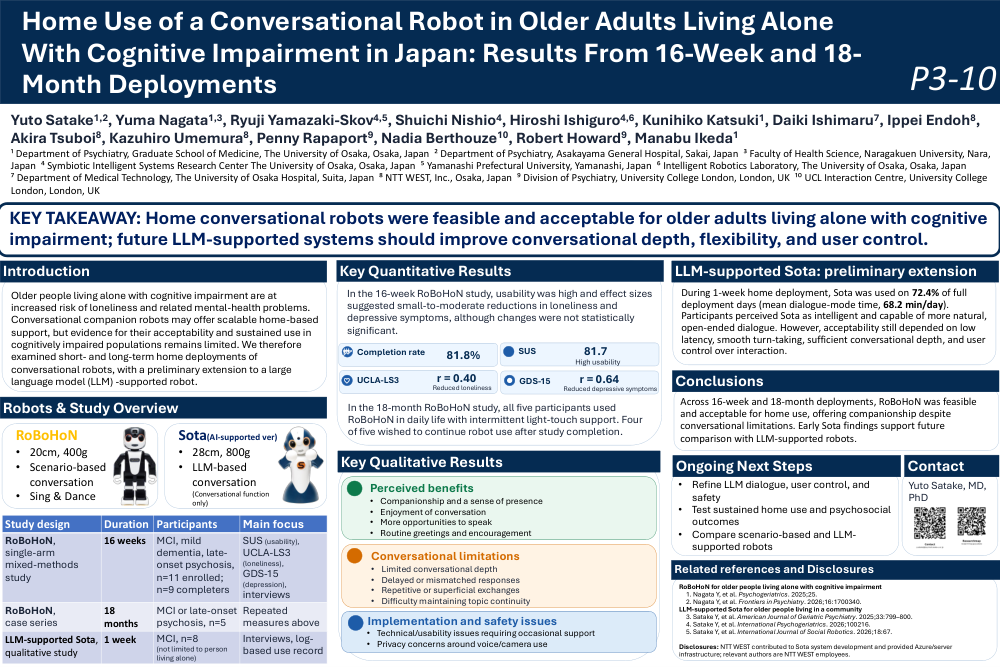
Older adults living alone with cognitive impairment are at increased risk of loneliness and related mental-health problems. We examined the feasibility and acceptability of conversational robots in home settings through 16-week and 18-month deployments of the scenario-based robot RoBoHoN, alongside early findings from a 1-week deployment of an LLM-supported robot, Sota.
In the 16-week RoBoHoN study, usability was high (SUS 81.7), with small-to-moderate effect sizes suggesting reductions in loneliness and depressive symptoms, although changes were not statistically significant. In the 18-month case series, all five participants used RoBoHoN in daily life with light-touch support, and four wished to continue use after study completion. Participants described companionship, routine greetings, and more opportunities to speak, while also reporting limitations in conversational depth, delayed or mismatched responses, and privacy concerns.
During the 1-week LLM-supported Sota deployment, participants used the robot on 72.4% of full deployment days, with a mean dialogue-mode time of 68.2 minutes/day. LLM-supported dialogue was perceived as more intelligent and open-ended, but remained dependent on low latency, smooth turn-taking, conversational depth, and user control.
Keywords: conversational robot; loneliness; cognitive impairment; home deployment; RoBoHoN; large language model; Sota
Comments
Email is required but is not shown publicly.
Loading comments...