4,068 posters, 219 videos, 101 topics, 69 sessions, 14,365 authors, 6,128 institutions
ePostersLive by SciGen Technologies S.A. All rights reserved.
Alzheimer's Association International Conference 2026
July 12-15, 2026 | London, United Kingdom, and Online

4642
Neuropsychological And Neurobiological Effects Of Gamma-tACS In MCI-AD: A Case Series
Poster Presenter
Authors
Valerio Manippa, Davide Villela, Giorgia Francesca Scaramuzzi, Giuseppe Volpe, Gaetano Scianatico, Agnese Valguarnera, Marzia Leopizzi, Daniele Urso, Chiara Zecca, Michael A. Nitsche, Paolo Taurisano, Davide Rivolta, Giancarlo Logroscino
Affiliations
eCampus University, Novedrate (CO), Italy, University of Bari "A. Moro", Bari, Italy, Leibniz Research Centre for Working Environment and Human Factors, Dortmund, Germany
Part of Topic
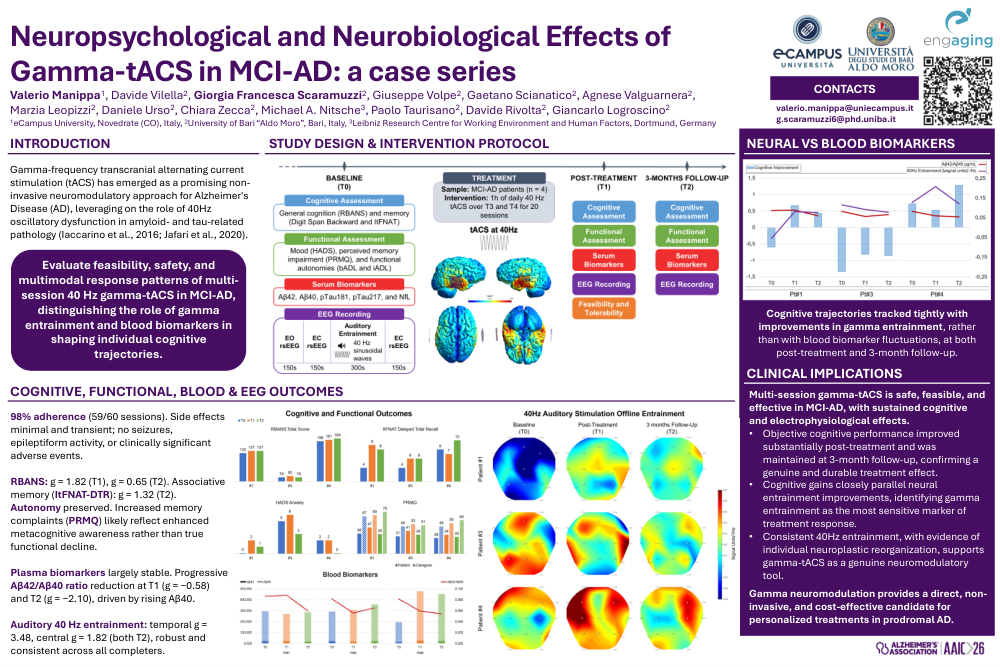
Gamma-frequency transcranial alternating current stimulation (tACS) has emerged as a promising noninvasive neuromodulatory approach for Alzheimer's Disease (AD), leveraging on the role of 40Hz oscillatory dysfunction in amyloid- and tau-related pathology (Iaccarino et al., 2016; Jafari et al., 2020). Evaluate feasibility, safety, and multimodal response patterns of multisession 40 Hz gamma-tACS in MCI-AD, distinguishing the role of gamma entrainment and blood biomarkers in shaping individual cognitive trajectories.
98% adherence (59/60 sessions). Side effects minimal and transient; no seizures, epileptiform activity, or clinically significant adverse events. RBANS: g = 1.82 (T1), g = 0.65 (T2). Associative memory(ItFNAT-DTR): g = 1.32 (T2). Autonomypreserved. Increased memory complaints (PRMQ) likely reflect enhanced metacognitive awareness rather than true functional decline. Plasma biomarkers largely stable. Progressive Aβ42/Aβ40 ratio reduction at T1 (g = −0.58) and T2 (g = −2.10), driven by rising Aβ40. Auditory 40 Hz entrainment: temporal g = 3.48, central g = 1.82 (both T2), robust and consistent across all completers.
Multi-session gamma-tACS is safe, feasible, and effective in MCI-AD, with sustained cognitive and electrophysiological effects.
• Objective cognitive performance improved substantially post-treatment and was maintained at 3-month follow-up, confirming a genuine and durable treatment effect
• Cognitive gains closely parallel neural entrainment improvements, identifying gamma entrainment as the most sensitive marker of treatment response
• Consistent 40Hz entrainment, with evidence of individual neuroplastic reorganization, supports gamma-tACS as a genuine neuromodulatory tool
Gamma neuromodulation provides a direct, noninvasive, and cost-effective candidate for personalized treatments in prodromal AD.
Comments
Email is required but is not shown publicly.
Loading comments...